Imagine the baseball world. On one side, we have the thrilling Home Run Derby. On the other, the strategic Contact Challenge.
This is like the debate between Marvel and DC, but with baseball. Are we looking for the amazing power of home runs? Or the skill of hitting the ball exactly where it needs to go?
Your choice isn’t just a matter of opinion. It’s practical. It decides how we pick players and what we measure.
It’s about whether a huge home run is better than several precise hits. Is a 450-foot shot worth it if it misses half the time? Or are three 95-mph hits more valuable?
We’re not just tracking how far the ball goes. We’re looking at the hard-hit percentage and the strategy behind each swing. This is where data meets drama.
Safety & Space Planning (Nets, L-Screens, Helmets)
Forget the open field; a modern hitting event’s first commandment is to build a cage. This isn’t about stifling fun. It’s about creating a space for controlled chaos.
Think of your safety setup as a three-point defensive strategy. It’s your fortress. Nets, L-screens, and helmets form the essential trinity that transforms a liability zone into a performance lab. Master this, and your Hitting Derbies & Contact Challenges become legendary for the right reasons.
Let’s start with the perimeter: the nets. The old adage “more than you think” isn’t a suggestion; it’s a law. Your protective netting must account for physics-defying foul balls and the rookie pitcher who channels his inner Wild Thing. Extend it high, extend it wide, and then add another ten feet for psychological comfort.
Where you place the L-screen is a masterclass in spatial psychology. Yes, its primary job is to shield your pitching arm from a 90-mph comeback line drive. But its secondary role is just as important. A poorly placed screen can create a visual barrier that makes hitters feel claustrophobic. Position it for maximum pitcher safety with minimal hitter intrusion. It’s a delicate dance.
Lastly, the helmet. This is the non-negotiable. It’s the seatbelt of the batter’s box. Making helmets mandatory for every hitter, regardless of age or skill level, sends a clear message: we take your safety as seriously as we take your swing. For organized youth events, this protocol is often detailed in resources like a comprehensive youth baseball coaching manual.
When you synthesize these elements, something magical happens. Safety stops being a buzzkill. It becomes the invisible framework that grants permission for unbridled aggression. Players swing freer. Coaches relax. The event hums with productive energy instead of nervous tension. You’ve moved from risk management to performance enablement. That’s the ultimate goal of any great Hitting Derbies & Contact Challenges setup.
Age-Adjusted Scoring Models and Field Dimensions
The sound of a bat hitting a ball means different things to kids and adults. Your scoring system needs to show this big difference. Using the same model for everyone is unfair, favoring strength over skill.

There are two main things to adjust: how points are scored and the size of the field. Get these right, and you create a fun and fair competition. But if you don’t, kids might get upset, and adults might get bored.
For younger players, like those in 10U to 14U, it’s not about how hard they hit the ball. It’s about how well they make contact. So, your scoring system should be smart and nuanced, not just about brute force.
Consider a weighted model:
- Base Hit: 1 point (contact is king).
- Line Drive: +2 bonus points (the coach’s dream).
- Hard-hit ball to the opposite field: +3 bonus points (this is advanced skill).
- Over-the-fence home run: 5 points (the glorious exception).
This model rewards the process, not just the outcome. A kid who hits the ball well to the opposite field is a genius, not just lucky.
Now, for older players, like those in 18U and college, it’s all about power. Here, the goal is to find out who is truly the best. Your model needs to set clear standards.
A power-tiered system works:
- Base Hit: 1 point (fundamentals matter).
- Exit Velocity over 95 mph: +2 points (hard-hit bonus).
- Home run 350+ ft: 5 points.
- Home run 400+ ft: 8 points (the “tape-measure” premium).
This system creates a clear power ladder. It turns a Hitting Derby into a measurable showcase.
Field dimensions are key to your scoring system. Bringing the fences in for younger players isn’t being soft. It’s making it possible for them to win. For older players, pushing the fences far away isn’t cruel. It’s showing who has the most power.
The table below shows how scoring and space should work together across age groups. It’s your blueprint for a well-calibrated event.
| Age Group | Scoring Philosophy | Key Metrics to Reward | Recommended Field Adjustment |
|---|---|---|---|
| 10U – 12U | Quality of Contact | Line drives, opposite-field hits, swing consistency | Fences at 180-200 ft. Use temporary, soft barriers. |
| 13U – 14U | Skill & Emerging Power | Hard-hit rate (85+ mph), gap power, two-strike approach | Fences at 220-250 ft. Define a clear “power alley.” |
| 15U – 17U | Power Development | Exit velocity (90+ mph), home run distance, barrel accuracy | Fences at 300-330 ft. Authentic field layout. |
| 18U & College | Elite Power Thresholds | Exit velocity (95+ mph), 350+ ft HRs, launch angle optimization | Fences at 350+ ft. Or, use the existing professional fences. |
This isn’t just about fairness. It’s about Hitting Derbies & Contact Challenges that tell a true story. A well-designed event shows who has the best swing, not just who’s the oldest.
The final analysis? Your scoring system and field layout are a dialogue. One sets the rules, and the other sets the stage. Get them both right, and you’ve built more than a competition. You’ve built a fair system.
Station Plan: Tee/Front Toss/Machine Live
Imagine a hitter’s journey through our Hitting Derbies & Contact Challenges as a hero’s quest. It starts quietly at the tee and ends with a bang at the machine. This isn’t just batting practice. It’s a carefully planned three-act play to build up the hitter, not break them down.
Act I: The Tee. This is where you find your true form. Forget about timing or the pitcher’s quirks. Here, swing mechanics are studied closely. It’s where your exit velocity is measured in its purest form. No excuses, just raw power and technique.
Act II: Front Toss. Now, a moving ball is introduced, but it’s a gentle, predictable arc. It’s like a coach’s comforting toss. This stage focuses on timing and rhythm. It’s the bridge from the controlled lab to the real world.
Act III: Machine Live. Welcome to the tough test. The machine offers no mercy. It separates the practiced from the panicked. Here, your beautiful swings from the tee are put to the test.
So, how do you structure this epic? You need a plan. Random rounds lead to fatigue and bad swings. A smart plan builds confidence and gathers useful data at every level.
| Station | Core Purpose | Swings | Time (approx.) | Key Focus |
|---|---|---|---|---|
| Tee | Isolate mechanics, establish pure exit velocity baseline | 8-10 | 3-4 min | Quality of contact, swing path |
| Front Toss | Introduce timing on a predictable, arcing ball | 10-12 | 4-5 min | Rhythm, barrel accuracy |
| Machine Live | Test against game-like velocity & spin under pressure | 15-20 | 5-7 min | Reaction, competitive mindset |
Notice the progression? Swings increase as the challenge does, but so does the time. This isn’t a sprint. We give a 90-second break between stations. This prevents fatigue from ruining a good swing. It gives the hitter a chance to mentally prepare.
The magic is in the story arc. A kid crushes the tee, feels confident. They succeed in front toss, and momentum builds. Then they face the machine’s pressure with a real chance. We’re not just measuring exit velocity; we’re building competence. Each station gives a clean data point, from the controlled lab to the game-like pressure.
Design this journey right, and your Hitting Derbies & Contact Challenges become more than a contest. They become a story of progression for every participant. The data you capture will mean something, showing exactly what stage of the journey it came from.
Data Capture: Radar/Device Alternatives, Manual Charts
Let’s get real: capturing hitting data isn’t just about the latest tech. In Hitting Derbies & Contact Challenges, data is key. But what if you’re on a tight budget but dream big?
You have choices. Think of it like building a home theater. You can splurge on an 8K TV or get a great 4K set and save for awesome speakers. Either way, you’ll enjoy the show.
Top radar units like TrackMan or Rapsodo are the 8K TVs. They offer tons of data: exit velocity, launch angle, spin rate. But they’re pricey. For many events, they’re too much.
Then, there are smart alternatives. Smartphone apps and devices give great insights at a lower cost. Apps like SwingTracker or simple video analysis can measure swing speed and contact quality. They’re like the 4K sets of the data world.
The manual spray chart is a hidden gem. It’s not just old-school; it’s essential. While a radar gun shows how hard, a spray chart shows where and how. It tells you if a hit was a line drive or a fly ball.
A spray chart is like a storybook of a hitter’s game. It shows patterns that numbers can’t. It turns anyone with a clipboard into a scientist. The trick is knowing what to track within your budget.
| Method | Cost Tier | Core Data Captured | Best For | Key Limitation |
|---|---|---|---|---|
| Professional Radar (e.g., TrackMan) | High ($$) | Exit Velo, Launch Angle, Spin, Distance | Elite showcases, pro scouts | Cost & complexity; data overload for novices |
| Device/App Alternative | Low-Mid ($) | Swing Speed, Contact Timing, Approx. Launch | Travel ball clubs, serious academies | Less spatial accuracy; relies on device calibration |
| Manual Spray Chart | Minimal (Free) | Hit Location, Type (LD/FB/GB), Direction | All Hitting Derbies & Contact Challenges, youth leagues | No velocity metrics; relies on scorer consistency |
Start with the spray chart. It’s free and priceless. Then, add tech based on your budget. Even a phone’s slow-mo can help with swing mechanics.
The aim isn’t to overwhelm with data. It’s to find key insights. Maybe a hitter pulls the ball when late. Or hits hardest to the opposite field. That’s where the real growth is.
Use the manual chart and affordable tech. You’ll capture the essence of the event, not just the numbers. That’s where real development happens.
Contact Challenges: Opposite-Field, Two-Strike, Situational
The Contact Challenge is like a fencing duel, all about precision and strategy. It’s the chess match to the derby’s checkers. Here, we see who’s a complete hitter, not just a slugger.
Why? Because hitting without consequences is easy. The real skill shows when you have to make tough choices. These devilish drills test a hitter’s smarts and baseball IQ.
Think of it as hitting with a purpose. The rules don’t limit greatness; they show it. Let’s look at the three main challenges that define elite Hitting Derbies & Contact Challenges.
The Opposite-Field Challenge is about hitting the ball where it’s pitched. It requires a flat, controlled launch angle. You’re not trying to hit the ball high. You’re trying to hit it where it’s pitched.
This isn’t about weakness. It’s about control and covering the plate. A hitter who can hit an outside pitch to right-center is tough for defenses. We give bonus points for hits through the 5.5-6 hole or down the opposite-field line.
Next, the Two-Strike Duel. This is survival mode. The hitter must shorten up, protect the plate, and value foul balls as lifelines. Power is not important. The goal is to stay alive and hit the ball.
It’s a mental challenge. We score foul balls with two strikes highly and any fair ball in play. A weak grounder that finds grass can be worth more than a majestic fly ball caught at the wall. It teaches competitive grit.
Lastly, Situational Scenarios. This is where game theory meets the batter’s box. We give hitters a script: “Runner on third, less than two outs. A ground ball to the right side scores the run and gets maximum points.”
The hitter isn’t just swinging. They’re solving a problem. It tests awareness and execution under pressure. Do they know how to elevate a fly ball? Can they hit a grounder to the right side on demand? This is hitting as a high-IQ craft.
| Challenge | Primary Goal | Key Skill Tested | Scoring Twist |
|---|---|---|---|
| Opposite-Field | Drive the ball to the side of the field it’s pitched to. | Bat control and adjusting launch angle. | Bonus points for hits through specific opposite-field gaps. |
| Two-Strike Duel | Stay alive and put any ball in play. | Plate coverage, shortening swing, mental toughness. | Foul balls are valuable; any fair ball in play scores. |
| Situational Scenarios | Execute a specific, game-like outcome. | Baseball IQ, situational awareness, and execution. | Points awarded based on achieving the prescribed result (e.g., sac fly, ground ball to right). |
Adding these Contact Challenges to your event does more than test skills. It creates drama. You’ll see the one-dimensional power hitter struggle in the Two-Strike Duel. The slick-fielding shortstop might win the Situational round.
It celebrates the complete hitter. The player who can adjust their launch angle for a line drive one moment and choke up to fight off a pitch the next. This is the soul of a great Hitting Derbies & Contact Challenges event.
So, make these rounds tough. Make the hitters think. The cheers for a perfectly executed opposite-field single or a clutch two-strike foul ball will be just as loud as those for a home run. Maybe louder, because they recognize the smarter game.
Brackets, Tie-Breakers, and Timekeeping
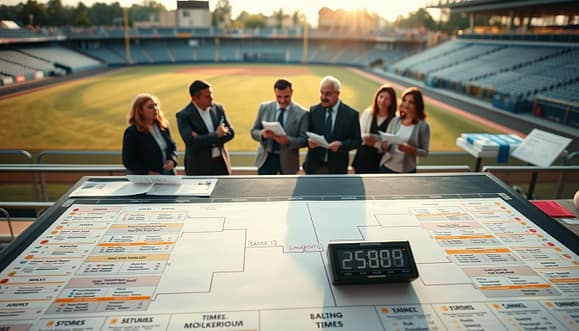
Your event bracket is like a blueprint for success. Get it wrong, and you’re in for trouble. The details of competition are key to a smooth Hitting Derbies & Contact Challenges event. A bad bracket can lead to chaos, which is why many coaches study best baseball biographies to understand how legendary players and managers approached preparation, structure, and competitive balance before stepping onto the field.
Let’s look at the different bracket types. Single elimination is intense and fast. It’s great for big groups or tight schedules. But, one mistake can end a player’s day early.
Double elimination gives players a second chance. It’s fair for groups with different skills. Pool play, on the other hand, is like a long series. It lets players compete more but needs careful time management.
Ties can be tricky. We need smart ways to break them. Something that rewards skill, not just luck.
- Highest Average Exit Velocity: This tie-breaker values power and quality of contact.
- Most Consecutive Fair Balls: It tests discipline and bat control.
- Best Performance With Two Strikes: It’s all about clutch moments.
These tie-breakers add strategy to your Contact Challenges. They make the data meaningful.
Timekeeping is also critical. An event that’s too fast is stressful. One that’s too slow loses energy. We need to plan for delays like broken bats.
Here’s a plan for a one-hour bracket segment:
- 0:00-0:05: Player warm-up and station explanation.
- 0:05-0:20: First round of swings (with a 2-minute buffer).
- 0:20-0:25: Quick data recording and bracket update.
- 0:25-0:45: Second round and tie-breaker resolution.
- 0:45-0:55: Final round and winner.
- 0:55-1:00: Buffer for any extra time or celebrations.
This plan is quick but not rushed. It respects everyone involved. It turns a messy Hitting Derbies bracket into a smooth story. The bracket is the plot, tie-breakers are the conflicts, and the clock keeps everything moving.
Prizes, Sponsors, and Music/MC Tips
At a hitting derby, you need to master the atmosphere. This is where data meets drama. Swings become spectacle. Let’s talk about the three levers you pull to transform a practice into an event: the loot, the logos, and the soundtrack.
The psychology of prizes is its own kind of game theory. Do you offer gear, trophies, or cash? Each sends a different signal.
Gear (bats, gloves, premium batting gloves) is practical and perpetuates the cycle of play. It’s a reward that says, “Go use this.” Trophies are iconic and eternal. They’re for the mantlepiece, the Instagram post, the permanent reminder of a day of glory. Cash is the universal motivator, the brutally honest metric of success. My advice? Layer them. A trophy for glory, cash for the leaderboard, and gear raffles for everyone. It covers all motivational bases.
| Prize Type | Psychological Signal | Best For | Potential Drawback |
|---|---|---|---|
| Gear (New Bat, Glove) | “Invest in your game.” Practical, forward-looking. | Younger participants, brand partnerships. | May not motivate the already well-equipped player. |
| Trophy/Plague | “Remember this achievement.” Iconic, status-driven. | All ages, specially for championship brackets. | Collects dust if not paired with other rewards. |
| Cash Prize | “Your skill has tangible value.” Direct, universally understood. | Open divisions, serious competitors. | Can overshadow the “fun” element for younger kids. |
Now, how do you fund these incentives? Enter the sponsor. Your pitch to a local business should never be, “Please support our little league.” That’s charity. Your pitch is, “Let me deliver 200 focused, sports-minded families into your marketing funnel for a Saturday.” Frame it as a targeted advertising buy. Offer logo placement on the home run fence, mentions by the MC, and a booth space. They’re not donating; they’re accessing a captive, demographic-perfect audience.
Lastly, the audio landscape. The MC is your event’s conductor, narrator, and hype-man. Their role is triple: educate the crowd, build suspense, and keep things running smoothly. The music is your emotional dial.
For Hitting Derbies, you want a pumping, high-BPM playlist—think stadium walk-up music. It’s about energy and explosion. For the tactical grind of Contact Challenges, switch to more subdued, tension-building tracks. The music should underscore the focus, not overwhelm it.
The pro move? The MC crafts a mini-narrative for each hitter. Not just, “Up next, Jake from team Blue.” Try, “Alright folks, here’s Jake. He’s sitting in the 8-seed, but he led his league in opposite-field hits. Let’s see if he can work his magic with two strikes.” Suddenly, Jake isn’t an also-ran; he’s the main character with a defined skill set. This transforms spectators into invested fans.
Prizes, sponsors, and sound aren’t afterthoughts. They’re the primary colors you use to paint the memory of your event. Get them right, and your Hitting Derbies & Contact Challenges stop being an assessment and start being an attraction.
Post-Event Reports and Individual Hitting Plans
The last pitch is thrown. The crowd disperses. Your real job starts now.
Gathering data for your Hitting Derbies & Contact Challenges is key. It’s like buying a library and just admiring the shelves. The raw exit velocity numbers, the spray charts, the challenge results—this is your gold. The Post-Event Report turns this data into something valuable.
This document is a player’s “State of the Union.” It connects different data points into a story. It answers the question they’re afraid to ask: “What does this all mean for me?”
The final step is the Individual Hitting Plan. It takes the report’s findings—”elite power, allergic to opposite-field contact”—and suggests two drills. This plan is the bridge between the event’s spectacle and a player’s actual development.
This process makes a day memorable and meaningful. It shows your Hitting Derbies & Contact Challenges were for progress. The trophy gathers dust. The plan changes swings.