Let’s start with a truth bomb: the most technically gifted youth baseball coach is a dead man walking without a solid communication strategy. I learned this the hard way, watching a post-game car ride turn into a detailed analysis. It was so detailed, it would make a Pentagon strategist blush.
Then I discovered Coach Duke’s “Hat Rule”—a simple protocol. The baseball cap means “coach” mode, and removing it means “dad” mode. It’s not just cute; it’s a lesson in setting boundaries.
So what does this have to do with development? Everything. Proactive dialogue isn’t about spamming emails or controlling schedules. It’s about building understanding before problems arise.
Imagine a kid knowing where the coaching ends and support begins. They can try their best without fear. They can fail, then get back up and try again. This stable environment is where growth happens.
You’re not just a firefighter anymore. You become an urban planner for your team’s mind. This shift from reactive to proactive unlocks their true abilities.
Preseason parent meeting: agenda and slides
Think of your preseason parent meeting as the season premiere of your coaching tenure. You wouldn’t want viewers changing the channel after the opening credits.
This gathering is your one shot to establish the show’s philosophy, cast the characters in their proper roles, and preview the season arc. Get it right, and you’ve got a loyal audience for the next five months.
Preseason parent meeting: agenda
Your parent meeting agenda needs the tight structure of a premium cable drama. I recommend a two-act format that moves from inspiration to implementation.
Act One: The Vision. This is where you channel your inner TED speaker. Introduce the Positive Coaching Alliance’s philosophy. Explain that you’re a “Double-Goal Coach.” Yes, you want to win games. But your primary victory is building better humans through ELM: Effort, Learning, and Mistakes.
This philosophical foundation becomes your team’s soul. It’s the unspoken code of conduct that governs every interaction. Parents aren’t just signing up for baseball. They’re enrolling in a character development workshop with cleats.
Act Two: The Nitty-Gritty. Now pivot from philosopher to project manager. This is where documents like the Brecksville Bees forms earn their keep. Be brutally transparent about the non-negotiable commitment.
If your season runs April through July, declare that baseball is the priority. Present the financial blueprint with the detail of a corporate earnings call. A clear parent meeting agenda leaves no room for mid-season plot twists about missing fees.
Outline your communication toolkit and define attendance policies with “excused” and “unexcused” categories. This isn’t merely sharing information. You’re drafting a social contract for mutual understanding.
Your slides are the visual script for this production. They should be clean, professional, and utterly unambiguous. Think of them as the subtitles for your coaching philosophy.
Start with a title slide that sets the tone. Follow with your coaching philosophy, visually representing the Double-Goal approach. Use the PCA’s “Filling Emotional Tanks” and “Honoring the Game” frameworks as your narrative pillars.
The commitment slide needs bullet-point clarity. List dates, required tournaments, and practice expectations. The financial slide should resemble an itemized invoice. Break down that $1,950 fee into registration, uniforms, equipment, and tournament costs.
Your communication slide is the tech spec sheet. Show the apps you’ll use—TeamSnap for scheduling, GroupMe for quick chats. Demonstrate how you’ll communicate, not just what you’ll say.
The behavior slide is where your code of conduct gets teeth. Display the Coach/Parent/Player Pledges from the Highland Park manual. These aren’t suggestions. They’re the rules of engagement for your dugout democracy.
End with the Parent Pledge slide. This is your symbolic contract signing. Frame it around the ROOTS of respect: Rules, Opponents, Officials, Teammates, and Self.
When parents read those words aloud, they’re not just reciting a pledge. They’re buying into the entire season’s narrative arc. The meeting ends not with questions, but with shared purpose.
Setting expectations: playing time, attendance, behavior
If your preseason meeting was the inspiring TED Talk, this is where we get down to the legally-binding terms of service. Welcome to the physics of coaching, where the lofty philosophy of development crashes into the immutable laws of fairness. Let’s be analytically blunt: perceived inequity in playing time is the uranium fuel for a parent mutiny. Your mission is to make the subjective objective.
Start with the third rail: playing time. At younger ages, adopt a radical-for-some, fair-for-all philosophy. Take a page from the Brecksville Bees’ playbook. Their goal? Continuous batting orders and a guarantee that every player gets at least half the game on defense. Communicate this “playing time philosophy” on day one. Is it equal for everyone? No. Is it transparent and based on clear developmental goals? Absolutely. This isn’t communism; it’s a meritocracy with a safety net.
Next, codify your attendance policy. Ambiguity is your enemy. Publish it verbatim. Is a family vacation an excused absence? According to the brutally clear Highland Park manual, it’s not. That’s a tough line, but it’s a line. Define what matters: game-day readiness forged in practice.
| Absence Type | Examples | Typical Consequence |
|---|---|---|
| Excused | School event, family emergency, verified illness. | Notification appreciated. Playing time may be adjusted based on missed practice. |
| Unexcused | Family vacation, non-emergency appointments, other sports conflicts. | Significant reduction in game-day playing time. Repeated offenses may lead to bench. |
| Tardiness | Arriving late to practice or games without prior notice. | Starts with a warning, can escalate to laps or reduced inning participation. |
Lastly, move beyond a list of “don’ts” for behavior. Instill an ideal. Use the “Triple-Impact Competitor” framework from the Player Pledge. Frame expectations around making oneself, one’s teammates, and the game better. It’s a three-part pledge:
- Personal Mastery: Hustle, focus, and a commitment to getting 1% better.
- Leadership: Picking up a teammate, respecting the chain of command (coach to player).
- Honoring the Game: Respect for opponents, umpires, and the traditions of the sport.
This isn’t micromanagement. It’s setting the gravitational pull for your team’s culture. Clear, upfront team communication on these three pillars transforms you from a dictator to a respected judge. You’re not making arbitrary calls. You’re simply enforcing the constitution everyone agreed to read.
Choosing tools: TeamSnap/Stack/GroupMe/email
Finding the right scheduling apps and communication tools is tricky. It’s clear that no single app meets everyone’s needs. You need a mix of tools, not just one.
Imagine your communication team like the Avengers. Each tool has its own strengths. Trying to make one tool do everything is like asking Hawkeye to fly the helicarrier.

Google Calendar is like Nick Fury—essential for planning. It keeps everyone on the same page with schedules and events. This is a must-have for parents.
For quick updates, GroupMe or a team text thread is perfect. It’s like Hawkeye, quick and precise, for messages like “field is wet” or “game moved to field 3.”
Game Changer is like Iron Man—flashy and full of features. It’s great for sending out game details and scores. It’s all about the experience, not just talking.
TeamSnap is like Captain America—reliable for organizing. It handles RSVPs, snack schedules, and more. It keeps everything running smoothly.
Email is like S.H.I.E.L.D. after the mission. It’s for important documents and updates. It’s formal and keeps records for later.
The Brecksville guide is right: what works for one doesn’t work for all. Some parents love email, while others check it rarely. The scorekeeper might only reply on a team thread.
Your goal isn’t to force everyone to use your favorite scheduling app. It’s to create a system where info flows well. Use Google Calendar and GroupMe together. Post scores on Game Changer and email a summary.
This way, you communicate well with everyone. It respects different ways of communicating. And makes sure your message is heard.
Calendar management and blackout dates
Your team calendar is like the Geneva Convention for your season. It sets the rules before anyone starts. It’s not just a list of dates. It’s the rulebook for six months of planning, player growth, and keeping coaches sane.
The travel baseball guide says April to July is all about baseball. During this time, baseball comes first when other sports conflict. This rule is strict to avoid last-minute changes.
A typical week includes practice on Monday, skills on Wednesday, a game on Saturday, and tournaments on Sunday. This schedule is the season’s heartbeat. Telling everyone about it early is your first step in clear communication.
Next, block out every game, practice, and tournament on Google Calendar as soon as the schedule is set. This makes the season’s demands clear for every family.
Then, you need to set blackout dates. These are your calendar’s First Amendment, allowing for important events like family weddings and religious observances. If a family trip to Disney is planned after teams are set, you use this rule.
The goal is not to be inflexible. It’s to create a predictable schedule for planning. Coaches suggest delegating tasks like snack schedules to team managers. This helps everyone learn to work together.
Here’s a framework for handling conflicts:
| Conflict Type | Priority Level | Action Required | Example |
|---|---|---|---|
| Religious Observance | High (Excused) | Notify coach 4+ weeks ahead | Passover Seder, Easter Sunday |
| Immediate Family Wedding | High (Excused) | Provide invitation/details | Sibling’s wedding ceremony |
| School Academic Mandate | Medium (Case-by-case) | Advance notice with proof | State science fair, final exams |
| Other Sport Conflict | Low (Baseball priority) | Discuss during preseason | Travel soccer tournament overlap |
| Vacation (Post-formation) | Low (Unexcused) | May affect playing time | Spring break trip booked after roster set |
This system turns subjective talks into clear rules. It teaches young athletes that commitment is key. It shows parents that their time is valued through clear rules.
The calendar is a powerful teaching tool. It shows how to balance different priorities. It proves that planning ahead is better than making last-minute requests. For more on creating a sports schedule, check out this resource.
Calendar management is like diplomatic realism for family planning. It’s not just about scheduling games. It’s about teaching the value of time and commitment. It builds a culture where planning and commitment are as important as sports skills.
Game-day roles: scorekeeping, dugout help, first aid, snacks
Game day is more than just innings. It’s a complex ballet where fans become helpers. Parents turning into active team members makes a big difference.
Assigning roles clearly helps everyone work together. This turns chaos into teamwork.
The Core Supporting Cast
Every team needs its supporting actors. These roles are more than just tasks. They show everyone’s commitment to the team.
The Scorekeeper: This person is not just recording scores. They are the team’s history keeper. They settle debates and keep a record of the season.
The Dugout Help: This role is about keeping spirits high and managing equipment. They make sure everything runs smoothly from the bench to the plate.
The First Aid Point Person: This role is about helping with minor injuries and keeping everyone calm. Having a first aid kit ready shows you’re prepared.
The Culinary Diplomacy of Snack Duty
Snack duty is very important in youth sports. It’s about making sure everyone has something good to eat. A good snack schedule keeps everyone happy.
Use a digital sign-up sheet to organize snacks. It helps avoid problems and makes sure everyone gets something they like. It’s a way to show teamwork.
The carpool network is also important. It helps get everyone to games on time. It’s a big help and shows teamwork.
| Role | Primary Function | Key Trait Needed | Common Pitfall |
|---|---|---|---|
| Scorekeeper | Official game recording & stats | Attention to detail | Getting distracted by the game action |
| Dugout Help | Morale & equipment logistics | Calm under pressure | Over-coaching from the bench |
| First Aid | Minor injury response & safety | Composure in crisis | Not having a properly stocked kit |
| Snack Duty | Post-game nourishment & morale | Organization & inclusivity | Last-minute scrambling or allergy oversight |
| Carpool Organizer (informal) | Transportation logistics & reliability | Communication skills | Assuming everyone has a ride |
At your preseason meeting, pass out a role sign-up sheet. Make it clear it’s a chance to help, not a must. When parents choose their role, they feel part of the team.
This system does more than just get things done. It builds connections. Parents on snack duty and carpool organizers talk. The scorekeeper and dugout help work together. It turns fans into a team.
Message templates: weather, reminders, praise, corrections
Message templates are more than just shortcuts. They shape your team’s culture. They’re like pre-written messages that manage emotions, set expectations, and show leadership.
Coaches who type fast before practice are amateurs. Pros have a digital plan ready. This mix of strategy and writing is key.
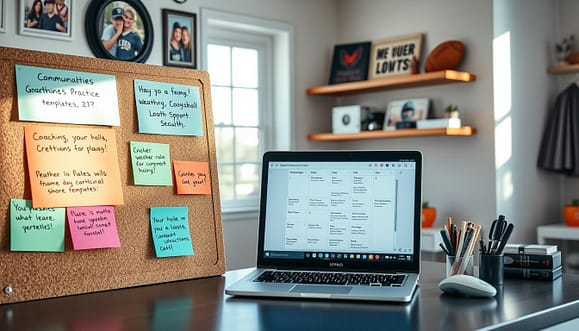
The Weather Alert Template is essential. Send it the night before or early morning. Be clear and direct. “Practice is ON unless you receive a SECOND email by 3 PM” is better than “Might be canceled, will update.”
The Game Day Reminder is your detailed plan. Include when to arrive, what to wear, and what gear to bring. Say “cleats, water bottle, helmet, and a positive attitude” instead of “bring your glove.”
Emotional templates are advanced. The Praise Template uses the “Magic Ratio” of five positives for every negative. This boosts morale.
Be specific with praise. “Great game, Sarah!” is vague. Say “Sarah, your extra base in the third inning showed great awareness.” This shows you’re paying attention and care.
For team praise, focus on teamwork. “The infield communication today was amazing. You called every pop fly perfectly.” This builds team identity. For more ideas, check out these phrases parents can use to encourage.
The Correction Template is delicate. Use the “Criticism Sandwich” method: positive, constructive, positive. This is strategic, not soft.
Correct behavior, not character. A template for fielding might say: “Loved the energy and hustle today (Positive). We need louder, clearer calls on pop-flies—priority always goes to the infielder (Constructive). Lock this down, and our defense becomes a brick wall (Positive).”
These templates help you stay calm and consistent. They show leadership that parents trust and players respect. You’re not just reacting; you’re following a plan.
| Template Type | Primary Purpose | Key Elements | Optimal Timing |
|---|---|---|---|
| Weather Alert | Provide certainty & safety instructions | Clear status (ON/OFF), decision deadline, alternative plans | Night before or by 7 AM |
| Game Day Reminder | Ensure logistical readiness | Arrival time, uniform, gear checklist, opponent info | 24 hours before game |
| Praise (Individual) | Reinforce specific positive behaviors | Specific action observed, connection to practice, encouragement | Within 24 hours of performance |
| Correction (Team) | Address issues without deflating morale | Positive opener, clear constructive feedback, positive forward vision | Next practice or team huddle |
Having these message templates makes you a strategic leader. Your emails build culture, not just schedules. You’ll spend less time typing and more time coaching. Consistent tone builds trust, and specific praise boosts confidence.
Every email teaches how you lead. Make each one count. Create them once and use them wisely. Your team’s performance will improve a lot.
Handling grievances and conflict resolution steps
Conflict in youth sports is inevitable. Heat, pressure, and emotional investment create friction. The key to success isn’t avoiding drama but having a robust, institutionalized conflict resolution process. Think of it as the law for your little league nation.
Without a process, you’re just a person yelling on Twitter. With one, you’re the wise leader who helps everyone find a fair solution.
The best approach is a formal “Feedback Procedure,” like seasoned leagues use. It’s not about red tape. It’s about protecting everyone’s feelings. Here’s how to make it work.
Step 1: Mandate the 24-Hour Cooling-Off Period. This rule is non-negotiable. No discussions about playing time, umpire calls, or coaching decisions within 24 hours of the event. It gives the brain time to calm down. This rule helps rational thinking take over. Make sure everyone knows about it at the start of the season.
Step 2: Channel Communication Correctly. Concerns should go through the right channels. If a parent has a concern, they talk to the coach. If a player has an issue, they speak up first. This builds accountability and teaches important life skills.
Step 3: The Formal, Fact-Finding Meeting. If a conversation is needed after Step 2, make it structured. It’s not a trial. The goal is to check if a specific action broke the rules or team pledges.
Focus on the incident: “On Tuesday, during the third inning, event X happened. How does that align with our pledge about Y?” This approach avoids personal attacks and focuses on facts.
| Aspect | Emotional Reaction (The Default) | Procedural Resolution (The Sage’s Method) |
|---|---|---|
| Timing | Immediate, heated confrontation post-game. | Structured discussion after a mandated 24-hour cool-down. |
| Focus | Personal attacks, perceived slights, and character judgment. | Specific incidents measured against the pre-established Code of Conduct. |
| Outcome | Winner/Loser dynamic, lingering resentment, team division. | Clear finding of “violation” or “no violation,” followed by a defined path forward. |
| Role of Leader | Referee in a shouting match, taking sides. | Facilitator and analyst, guiding the review of facts. |
This table shows how to move from chaos to clarity. By following these conflict resolution steps, you teach respect and reason. You become more than a problem solver. You build a strong team culture.
The real win isn’t about winning games. It’s about turning a conflict into a calm conversation. That’s the power of a good conflict resolution system.
Inclusive communication: language and accessibility
Inclusive communication is not just about being polite. It’s about making sure everyone feels important and heard. Imagine your team as an orchestra. If one musician is off, the whole team suffers.
Start with language. Saying “you guys” is like serving plain bread at a team dinner. It’s boring and might leave some people out. Use “team,” “everyone,” or “athletes” instead. This shows you see everyone as part of a team, not just some extra people.
Be careful with how you praise people. Saying a girl is “tough” and a boy is “smart” is outdated. Instead, praise what they did, like “that was a strategic throw to second base.”
Inclusive communication is more than just words. It’s about making sure everyone can get the information they need. Using only GroupMe might leave out some team members, like grandparents who prefer email. Use different ways to share important info.
Make sure everyone knows where to meet. Saying “meet at the Johnson field” might not be clear to everyone. Always give the full address and a link to Google Maps if you can.
Think about how people learn best. If you explain something verbally, also use pictures or diagrams. This helps everyone understand better.
Emotional accessibility is key to a strong team. Everyone needs positive feedback and to feel valued. Give specific, helpful feedback to everyone, not just the stars. Use jokes and references that everyone can understand.
The Positive Coaching Alliance’s “Honoring the Game” ROOTS framework is great for this. The “R” for Respect for Teammates and Self is all about inclusivity. It’s about creating a safe space where everyone’s contribution is valued.
Is this just about being woke? No, it’s smart strategy. A team is stronger when everyone is supported. One person left out can be a weakness. Choose how you communicate wisely to unlock everyone’s full strength.
FAQ
Q: What is the significance of the 2024 US Presidential Election?
A: The 2024 US Presidential Election is a critical event that will shape the future of the country. It will determine the direction of the nation, the policies that will be implemented, and the leadership that will guide the country for the next four years.
Q: Who are the main candidates running for the 2024 US Presidential Election?
A: The main candidates running for the 2024 US Presidential Election include Joe Biden, Donald Trump, and several other notable figures. Each candidate has their own platform, vision, and policies that they believe will benefit the country.
Q: What are the key issues that will be addressed during the 2024 US Presidential Election?
A: The 2024 US Presidential Election will address a range of key issues, including healthcare, education, economic growth, national security, and climate change. These issues will be at the forefront of the campaign and will shape the policies and decisions made by the next president.
Q: How can I stay updated on the latest news and updates about the 2024 US Presidential Election?
A: To stay updated on the latest news and updates about the 2024 US Presidential Election, you can follow reputable news sources, such as CNN, Fox News, and The New York Times. You can also follow the official social media accounts of the candidates and the election commission to get real-time updates.
Q: What are the voting requirements and deadlines for the 2024 US Presidential Election?
A: The voting requirements and deadlines for the 2024 US Presidential Election vary by state. It is important to check with your local election office or visit the official website of your state’s election commission to find out the specific requirements and deadlines for voting in your area.
Q: How can I make an informed decision when casting my vote in the 2024 US Presidential Election?
A: To make an informed decision when casting your vote in the 2024 US Presidential Election, it is important to research the candidates, their policies, and their track records. You can also attend debates, town halls, and other campaign events to get a firsthand understanding of their positions and vision for the country.
Q: What is the role of the Electoral College in the 2024 US Presidential Election?
A: The Electoral College plays a significant role in the 2024 US Presidential Election. It is a system established by the Founding Fathers to ensure that smaller states have a voice in the election process. Each state is allocated a certain number of electoral votes based on its population, and the candidate who wins the most votes in a state gets all of its electoral votes.
Q: How can I participate in the democratic process and make my voice heard in the 2024 US Presidential Election?
A: To participate in the democratic process and make your voice heard in the 2024 US Presidential Election, you can register to vote, attend campaign events, engage in discussions with friends and family, and encourage others to exercise their right to vote. By participating in the democratic process, you can contribute to the future of the country and ensure that your voice is heard.
Downloadables: Agenda, Email Scripts, Role Sign-Up Sheet
Theory is for philosophers. Your dugout needs actionable plans. These downloadables are your season’s D-Day documents. They turn good intentions into smooth execution.
First, grab the Preseason Meeting Agenda and Slide Deck Template. It’s filled with Positive Coaching Alliance philosophy and clear placeholders for your team’s rules. Pair it with the ready-made Parent, Player, and Coach Pledges. These PDFs are your code of conduct, ready for signatures.
Next, deploy the library of Email & Text Scripts. Weather cancellations, tournament reminders, and post-game praise are now templated. No more staring at a blank screen before a 7 AM game. The editable Role Sign-Up Sheet syncs with Google Sheets or your scheduling app like TeamSnap. It automates snack duty and game-day jobs.
These aren’t mere documents. They’re communication force multipliers. They scale your effectiveness while saving you hours of weekly reinvention. They project a level of professionalism that makes parents trust the entire operation.
Think of this pack as open-source code for a conflict-minimized season. It lets you focus on development, not administrative headaches. Download, customize, and execute. Your future self, already less stressed, thanks you.