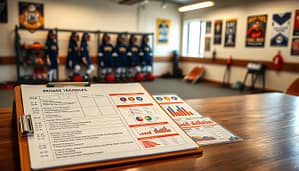
Before the first pitch, building a tournament team is more than talent. It’s a complex process, like a political campaign.
The eligibility checklist is key, like the first primary. It shows you’re qualified to play.
Academic standards are strict, like the MPSSAA’s four-class rule. You need to meet full-time enrollment and residency rules. Attendance is also a must.
Ignoring these rules can lead to disaster. A star player might be ruled out. Volunteer coaches play a big role in handling these details.
This part isn’t glamorous, but it’s essential. A strong start sets the stage for success.
Eligibility Rules & Team Identity
Think of eligibility as the government’s rulebook. Team identity is your rock-and-roll manifesto. The first tells you who can play legally. The second shows who you want on your team. This is where philosophy meets the real world.
Charles County has its rules, for example. A player must play in 50% of innings or 25% of games as a pitcher. It’s all about following rules, but it’s not exciting.
Now, the real question is, what kind of team do you want? Do you want to be a powerhouse or a speed team? Your answer goes into your tryout rubric.
Your rubric is your guide. It goes beyond just numbers. It looks at grit, game IQ, and the will to win.
The handbook has more than just numbers. It talks about attitude, sportsmanship, and taking care of things. Most coaches overlook these, but they’re key.
How a player acts during drills, their attitude in the batting cage, and how they react to mistakes show a lot. These moments reveal if they have what it takes to win.
This is about fairness and being clear. A fair evaluation isn’t just about timing. It’s about seeing if they fit your team’s vision. Your rubric makes this vision clear.
Let’s create a rubric that finds your athletes, not just any athletes.
| Category | What We Measure | Why It Matters | Evaluation Method |
|---|---|---|---|
| Skill & Physical | Arm strength, foot speed, hitting mechanics. | The raw material. Can they execute the fundamentals? | Timed drills, radar gun, live batting practice. |
| Game IQ & Instinct | Base running decisions, defensive positioning, situational awareness. | Do they understand *why* plays happen? Can they think ahead? | Controlled scrimmage scenarios, Q&A sessions. |
| Character & Coachability | Response to failure, hustle between drills, communication, care of equipment. | Defines team culture. Determines how they’ll handle adversity and coaching. | Coach observation during downtime, peer feedback, attitude in drills. |
The table balances what you can measure with what you can see. It turns “Sportsmanship/Citizenship” into something you can score. Your tryout rubric becomes a filter. It shows who truly fits your team.
Who should play? The players whose profiles match your team’s identity. That’s how you build a team, not just a roster.
Designing Fair Tryouts (skills + game IQ)
The art of the tryout isn’t just watching kids play. It’s about understanding what you’re seeing. Without a clear plan, it’s like hosting a big party without knowing the rules.
Imagine building a band. You might have a great lead guitarist, but without a solid rhythm section, it won’t work. Your team needs positional balance just like a band needs different parts.
This isn’t about picking the 12 best players. It’s about building a team that can last through tough games. Players get tired, and catchers’ knees hurt.
We learn from other sports. In football, players need to be on the field a lot. In soccer, it’s half of each half. It’s about knowing each player’s role.
To design a fair tryout, start with a scoring system. This turns opinions into facts. We use different categories to measure skills.
Here’s the framework:
- Arm Strength & Accuracy: Can they make the throws from their position?
- Bat Control & Power: Not just hitting the ball, but how and where.
- Defensive Range & Hands: The first step and the secure catch.
- Baseball Acumen (Game IQ): This is the separator. Do they know where to go before the play happens?
Weight these categories based on your team’s style. A team that likes small ball will value bat control more. A power team will focus on arm strength.
Assign roles to your staff. Without clear roles, chaos happens. You need specific jobs.
Who watches footwork and positioning from behind the backstop? Who runs game-like scenarios? Have a “Station Master” for each drill to keep things consistent.
This way, you avoid arguments. When disagreements happen, look at the data. “His bat control score was a 7, but his defensive range was a 4 for a shortstop.” That settles it.
Finding positional balance is the hardest part. Don’t just pick the best hitter. Your drills should show who can do the important, unseen jobs.
Can that pitcher also play first base? Does that speedy outfielder have good hands for catching? You’re not just picking players; you’re building a team.
Lack of positional balance is a big problem. It’s the difference between a strong team and one that falls apart. Design your tryout to find the whole team, not just the star.
Your final roster should have depth and versatility. That’s what makes a tryout fair and smart.
Scoring Rubrics and Staff Roles
Think of your coaching staff as a pit crew. Each member has a specific role. The scoring rubric is like the torque wrench, ensuring every bolt is tightened to spec.
After tryouts, you can’t afford to be subjective. You need a system. This system turns “he looked good” into “he scored 8.5 on defensive range.” It’s the difference between a hunch and a fact.
Why does this matter now? The roster is set. Parents have opinions. Players have feelings. A transparent rubric isn’t just for evaluation. It’s your first line of defense in every post-game conversation.
Your communication plan is the other half of this equation. It’s the schedule, the rules, the fine print. A confused parent is a distraction you cannot handle during a pitching change.
Let’s get local. Take Charles County’s policies. They mandate parent notification of practice times with 48-hour notice. They have equipment responsibility clauses. Players are liable for lost gear. The transportation rule is non-negotiable. The team must travel and return together by bus.
This isn’t bureaucracy. It’s your blueprint for sanity. Your job is to communicate this, not debate it.
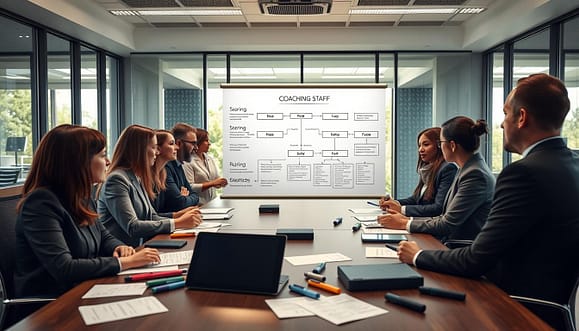
Now, assign the roles. Clarity prevents overlap and covers every base. Below is the staffing table that turns a group of volunteers into a precision unit.
| Role | Primary Duty | Key Rubric Alignment | Communication Touchpoint |
|---|---|---|---|
| Head Coach | Final lineup decisions, game strategy | Overall player performance composite | Daily team/parent briefings |
| Pitching Coach | Arm care, pitch counts, bullpen management | Pitching mechanics & stamina rubric | Pitcher/Catcher family updates |
| Bench Coach | In-game substitutions, opponent tendencies | Game IQ & situational awareness score | Real-time player feedback |
| Logistics Manager | Equipment, bus schedules, hotel meals | N/A (Operational) | Primary executor of the communication plan |
See the last column? That’s where your communication plan lives. It’s assigned. It’s not an afterthought.
The rubric itself should be simple. Borrow from proven models. For instance, an evaluation rubric designed for classrooms translates beautifully to the diamond. It breaks down complex skills into observable, measurable components.
Use it to score defensive footwork or bunt defense execution. This objectivity is liberating. It ends the “my kid” debates before they start.
So, before you dream about bracket strategy, lock this down. Define the roles. Publish the rubric. Drill the communication plan like a set piece. The peace of mind you gain is the real home-field advantage.
Roster Construction: Pitching Depth, Catcher Management, Versatility
In an all-star selection Texas tournament, your roster is more than just names. It’s a detailed plan for success. You have only two weeks, or maybe less. It’s a fast-paced game, not a long race.
Imagine building a team for a big heist. You need experts, but also people who can adapt quickly. Your team must be ready for the quick pace of the tournament.
Pitching depth is key. With games coming fast, your pitchers’ arms are precious. You need more than one ace. Aim for a group of five reliable pitchers for three innings each.
Practice time is limited. You can’t just keep throwing until someone gets tired. Your practices must be precise. Spend one hour on live pitching, another on fielding drills, and a third on game-like scenarios.
Catcher management is critical. Catchers face the most physical demands. If your main catcher gets hurt, your whole strategy falls apart. You need at least two, preferably three, catchers who can handle the job.
Versatility is your secret. A player who can play shortstop and catch is invaluable. A first baseman who can also pitch in relief is a game-changer. These players help you manage games without losing power.
This all fits into the 14-day ramp. Your roster choices guide your practices. You can’t work on everything. The table below shows how to match your limited practice time with your roster needs.
| Practice Day Focus | Roster Priority | Key 3-Hour Activity | Outcome |
|---|---|---|---|
| Days 1-3 (Assessment) | Identify Pitching & Catching Depth | Live batting practice with pitch counts; catcher pop-time drills. | Map your stable of arms and confirm catcher durability. |
| Days 4-7 (Integration) | Test Player Versatility | Multi-position defensive rotations; situational scrimmages. | Discover which athletes can handle “utility” roles effectively. |
| Days 8-11 (Refinement) | Lock In Roles & Relays | Set-piece execution (bunt D, pickoffs) under fatigue. | Solidify game-day defensive alignment based on roster skills. |
| Days 12-14 (Rehearsal) | Simulate Tournament Conditions | Controlled intra-squad games with strict pitch limits. | Finalize pitching rotation and late-game substitution patterns. |
Notice how you’re testing your roster in real time. The three-hour limit means every drill must be focused. You can’t waste time on slow drills. Every drill must answer a key question: Can this kid give me 50 competitive pitches on back-to-back days? If my starting catcher needs a break, who steps in without causing chaos?
A well-built roster is your biggest advantage. It turns the short window and practice limits into a strong plan. You’re not just picking stars. You’re building a winning machine, piece by piece, for Texas.
14-Day Performance Ramp: Practices, Scrimmages, Roles
In tournament baseball, talent is key. A 14-day ramp is your plan. It’s not just a preseason. It’s a boot camp to win games fast.
It’s like a software launch. You’ve tested the beta (tryouts). Now, you’re ready for the final version. Every practice is for game readiness for district tournaments.
The old “run laps and take fungos” model won’t cut it. Your ramp needs structure and focus. Drill the plays that win games in October.
We divide the fortnight into three phases. Each phase gets more intense, building towards the game.
Phase 1: Integration & Muscle Memory (Days 1-5)
This phase is about learning fast. Introduce your defensive schemes. The goal is to clear up confusion. Run drills slowly, then faster, correcting every mistake.
Pitchers and catchers also start their ramp. Bullpens focus on command, not speed. Catchers work on receiving and calling plays. Every player’s role is a vague idea here.
Phase 2: Situational Pressure Cooking (Days 6-10)
Theory meets reality here. Practices are live scrimmages. Start with a runner on second and create bunt situations.
Keep score and introduce pressure. This shows who can execute under pressure. It also teaches professionalism, like picking up equipment.
Phase 3: Dress Rehearsals & Role Finalization (Days 11-14)
The final days are for fine-tuning. Run a full game simulation. Treat it like a playoff game.
Roles become clear here. The closer knows he’s the closer. This clarity is a weapon. It eliminates hesitation in a tournament run.
Your team is now a single unit. When the game gets tight, you react, not think. That’s the ramp’s goal.
Set Pieces: Bunt Defense, 1st/3rd, Pickoffs, Cuts/Relays
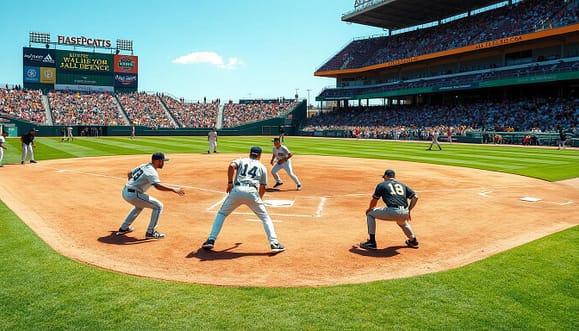
In the fast-paced world of All-Star & District Play, games are often won by defense, not offense. It’s about executing well-rehearsed plays, not just hitting home runs. Your athletic skills are put to the test in these moments.
Think of these four systems as your defensive must-haves. They are the key plays in tournament baseball, the ones you must master.
| Set Piece | Primary Goal | Key Actors |
|---|---|---|
| Bunt Defense | Kill the sacrifice, get the lead out. | Corner Infielders, Pitcher, Catcher |
| 1st & 3rd Defense | Prevent the steal of home, trap the trail runner. | Pitcher, Catcher, Middle Infielders |
| Pickoffs | Apply pressure, erase free bases. | Pitcher, First/Third Baseman, Middle Infielder |
| Cuts & Relays | Short-circuit extra-base hits, deliver a strike to the target. | All Outfielders, Shortstop, Second Baseman |
Bunt Defense is a declaration of intent. Are you aggressive or conservative? Decide, practice, and make it automatic. The pitcher, catcher, and corner infielders work together like a well-oiled machine.
The First-and-Third situation is a mental challenge. The offense hopes you’ll get confused. Your goal is to prevent the steal of home and catch the trail runner in a run-down. Good communication is key here.
Pickoffs are a weapon, not a trick. A well-timed pickoff can change the game. Practice the lefty move to first, the righty spin to second, and the catcher’s snap-throw to third. It’s about constant pressure.
Lastly, Cuts and Relays are all about geometry. Extra-base hits shouldn’t always score. Practice the relay paths until your shortstop and second baseman can execute them without thinking. It’s about precision, not reaction.
Drill these plays with dedication. When the game starts, your team will perform without hesitation. That’s true facilitation.
Scouting Opponents & Advance Reports
Scouting reports for All-Star & District play need to look beyond just batting averages. They must consider things like hotel location and how well the team is acclimated to the heat. The game isn’t just played on the field. It’s also influenced by a three-hour bus ride and the local transportation rules.
Starting with the basics is key. You need to know about their number three hitter’s tendencies. You should also understand their defensive strategy, like when they go for a pickoff. This is the what of your opponent.
But the smart coach digs deeper. The how and why of their performance often comes from off the field. Did their star pitcher get enough sleep? What did they eat for breakfast? Their weakest link might be their adherence to a good bedtime.
Your report should be a detailed dossier. Look at these logistical factors as important intelligence:
- Travel Fatigue: When did they arrive? Teams following strict policies, like in Charles County, often have an advantage.
- Lodging Layout: Is their hotel quiet or noisy? How far is it from the venue?
- Nutritional Readiness: Are they eating the right foods? Meal planning can show a lot about their readiness.
- Discipline Metrics: How well do they follow curfew? This shows their focus and how they might perform the next day.
- Climate Preparedness: Do they have a plan for staying hydrated and rested in the heat?
The Heat Plan is a key, often overlooked, piece of information. In hot summer tournaments, a team without a plan for staying cool is at risk. Watching how they manage water and rest can show a strategic weakness.
Getting this information requires a different approach. Arrive early and watch their pre-game routine. Talk to other coaches to learn about any travel issues. It’s more like observing animals in their natural habitat than a spy mission.
| Traditional Scouting Data | Logistical & Environmental Intelligence |
|---|---|
| Batting Order & Tendencies | Team Travel Schedule & Arrival Time |
| Pitching Rotation & Velocity | Hotel Quality & Distance from Fields |
| Defensive Alignment & Shifts | Observed Meal & Hydration Habits |
| Bunt Defense & Pickoff Plays | Coach-Enforced Curfew & Discipline |
| Catcher’s Pop Time | Presence of a Formal Heat & Safety Plan |
Your opponent is a system, not just a team. You need to understand their players and their situation. A complete report will show you not just what they’ll do, but how well they’ll do it. In District Play, this approach is not just smart. It’s what separates winning from losing.
Game-Day Operations: Hotels, Meals, Curfews, Heat Plan
Your tournament hotel is more than a place to sleep. It’s the base for your All-Star & District Play campaign. Get it wrong, and you face a tough battle before the first pitch.
Start with the hotel. It’s not a family vacation. Room assignments should be strategic. Pitchers and catchers together, leaders spread out.
Set clear rules: no pool after 9 PM, limit elevator use, and quiet hours. Because nothing says “we’re focused” like a pack of 12-year-olds playing Marco Polo at midnight. Know and enforce safety levels, like those in Charles County.
Next, meals. Tournament eating is tricky. Stick to protein for breakfasts. Pack snacks that replenish energy, not just taste good. For away games, check the concession menu ahead of time.
Curfews are a challenge. Explain the need for rest as “professional preparation,” not punishment. “We need 9 hours of sleep for elite reaction times tomorrow.” Make the curfew earlier for morning games. Yes, bed checks are needed.
The heat plan is critical. It’s not just about drinking water. Have a hydration schedule 48 hours before games. Use cooling stations and know the signs of heat exhaustion.
This plan creates a safe bubble for your players. But what about outside the bubble? Charles County policies on spectators are key. Your parents are your biggest cheerleaders and possible distractions.
Proactive communication is key. A pre-tournament memo should set clear expectations. Cover playing time, conduct in the stands, and post-game protocols.
- Playing Time: Start with the “50% of innings” guideline for tough talks. In All-Star & District Play, it’s about winning, not equal time.
- Conduct in the Stands: Sportsmanship is a must. Explain what cheering looks like and what it doesn’t.
- Post-Game Protocols: Have a cool-down period. The parking lot is not for reviews. Use official channels for feedback.
The goal is to unite everyone—players, coaches, parents—to win games. A united front in the stands is as important as a unified infield. When operations off the field are tight, talent on the field can shine. In All-Star & District Play, that’s a big advantage.
Parent Communication & Expectations
The last pitch is thrown. The final out is recorded. Your All-Star & District Play run is technically over. The real work, the kind that builds programs, is just beginning.
We hold a structured post-tournament debrief. This isn’t a blame session. It’s a film-like post-mortem for the team and individual players. We discuss what worked well and where we fell short.
The handbook’s awards—letters, pins, championship patches—provide a formal recognition framework. Celebrate the MVP, sure. But also honor the role player who nailed that perfect sacrifice bunt in the third inning. That recognition closes the loop.
This process is your final, critical act of parent communication. It sets the expectation that All-Star & District Play is about growth, not just gold. It provides closure for families. It plants seeds for next season’s roster, much like the timeless lessons captured in classic baseball literature that go beyond stats and highlight the values of the game.
Because the pursuit of a trophy teaches more than winning ever could. The debrief makes those lessons stick.