Let’s talk about youth baseball training programs. Everyone wants to sell you something, but no one teaches you how to choose. I’ve seen many parents struggle with this. Finding the right training partner is more than just about hitting skills. It’s about knowing what you’re really getting.
This guide is like Consumer Reports for baseball academies. Instead of testing toasters, we’re looking at places that claim to make your kid a star player.
Are you aiming to build basic skills in a friendly setting? Or maybe you dream of making it to a top select team with all its travel-ball adventures? Or perhaps you’re focusing on getting ready for a high school tryout eighteen months from now?
Each goal needs different tools and coaching styles. When you compare baseball academies, knowing your goals is key. Selecting training academies becomes much simpler once you know what success means for your family.
This isn’t about ruining dreams. It’s about baseball facility evaluation that matches what you hope for with what’s real. Then, finding a program that keeps its promises, not just its marketing.
Non‑negotiables safety certifications heat lightning EAP background checks
Let’s talk about the elephant in every facility tour: the safety standards that many parents overlook. Nobody wants to be that parent questioning coaches about liability waivers. But, we need to face the reality.
There’s a wide range in youth sports organizations. Some have strict baseball training safety protocols. Others might not even have a first-aid kit.
This isn’t about being paranoid. It’s about doing your homework in a world where trust needs proof.
Start with the basics. CPR and AED certification are essential. First Aid training is key when accidents happen. But, not all youth sports certifications are the same.
That old CPR course from 2003 isn’t enough anymore. Look for certifications that are up to date and specific to sports.
Heat illness is a big deal in hot places like Texas in June. Ask about their heat rules. Find out when they stop training due to heat. Who watches the weather? If they’re unsure, it’s time to leave.
Lightning policies are also critical. The old “count to thirty” rule isn’t good enough anymore. Facilities should have weather systems and clear plans for when it rains. Ask them about their lightning plan and where athletes go when it’s too stormy.
Now, let’s talk about emergency action plans. You want to see a real document, not just promises. An EAP should be clear, practiced, and specific to each place. It should tell you who calls 911 and who uses the AED.
Here’s a secret: not all youth sports groups do background checks. Some do the minimum, others skip it. You need to check their background check requirements in writing. This includes coaches, volunteers, and anyone who watches kids.
Ask these questions without feeling bad:
- Can I see current certifications for all staff members who will interact with my child?
- What’s your written policy on heat index thresholds and training modifications?
- Who monitors weather conditions, and what technology do you use?
- May I review your facility-specific Emergency Action Plan?
- What background check service do you use, and how often are checks renewed?
Programs that are confident will give you this info right away. They know safety protocols are the base of everything. If a program gets defensive or vague, that’s a red flag.
See how different programs answer your safety questions:
| Red Flag Response | Acceptable Response | Gold Standard Response |
|---|---|---|
| “We’ve never had any problems.” | “Here’s our certification roster and safety manual.” | “Let me introduce you to our safety coordinator and show you our posted protocols.” |
| “That information is confidential.” | “We use [specific service] for background checks annually.” | “All staff complete FBI fingerprinting and we use continuous monitoring services.” |
| “Our coaches know what to do.” | “We have a written EAP for each field location.” | “Here’s our EAP, and we run emergency drills quarterly with documented reviews.” |
Facilities that ignore your safety questions aren’t ready for you. The ones that open up about their youth sports certifications and safety plans are showing they care about athlete safety.
Remember, these aren’t just concerns for helicopter parents. They’re basic standards that show a program is serious about safety. If a facility can’t show you their safety plans, you shouldn’t trust them.
You’re taking a risk by choosing them.
Staff expertise degrees CEP levels pro experience development track record
Every baseball facility claims to have “professional coaching,” but the truth is often different. It’s your job to find out who’s telling the truth and who’s just making it up.
The world of baseball coaching is complex. When you compare baseball academies, you’ll see many different types of coaches. Some have played in the MLB, while others just love the game too much. Let’s focus on what really matters.
First, look at their education. Degrees in kinesiology, exercise science, or sports management show they know about human movement. These certified baseball instructors understand how bodies grow and how to improve performance. It’s all about science, not guesswork.
Then, check for real certifications. A Certified Exercise Physiologist (CEP) or NSCA certifications mean a lot. These aren’t just weekend courses. They require hard work and ongoing learning. They show your coach knows how to train safely and effectively.
Now, let’s talk about professional baseball experience. While it’s good, it’s not everything. Just because someone played in the MLB doesn’t mean they can teach well. Ted Williams was amazing, but not all his students were.
What really matters is the player development track record. This shows if the coaching actually works. It’s about results, not just promises.
Ask these specific questions:
- How many players moved to the next competitive level in the past three years?
- How many earned high school varsity spots, college scholarships, or draft selections?
- Can you provide specific examples with verifiable details?
- What’s your coaching philosophy for age-appropriate progression?
- What continuing education do staff members complete annually?
The best programs will answer these questions with real data, not just empty words. They’ll talk about their methods and how they help players grow. They won’t just give you feel-good speeches.
Coach-to-player ratios are very important. Too many kids with one coach is not good. Look for places where each player gets the attention they need.
Here’s a comparison framework that cuts through the noise:
| Credential Type | What It Signals | Red Flags to Watch | Questions to Ask |
|---|---|---|---|
| Formal Degree (Kinesiology, Exercise Science) | Scientific understanding of human movement and development | No formal education, only playing experience | What’s your educational background in sports science? |
| Professional Certifications (CEP, NSCA) | Commitment to evidence-based training methods | Vague “certified coach” claims without specifics | Which certifications do you maintain, and when were they last renewed? |
| Playing Experience | Practical understanding of game situations | Relying solely on past glory, no teaching training | How do you translate playing experience into age-appropriate instruction? |
| Development Track Record | Proven ability to improve player performance | Generic testimonials, no measurable outcomes | Can you share specific progression data for players in my child’s age group? |
When you compare baseball academies, look for coaches who are more than just former players. They should be educators, technicians, and mentors. Not just people who want to relive their glory days through your kid.
Ask for references you can check. Request examples of individualized development plans. Inquire about staff turnover rates. The answers will tell you everything you need to know about whether this facility develops players or just collects checks.
Your kid deserves coaches who understand the science of development, not just the romance of the game. Choose wisely.
Curriculum clarity weekly blocks individualized plans and ratio of coach to player
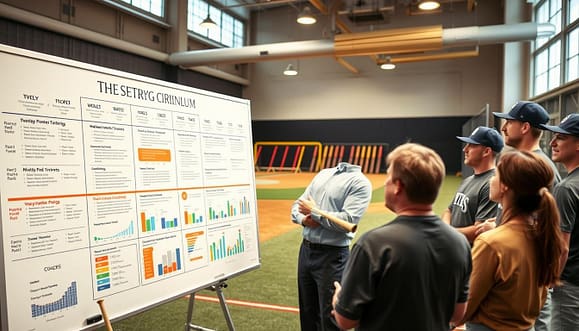
Want to spot a weak baseball program? Just ask them about a typical week. If they talk vaguely about “fundamentals” and “skill development,” it’s just a place where kids play with adults watching. Real programs will give you a detailed plan for every day, like a project manager would.
The curriculum should be clear and detailed, like a roadmap. What’s the plan for Week 1 versus Week 8? Is there a logical flow, or do coaches make it up as they go?
Some places have a curriculum that only one coach remembers. That’s not a program; it’s just knowledge waiting to be lost. You should see weekly schedules before you sign up.
Good programs focus on growth. Do they tailor training for different ages? A young player needs different work than a high schooler. If they treat everyone the same, it’s not personalized training.
Basic drills are okay for beginners. But advanced players need specific training. This is where individual plans are key, not just nice to have.
Do they really assess skills and create plans based on them? Or is it the same for everyone?
Ask for real training plans for actual players. If they can’t show you, it’s just marketing.
Now, let’s talk about the coach to player ratio. This is key, but programs often play with words.
What does “small groups” really mean? Ask for exact numbers. A 1:4 ratio means real attention and feedback. But a 1:15 ratio means you’re paying for supervised practice.
Here’s why this ratio is so important:
| Coach to Player Ratio | Attention Per Player | Feedback Quality | Progress Tracking |
|---|---|---|---|
| 1:4 | 15 minutes per hour | Detailed mechanical correction | Individualized notes after every session |
| 1:8 | 7-8 minutes per hour | General observations and group instruction | Weekly summaries for the group |
| 1:12 | 5 minutes per hour | Surface-level comments during rotations | Monthly progress reports if you’re lucky |
| 1:15+ | 4 minutes or less | Glorified cheerleading from across the cage | Generic participation certificates |
The difference between a 1:4 ratio and 1:12 is huge. One offers real coaching; the other is just expensive practice.
Look for programs that can explain their curriculum clearly. Ask how they measure progress and adjust plans. They should show you how they tailor training based on performance.
Structure helps, not hinders, development. Without clear plans, measurable goals, and the right coach ratio, you’re not investing in growth. You’re just hoping for the best.
If a program can’t explain its curriculum clearly, keep looking. Vague promises about “elite training” mean nothing without a solid plan to back them up.
Tech and data policy access to reports parent communication and privacy
Most programs collect training data but share it little. They treat your kid’s progress reports like secrets. This is the world of youth baseball and technology, where technology in baseball training has grown fast but sharing data slowly.
Top facilities use cool tech like Rapsodo units and Trackman systems. They also have cameras and sensors to track arm stress. But, the real question is if they share this data with you.
What you want from training data tracking is clear progress. You want to see how fast your kid is getting better. But, often, you just get emails saying “Johnny had a great week!” without any numbers.
Good parent communication systems make a big difference. Do they have a parent portal where you can see notes and videos? Can you track your kid’s progress easily without texting the coaches?
How often you hear back matters too. Getting updates every month shows they care. But, if you only hear back when you ask, it’s a sign of a problem.
Every program should answer these questions clearly:
- What metrics do you track consistently? Look for specific numbers like velocity and sprint times.
- How often do families receive detailed reports? Do you get updates monthly or just at the end of the season?
- Is there a digital platform for accessing training data? Is it an app, a website, or just emails?
- Who reviews the data with athletes? Do coaches discuss it during sessions, or is it just uploaded?
- How do you incorporate assessment results into training adjustments? Data should lead to better training, not just be shown.
Now, let’s talk about data privacy. What info are they collecting, and who sees it? Are they selling your contact info or sharing your kid’s stats without asking?
Any good program has clear privacy policies youth sports should follow. Ask to see the policy before you sign up. If they don’t have one or seem surprised you asked, that’s a big warning sign.
Video use can be tricky. Footage for skill improvement is okay. But, if it shows up in ads or social media without your okay, that’s not right. Make sure you agree to video use in writing.
| Communication Aspect | Red Flag Approach | Gold Standard Practice |
|---|---|---|
| Progress Updates | Vague encouragement emails, no specific data shared | Detailed quarterly reports with measurable metrics and video analysis |
| Parent Access | Information only available by repeatedly asking coaches | Self-service portal with 24/7 access to training notes and assessments |
| Data Privacy | No written policy, dismissive when questioned about usage | Clear privacy policy, explicit consent forms for all data collection |
| Video Usage | Footage appears in marketing without prior approval | Separate consent for promotional use, with annual renewals |
Ask about data security and where it’s stored. Is it encrypted in the cloud, or on someone’s laptop? Who can see it, and how long do they keep it?
Programs that are open about parent communication systems and data tend to be better. Those that are secretive or vague? That usually means there are bigger issues you’ll find out too late.
The mix of youth sports and technology in baseball training can really help your kid grow. But, it can also be risky if programs don’t handle your data well. Always ask for clear information before you sign up.
Facility assets fields cages mounds recovery area and study room
The physical plant shows what a program really values, more than any mission statement. Baseball training facilities look great on Instagram, but do they actually help players improve?
Let’s look past the marketing. A tour of the facility shows what the program values and where they invest.
Field Access and Quality Matter More Than You Think
First, check the field access. Do they have well-maintained turf or natural grass fields? Or are they cramped indoor spaces where balls hit the ceiling?
Check the field’s condition during your visit. Are the base paths worn? Is the outfield patchy? These details show if they care about maintenance.
Indoor training is key in most climates. But many programs struggle here.
Indoor Batting Cages: Quantity Versus Quality
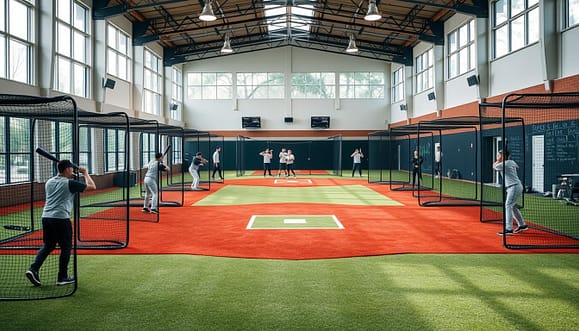
How many indoor batting cages are there? More importantly, how busy are they during peak hours?
If your kid waits a lot for a cage, they’re not getting enough training. Six cages for sixty players means big problems.
Cage quality is also important. Look for proper netting, enough space, and working pitching machines.
Pitching Mounds: Regulation or Improvisation?
Are the pitching mounds the right height and well-maintained? Or are they makeshift and deteriorating?
Top programs have both indoor and outdoor mounds. Pitchers need to throw on proper surfaces all year, not makeshift ones.
Ask about mound maintenance. A clay mound needs regular care, and neglected ones are risky.
Recovery and Sports Science Areas Separate Serious Programs
Elite programs stand out with dedicated recovery spaces. Do they have areas for arm care, mobility, and recovery?
Look for these specific elements:
- Foam rolling equipment and stretching areas for post-training recovery
- Resistance bands and arm care tools for injury prevention
- Recovery equipment like ice baths or compression systems
- Access to sports medicine professionals for assessment and treatment
Programs that invest in recovery know training stress needs support. It’s not optional for serious development.
Age-Appropriate Strength and Conditioning Spaces
Does the facility have strength training areas for youth athletes? Adult gym equipment doesn’t work for kids.
Age-appropriate training tools are key. Look for equipment that supports proper movement for developing bodies, not bodybuilding.
The Academic Space Wildcard
Study rooms show a program’s values. Facilities with quiet spaces for homework show they value education.
This small detail shows if the program sees kids as athletes or students. Athletic training is important, but so is education.
It’s a values statement in a furniture choice.
Practical Evaluation During Facility Tours
Look beyond the shiny surfaces during your visit. Here’s your inspection sequence:
- Check bathroom cleanliness as a reliable proxy for overall maintenance standards
- Observe peak-hour crowding to understand real capacity versus marketed capacity
- Ask about equipment replacement cycles and maintenance schedules
- Request access to see recovery areas and training spaces in active use
- Note the staff-to-space ratio during busy periods
Small details reveal operational priorities. A clean lobby but neglected training areas show budget priorities.
Comparing Facilities: Function Over Flash
When evaluating baseball training facilities, apply this framework:
| Facility Feature | Must-Have Standard | Elite Indicator | Red Flag |
|---|---|---|---|
| Batting Cages | 1 cage per 10 active players | Varied cage types (velocity, tracking) | Constant wait times |
| Mound Access | Regulation indoor mound | Multiple mounds, indoor/outdoor | Portable or damaged mounds |
| Recovery Space | Dedicated area with basic tools | Sports medicine staff on-site | No recovery infrastructure |
| Maintenance | Clean, functional equipment | Published maintenance schedules | Worn or broken equipment |
A fancy facility with poor programming is no good. But bad infrastructure limits development.
The goal is not the most expensive equipment. It’s finding functional, well-maintained facilities that support training.
Quality coaching supported by good facilities is key. Not the other way around.
Scheduling and logistics commute parking school conflict flexibility
The most overlooked factor in choosing a program isn’t coaching philosophy or facility size. It’s whether the schedule fits your family’s life without chaos. I’ve seen parents invest in top programs but quit after eight weeks because the baseball program logistics didn’t work.
Let’s talk about the unglamorous math nobody discusses. That “only thirty minutes away” academy actually takes sixty minutes round trip. Over six months, that’s seventy-two hours lost to driving.
Then there’s rush-hour traffic, making your commute considerations worse. Map the real route during rush hours, not midday. Is the location easy to get to from work, home, or school? Or does it require tricky routes?

Parking is a big deal until you’re stuck circling for twelve minutes. Quality programs think about facility parking access before opening. Is there enough parking? Is it free, or do they charge?
Ask about drop-off procedures. Can kids get to the facility safely and alone? If not, that “quick drop-off” adds fifteen minutes to your time.
Now, let’s talk about school sports conflicts. Youth baseball often clashes with school teams, exams, and family life. Managing multiple athletic commitments affects young athletes a lot. The question is how the program handles these conflicts.
Does the program offer flexible session times? Can you make up missed sessions? What’s the makeup policy—generous or strict? If your son makes the middle school team, can the schedule adjust?
Training schedule flexibility is key. The best facilities fit into your life, not the other way around. They offer flexible options, not demanding you change your life.
Here’s what to ask about school sports conflicts:
- How many makeup sessions are allowed per month?
- Is there a deadline for rescheduling, or can you adjust on short notice?
- Do makeup sessions receive the same coaching quality as regular sessions?
- What happens if you miss sessions due to school team playoffs or tournaments?
- Is there a refund or credit policy for extended absences?
This last question shows a program’s philosophy. Programs confident in their value don’t trap families with no-refund policies. They keep families through results, not contracts.
Also important: Does coaching quality vary by time slot? Some facilities use their A-team in after-school hours but not in morning or evening. Compare academies on consistent coaching across all times.
| Logistics Factor | Red Flag | Green Flag |
|---|---|---|
| Commute | Over 30 minutes in traffic | Under 20 minutes, multiple route options |
| Parking | Limited spaces, paid parking, unsafe drop-off | Ample free parking, safe independent entry |
| Schedule Options | Single rigid time slot | Multiple times with makeup flexibility |
| Conflict Policy | No accommodations for school sports | Explicit school-sport prioritization support |
The truth is, training schedule flexibility is more important than you think. Attending a perfect program twice a month is less valuable than a good program three times a week. Consistency is key, not sporadic excellence.
Before signing, plan a typical month. Include school, family, and downtime. Does the schedule fit, or does it require sacrificing everything? Sustainable is always better than perfect.
The program you can attend consistently is better than an elite one you can’t. That’s smart thinking about commute considerations and real-life limits. Choose wisely.
Cost transparency refund policies hidden fees and fundraising guardrails
Baseball training costs need careful review, like checking a menu without prices. Youth baseball has turned into a big test of how much parents will spend on their kids’ sports dreams. It’s important to think clearly about these costs, not just because of guilt or to keep up with others.
First, look for pricing transparency. Can you get a detailed breakdown of what you’re paying for? Is it a monthly fee, per session, or package deals? Make sure the price you’re quoted includes everything, or if there are extra costs later.
Details are key. Many programs have extra charges that can make the initial price look good but end up being more expensive.
Here are some hidden fees youth sports programs might have:
- Facility maintenance fees – ongoing costs for keeping the place running
- Technology charges – fees for video analysis or tracking software
- Uniform costs – you might have to buy special clothes
- Assessment fees – charges for checking your child’s skills
- Administrative charges – fees for managing the program
Ask for a detailed list of all costs for the whole season. Find out what happens if you need to stop mid-season.
Next, look at program refund policies. These show how programs handle life changes. Injuries happen, families move, kids lose interest. What’s the policy on refunds?
Read contracts carefully, before you’re excitedly standing in the facility with your child. The pressure of the moment can make bad contracts seem okay. Program refund policies with no flexibility show the program values money over people.
Now, let’s talk about fundraising requirements. Some programs make you help with fundraising. This can include selling tickets, working at concessions, or getting sponsors. It’s like volunteering, but with financial risks if you can’t or won’t do it.
What are the specific fundraising tasks? What if you can’t do them—is there a way to pay instead? How much would it cost? Compare programs based on total cost, including time spent on fundraising.
| Cost Component | Program A | Program B | Program C |
|---|---|---|---|
| Base Monthly Fee | $250 | $195 | $275 |
| Additional Fees | $0 | $75 (facility + tech) | $25 (assessment only) |
| Fundraising Buyout | Optional ($150) | Mandatory ($200) | None required |
| Total Monthly Investment | $250-$400 | $470 | $300 |
The most expensive program might actually be the best value if it delivers results without extra charges. The “affordable” program might cost more when you add up hidden fees youth sports programs have, fundraising, and extra charges.
The key to baseball training costs is to ask for clear information upfront. Programs that are confident in their value will share detailed financial information. If they’re secretive, there might be other issues. Your budget is important, but so is knowing what it buys and what it doesn’t.
Ask for references about financial experiences. Did costs match what was promised? Were there surprise fees? How did the program handle refund requests? These stories tell more about a program than any brochure.
Reference calls what to ask former families and coaches
Marketing materials show what programs want you to believe. But reference calls show what really happened. Every facility has parent testimonials on their website, like participation trophies. What you really need are honest conversations with families who have no reason to sell you anything.
This is your detective work—the due diligence questions that separate what’s promised from what’s real.
Start by asking for names of former families like yours. Look for similar ages, skills, and goals. If programs don’t give you references or only offer certain ones, that’s a red flag.
When you call, don’t be soft. Don’t waste time asking if they “liked” the program.
Essential Coach Questions for Reference Calls
Your coach questions should focus on real results and specific experiences. Here’s how to ask meaningful questions:
- What specific, measurable improvements did you observe? Look for numbers like exit velocity gains or batting average jumps.
- What didn’t work as advertised? Every program has gaps. Look for patterns of shortfalls.
- What surprised you, positively or negatively? The unexpected shows a program’s true character.
- If you could rewind, what would you do differently? This question gets real thoughts, not just nice words.
- Did promised curriculum match actual delivery? Compare what you learned about curriculum goals for specific age groups with what families experienced.
Communication and Problem-Solving Patterns
Ask about how staff handled problems. How did coaches deal with conflicts? Were updates helpful or just a formality?
These questions show how a program really works. How they handle problems is more important than how they perform when everything goes right.
Look at the little things: Did your kid stay motivated? How did staff treat all players? What happened to families who left early?
That last question is key. Exit stories tell the truth that marketing doesn’t want you to know.
The Advanced Reference Check Strategy
For a deep dive, ask for official references and then do your own research. Find families through local baseball groups or social media who weren’t featured as parent testimonials.
These off-the-record talks often reveal more than scripted references.
If you can, talk to former coaches, too. Ask why they left and what they saw from the inside. People who are no longer with the program tend to be honest.
Comparative Reference Question Framework
Use this table to compare different programs. Look for patterns, not just individual stories.
| Question Category | Key Focus Areas | Red Flag Indicators | Green Light Signals |
|---|---|---|---|
| Measurable Outcomes | Specific skill improvements, velocity gains, performance metrics | Vague answers, lack of data, “he got better” responses | Concrete numbers, documented progress, clear benchmarks |
| Communication Quality | Response time to concerns, progress update frequency, conflict resolution | Slow responses, defensive reactions, ignored issues | Proactive updates, transparent problem-solving, accessible staff |
| Promise vs. Reality | Curriculum delivery, staff expertise, facility access as advertised | Consistent gaps between marketing and experience | Delivered commitments match or exceed expectations |
| Player Treatment | Attention to all skill levels, motivation maintenance, inclusivity | Favoritism toward elite players, neglect of average performers | Equitable attention, individualized approach, sustained engagement |
Pattern Recognition in Due Diligence
No program is perfect. One bad experience might be a one-off. But if many families say the same thing, there’s a problem.
Look at how facilities handle everyday situations, not just the best-case scenarios. How do they deal with kids who struggle? When schedules clash? When promised resources aren’t available?
A program’s true character shows in how they handle tough times, not just when everything goes well.
Trust, but verify. Verify again. Your due diligence questions should make you confident. Not because you found a perfect program, but because you know what you’re getting, flaws and all.
That clarity is worth more than any glossy brochure or curated testimonial.
Printable scoring matrix plus site visit checklist
When you’re at a facility, it’s easy to forget what’s important. The program comparison matrix turns all our talk into a real tool for tours.
Your baseball academy scorecard should reflect what matters most to your family. Safety is a must; any lack of it ends the discussion. Looks are nice but not essential. Give points based on what’s important to you.
The facility inspection checklist helps you see past the fancy facilities. Ask tough questions and demand proof of background checks. Watch how they train, not just the facilities. Clean bathrooms show more about a place than fancy presentations.
Use your due diligence worksheet for all the places you visit. Write down your thoughts right after each visit. Score each point while everything is fresh in your mind.
This method might not always match your first impression or your kid’s excitement. That’s okay. It might highlight issues your gut didn’t catch or show you’re focusing on the wrong things.
The scorecard doesn’t decide for you. It makes your choices clear and justifiable. Looking back, you’ll know if you made the right choice or not.