Major League teams use tons of data per game. But most youth coaches rely on radar guns and luck. This gap is not just a problem—it’s risky.
UCL surgeries in young pitchers have skyrocketed by 500% in ten years. It’s not an outbreak—it’s a big failure.
Knowing baseball biomechanics is key for protecting young athletes’ arms. It’s not just for making MLB stars. It’s about keeping kids safe and healthy.
We’re making professional insights available to all coaches. Every young player should get better training than just hoping for the best.
Kinematic sequence in plain language
Ever watch a pitcher throw and wonder why some look effortless while others look like they’re fighting their own body? That’s the kinematic sequence at work – the body’s elegant domino effect that turns stored energy into explosive power.
Think of your body as a series of dominos. The hip taps the torso, which taps the shoulder, which whips the arm. When this sequence flows perfectly, it’s biomechanical poetry. When it doesn’t? Well, let’s just say elbows start filing divorce papers from shoulders.
Professional motion capture labs use kinetic chain sequencing analysis to study these patterns. But here’s the kicker: AI can now detect pitching mechanics patterns that were previously invisible to the human eye. It’s like having X-ray vision for movement efficiency.
The most common breakdown happens when hips and shoulders rotate together like awkward dance partners. We call this “early trunk rotation” in biomechanics jargon. But your athletes will understand it better as “your upper body arriving at the party before your lower body sends the invites.”
Why does this matter? A messy kinematic sequence means:
- Lost velocity on pitches
- Increased injury risk
- Inefficient energy transfer
- That frustrating feeling of working harder for less results
The beautiful part? Once you understand this domino principle, you can spot the breakdowns almost instantly. It’s the difference between seeing a pitcher struggle and knowing exactly why they’re struggling.
Remember: the body’s kinetic chain should unfold like a perfectly timed Rube Goldberg machine, not like a toddler trying to assemble IKEA furniture. When each segment activates at the right moment, magic happens.
Budget tiers: phone-only, phone + radar, add-on sensors
Let’s talk about real budgets. You don’t need Elon Musk’s money to analyze sports. Your smartphone can do a lot already. We’ll look at three affordable ways to track motion without breaking the bank.
The minimalist approach: Your phone is smarter than you think
Your phone is like a mini-science lab. It has better cameras than NASA had in the 90s. Apps like Coach’s Eye and Hudl Technique turn it into a real analysis tool.
For under $30 a month, you get top-notch video analysis. It’s like having a pro VCR coach from the 80s. This shows you can do a lot with what you already have.
The middle ground: Adding radar to the mix
Now we’re talking about spending a bit more. Add a pocket radar like the Bushnell Velocity to your phone. You can track pitch velocity and exit speed.
These motion capture alternatives offer more than basic video. They cost $300-500 and give data that parents can understand. It’s a big step up from just video analysis.
The full monty: Sensor suites for funded programs
If you have a big budget, look at systems like Diamond Kinetics or Blast Motion. These are used by college programs. They track everything from bat speed to rotational acceleration.
But, systems like the $3,000 Rapsodo are very expensive. Is the extra data worth the high cost?
Most youth programs do well with simpler options. The best motion capture alternatives are affordable and easy to use. They don’t need a big budget to be effective.
Filming standards (angles, FPS, lighting)
Your smartphone is more than just for TikTok. It’s a tool for detailed analysis, like a mini-lab. But, quality footage is key for good analysis. Let’s make your phone a top-notch tool for baseball video analysis.
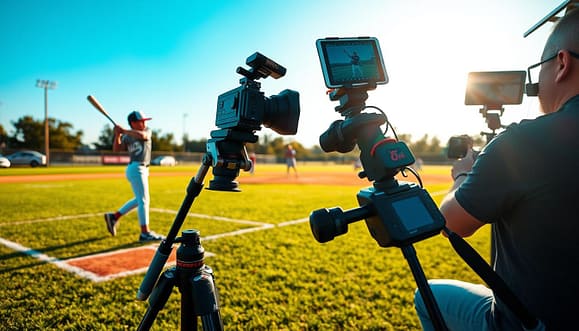
The CSI: Baseball Edition Setup
Setting up your filming is like preparing a crime scene. Instead of solving crimes, you’re helping athletes avoid injuries. The right setup is essential for good data.
For angles, use two cameras: one behind the hitter or pitcher, and another from the side. The rear view shows timing. The side view shows how weight is transferred and how the body extends.
Place cameras at hip level for the best view. Cameras too high or too low can distort what’s happening. It’s like trying to understand a painting from the wrong angle.
Frame Rates: Seeing the Invisible
Standard 30fps video is like watching baseball through fog. You miss important details. For good analysis, you need slow-motion.
Most smartphones can shoot 240fps, which is great for catching small flaws. These include early casting, hip-shoulder issues, or foot problems.
Start recording before the action starts. This way, you catch the setup phase where many problems begin.
Lighting: The Secret Weapon
Lighting is more important than camera quality. Bad lighting causes motion blur, hiding important details. It’s like trying to see in a dark cave.
Record with the sun behind you, not the athlete. Overcast days are best because they provide soft, even lighting. Avoid midday sun for too much contrast.
Indoors, use lights to remove shadows. You want clear footage where every movement is clear. Good footage is essential for accurate analysis.
Remember, quality footage leads to accurate analysis. Bad footage means guessing. Guessing about mechanics is like surgery with oven mitts.
Hitting Checkpoints: The Swing’s Mechanical Poetry
Ever watch a young hitter and wonder if they’re trying to swat flies or hit baseballs? The difference between a powerful swing and a frantic flail comes down to two critical mechanical checkpoints that separate the pros from the pretenders.
These aren’t just fancy biomechanics terms—they’re the secret sauce that turns batting practice into actual hits. Think of them as your swing’s quality control department, working while the pitcher’s trying to make you look foolish.
Pelvis and Torso Separation: The Power Generator
This isn’t some yoga class move—it’s the kinetic chain in action. Proper hip-shoulder separation creates what physicists call elastic energy storage. Translation: it’s how you generate serious pop without swinging like you’re trying to chop down a tree.
Real analysis shows elite hitters achieve peak separation just before foot plant. Their hips fire toward the pitcher while their shoulders stay back, creating that beautiful coil that unleashes devastating power. Poor timing here isn’t just inefficient—it’s an invitation to shoulder and oblique injuries that can sideline a player for months.
The numbers don’t lie: hitters with optimal separation patterns show 15-20% higher exit velocities than those with poor sequencing. It’s the difference between warning track power and actual warning track hits.
Barrel Path: The Swing’s GPS
If pelvis-torso separation is the engine, barrel path is the steering. A proper path allows hitters to cover the entire plate while maintaining the ability to adjust to different pitches. A poor path? That’s like trying to navigate with a broken compass—you might get lucky sometimes, but you’re mostly lost.
Optimal barrel paths stay through the hitting zone longer, giving players margin for error. We’re talking about that sweet, slightly upward plane that drives balls into gaps. It’s what separates consistent hitters from the “once-in-a-while” mashers.
Watch for these red flags: casting (early barrel release), dropping hands, or that ugly loop that makes the bat look like it’s taking the scenic route to the ball. These flaws turn 90 MPH fastballs into weak grounders and make curveballs look like optical illusions.
Mastering these mechanical checkpoints transforms hitting from guesswork to science. It’s not about being robotic—it’s about building an efficient, powerful swing that works when the lights are brightest and the pitcher’s throwing gas.
Pitching Checkpoints: The Three Pillars of Mechanical Excellence
Pitching is like classical ballet, needing every move to be perfect. If you mess up, it’s like watching a train crash. That’s why knowing about mechanical checkpoints is key to avoiding injuries and improving performance.
Stride Length: The Goldilocks Principle
A stride that’s too short means you’re all arm, like throwing with a wet noodle. Too long, and you’re like a gazelle on ice skates. The best length is about 85-90% of your body height for young pitchers.
Why is this important? The right stride length is the base of the kinetic chain. Short striders lose power, forcing their arms to work too hard. Overstriders lose balance and timing, making pitching a struggle.
Trunk Timing: The Spinal Tango
Trunk rotation is like a dance between your hips and shoulders. If you rotate too early, you lose power and accuracy. If too late, your upper body feels like it’s moving through molasses.
The perfect timing is when hips lead shoulders by milliseconds. This creates a whip-like effect. But if you get it wrong, pitching becomes like trying to move a stuck torso.
Deceleration: The Art of Stopping
Everyone focuses on getting the ball fast, but stopping is what separates pros from amateurs. Bad deceleration is like crashing a Ferrari into a wall. All that energy goes into your elbow and shoulder.
Good deceleration means:
- Controlled follow-through across the body
- Gradual energy dissipation
- Balanced finish position
These mechanical checkpoints are more important than how fast you throw. They help you develop a pitcher, not hurt your arm. In youth baseball, the best pitch is the one that doesn’t hurt you.
Translate findings to constraints-led drills
You’ve got biomechanical data that’s impressive. Now, how do you turn it into real improvement? It’s not just about knowing your athlete’s movements. You need to make them better.
Constraints-led training isn’t about making drills harder. It’s about making specific movements easier by removing distractions. It’s like putting training wheels on a bicycle, but these wheels target what your data says needs fixing.
From Data Points to Drill Design
AI analysis gives you tips and coaching cues. Your job is to turn these into sequencing drills that work. The key is to create exercises that force the body to solve the problem itself.
For example, if there’s an issue with hip-shoulder separation, create a drill that prevents over-rotation. Constraints lead to their own solutions.
Here’s how common mechanical issues can be solved with constraint-based drills:
| Mechanical Issue | Constraint Solution | Drill Example | Why It Works |
|---|---|---|---|
| Poor hip-shoulder separation | Limit lower body movement | Kneeling throws | Forces upper body to work independently |
| Early trunk rotation | Delay rotation cue | Pause at stride foot | Builds timing sequence |
| Inconsistent follow-through | Target endpoint | Throw to specific spot | Creates movement pattern consistency |
| Poor weight transfer | Narrow stance | Feet together pitches | Forces efficient energy transfer |
The beauty of constraint-led sequencing drills? They’re self-correcting. Athletes either figure it out or the drill won’t work. It’s like nature’s way of saying “try something else.”
Remember: good constraints feel like solving a puzzle, not running a marathon. The drill should challenge the specific movement pattern, not just exhaust the athlete. If they’re breathing harder but moving the same, you’ve created conditioning – not correction.
Start with one constraint at a time. Fix the biggest issue first, then add more challenges. It’s like eating an elephant – one bite at a time.
Avoid over-coaching and protect growing athletes
Here’s a harsh truth about smartphone analysis: too much data can be a problem. It’s like giving a toddler a Swiss Army knife. Everything seems broken, even when it’s not.
Young athletes are not machines. They are growing humans who need space to develop. They should not be controlled too much. It’s like the saying “first, do no harm” but also knowing when to step back.
The Paradox of More Data
Staring at screens full of metrics can be overwhelming. The irony of smartphone analysis is that it can cause too much thinking. You might forget the most important thing: is the kid having fun?
Here are some key rules when data gets too much:
- If it ain’t broke, don’t biomechanically over-engineer it
- One meaningful correction beats ten microscopic adjustments
- Growth plates trump perfect kinematics every single time
Professional assessments are key for serious issues. Your phone’s sensors are good for spotting trends, not for diagnosing injuries. Always refer to a sports medicine professional when unsure.
When to Step Back
The art of coaching is not just about changing things. It’s also about knowing when not to. Young athletes can self-organize if given the right space and constraints.
Watch for these signs you might be over-coaching:
- The athlete looks more confused after your “correction” than before
- You’re quoting launch angles at dinner instead of asking about their day
- Every movement becomes mechanical instead of athletic
Work within natural constraints, not against them. Let athletes figure things out through play and repetition. The goal is to create adaptable athletes who love the game.
Reporting visuals for parents
If your player analysis looks like a NASA control panel, you’ve already lost the parent audience. They’re not here for your biomechanics PhD – they want to know if little Johnny will need Tommy John surgery before he hits high school.
Great video analysis baseball reporting isn’t about showing off how smart you are. It’s about making complex data easy to understand. Even baseball-illiterate parents should get it in three seconds flat.
The Traffic Light Safety System
Parents understand stoplights, not standard deviations. That’s why we use a simple color-coded system. It’s easy to understand and screams “pay attention here” without needing a textbook.
Green means “keep doing what you’re doing.” Yellow says “let’s monitor this.” Red shouts “we need to address this yesterday.” It’s biomechanics in universal visual language.
| Movement Category | Green Zone (Optimal) | Yellow Zone (Monitor) | Red Zone (Action Needed) |
|---|---|---|---|
| Pelvis/Torso Separation | 25-35 degrees | 20-25 or 35-40 degrees | Under 20 or over 40 degrees |
| Shoulder Rotation Timing | 85-95% of stride phase | 80-85% or 95-100% | Before 80% or after 100% |
| Elbow Position at Release | Within 6″ of optimal path | 6-12″ deviation | Over 12″ deviation |
| Deceleration Pattern | Smooth, controlled stop | Moderate jerking | Violent, abrupt stop |
Before-and-After Magic
Nothing sells progress like visual proof. Overlay this month’s swing over last month’s and suddenly parents see what “improved hip rotation” actually means.
It’s the difference between saying “his kinetic chain improved” and showing two identical frames where one clearly has better sequencing. Visual evidence beats biomechanics jargon every time.
Timestamp Storytelling
Modern AI video analysis baseball tools generate timestamped events with coordinates. Instead of drowning parents in data, we tell stories: “At 0:47, notice how his front foot plants early, creating this chain reaction…”
It turns abstract numbers into concrete moments they can actually see and understand. The coordinates become map points in a journey toward better mechanics and safer play.
Remember: if you can’t explain why early trunk rotation matters in one sentence using a visual, you’re overcomplicating it. Parents want clarity, not complexity.
Periodic reassessment calendar
Timing biomechanical assessments is like checking fantasy baseball stats. It’s best to check in regularly, but not too often. You want to find the right balance.
Baseball biomechanics is a long-term story, not just a snapshot. It’s about an athlete’s growth over time. You need to check in often, not just at the end.
The Rhythm of Progress
We suggest doing assessments every 4-8 weeks. This allows for growth without measuring just fatigue or missing chances to improve.
Imagine having big check-ups every quarter and smaller ones each month. The big ones look at everything. The monthly ones focus on a few key areas.
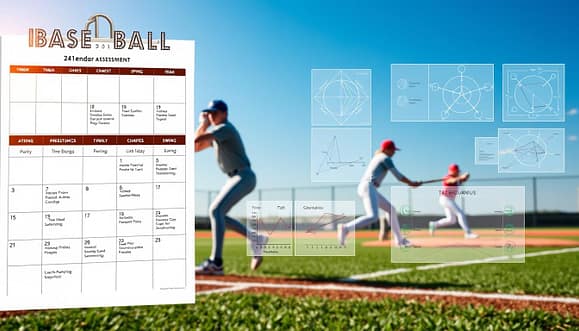
Your first assessment sets the baseline. All future checks compare to this starting point. It’s like the athlete’s biomechanical origin story.
Don’t let a calendar dictate your schedule. Growth spurts, competitive seasons, and rest periods all play a role. Your schedule should match the athlete’s natural rhythm.
This way, you avoid turning every practice into a data-gathering stress. Quality is more important than quantity in baseball biomechanics.
The best insights come from patterns, not single numbers. Regular checks help create these patterns. They turn numbers into stories.
Data privacy and consent
Welcome to baseball’s digital age. Every swing now creates more data than a congressional hearing. We’re collecting kinematic sequence metrics like crazy. But, when working with minors, you need legal safeguards more than a White House press briefing.
It’s like FERPA meets Moneyball. You’re not just tracking hip-shoulder separation. You’re handling sensitive info that could follow these kids for years.
The Consent Conundrum
Parental consent forms should be simple. Explain what you’re measuring, why it matters, and where the data goes. If it’s too complicated, you’ve already struck out.
You’re not like the MLB collecting data for contracts. You’re helping kids improve their swing, not creating a permanent digital footprint.
Storage and Deletion Protocols
Your data storage strategy needs to be as secure as a presidential briefing room. Here’s your plan:
- Local storage only: Cloud storage is for MLB teams, not youth leagues
- Anonymous labeling: Use codes instead of names – think “Player 7” not “Johnny Smith”
- Regular deletion cycles: Data shouldn’t outlast the season. If they’re not playing for you anymore, their metrics shouldn’t be on your device
- Device security: Password protection isn’t optional – it’s your first line of defense
The kinematic sequence data you collect shows mechanical efficiencies. But, in the wrong hands, it could be damaging. We’re talking about kids’ performance metrics, not WikiLeaks material.
The Ethical Analytics Playbook
Your data collection should follow three simple rules:
- Collect only what you need to improve performance
- Explain everything to parents in plain English
- Delete everything when the player moves on
Think of yourself as a temporary custodian of this info, not a data hoarder. The best coaches protect young athletes’ digital wellbeing too.
No one wants to be remembered as the coach who caused baseball’s first data breach. Keep the metrics, lose the liability.
Resource kit and templates
Forget about building a Tony Stark lab. Your smartphone and some smart templates can make motion capture work in real life. We’ve got the basics so you can skip the theory and start doing it.
Filming Protocols Made Simple
Our angle guides turn your phone into a pro camera. It’s like IKEA instructions for biomechanics. Follow the steps and get pro results without spending a lot. Hudl Technique and Coach’s Eye are your new friends.
Assessment Templates That Don’t Suck
We’ve made Google Sheets templates that do the math for you. No more squinting at video to count degrees. These spreadsheets help you focus on coaching while they do the math.
Drill Libraries With Purpose
Every drill in our library fixes a specific biomechanical issue. It’s like a playbook with effective plays. Kinovea’s free software helps analyze movements without costing you a lot.
These alternatives show you don’t need NASA’s budget for great results. Download the kit, start tomorrow, and see your athletes improve fast.