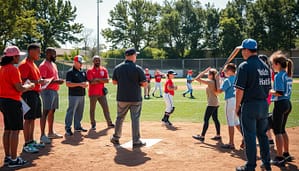
Welcome to baseball’s intellectual revolution. We’re breaking down old hitting myths with science. It’s like Moneyball meets neuroscience for today’s players.
We’re making better hitters through movement analysis and learning with limits. Say goodbye to the “see ball, hit ball” way. We’re bringing high-tech precision to the batter’s box.
This guide turns messy batting practices into precise sessions. We build muscle memory, improve timing, and enhance swing mechanics. Travel coaches will be amazed.
From the first movement screens to game-ready strategies, we create hitters who shine when it matters. It’s not just practice—it’s about making performance better.
Clinic goals and athlete flow
Ever watch a youth hitting clinic and wonder if you accidentally stumbled into a Lord of the Flies adaptation with batting gloves? Most facilities treat hitting instruction like assembling IKEA furniture without the instructions. Our approach is more like conducting a symphony orchestra where every musician knows their part.
Our clinic goals operate on three non-negotiable pillars:
- Biomechanical efficiency that actually produces exit velocity (because pretty swings that can’t dent a watermelon are just athletic cosplay)
- Repeatable timing mechanisms that transform hopeful hacking into calculated contact
- Adaptable approaches that work against real pitchers instead of batting practice pitchers who might as well be serving tea
The athlete flow follows what we call the “Four-I Symphony” – a deliberate progression. It separates our method from the chaotic group training alternatives that dominate the youth sports landscape.
| Phase | Focus | Tools | Time Allocation |
|---|---|---|---|
| Assessment | Movement pattern screening | Slow-motion video + coach observation | 15% |
| Isolation | Individual component work | Mirror drills + resistance bands | 25% |
| Integration | Combining movements | Constraint drills + tee work | 35% |
| Application | Full execution | Live pitching + game scenarios | 25% |
This isn’t just theory – it’s physics. The flow minimizes standing time (that silent engagement killer) while maximizing purposeful swings. We move from individual movement patterns to constrained environments to full batting practice, ensuring each swing has intentionality behind it.
Think of it as the difference between learning scales versus attempting to play Beethoven on day one. The progression creates what neurologists call “chunking” – grouping individual movements into automated patterns that actually hold up under game pressure.
Our athlete flow turns the typical clinic model inside out. Instead of herding cats, we’re conducting precision surgery on hitting mechanics. The result? Kids who don’t just look like hitters – but actually become them.
Quick movement screens for coaches
Let’s face it—most youth hitting lessons are like bad karaoke. Everyone mimics the actions without grasping the meaning. Our movement screens help coaches spot the real deal from those who just shout “swing harder.” We look at the five steps of hitting that even Ted Williams would admire.
These screens aim to find real power, not just look good. We use slow-motion videos and drills with Jaeger bands to focus on each step. This way, we make sure each phase is mastered before combining them.
Teaching Sequence: Posture → Load → Launch → Contact → Finish
This order makes sense, unlike following YouTube trends. Teaching contact before load is like learning calculus before basic math. It frustrates hitters with fancy but useless swings.
Posture Evaluation: We check if athletes are ready to move or just posing. They should be in athletic position but not stiff.
Load Analysis: Here, we see if players store energy well or just look good. Storing energy is more important than looking good.
Launch Assessment: We check if players sequence their swing correctly. This means hips before hands, not a democracy.
Contact Point Analysis: This shows who controls the barrel and who just makes noise. Quality contact is better than loud swings.
Finish Evaluation: We see who commits to rotation and who doesn’t. Completing the swing is as important as starting it.
| Phase | Common Flaw | Quick Fix Drill | Success Indicator |
|---|---|---|---|
| Posture | Over-stiffness | Athletic stance mirror drills | Natural knee bend, relaxed shoulders |
| Load | Decorative rock-back | Resistance band separation drills | Energy stored in back hip |
| Launch | Upper body dominance | Lower half initiation exercises | Hips lead hands by 0.1 seconds |
| Contact | Castling/early extension | Inside pitch recognition drills | Barrel stays through zone |
| Finish | Incomplete rotation | Full follow-through exercises | Back shoulder faces pitcher |
Hitters learn to control their swing at every millisecond. These drills turn them into athletes who can correct themselves. Understanding beats imitation every time.
Our method turns youth hitting drills into smart movements. This leads to consistent hard contact, not just lucky swings.
Tee progressions with constraint drills
Most batting tee setups look like they were put together by beginners. We aim to change that. The humble tee becomes a swing lab with intentional progressions.
Our system starts with middle-middle location work. This is the foundation of your swing’s blueprint. Next, we move to high-away pitches, teaching you to hit opposite field like a pro. Lastly, we tackle inside pitches, making your swing quick and smooth.
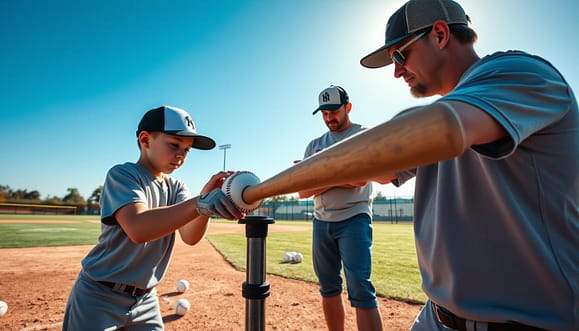
Constraint drills are what separate pros from amateurs. They’re not tricks, but scientifically-designed limits that force you to swing right. We use:
- Two-handed finish drills for barrel control
- Front-foot-only work for weight transfer
- No-stride approaches for rotation efficiency
Each drill targets a specific swing flaw. They’re like personal trainers for your muscle memory.
External vs Internal Cues
Now, let’s settle the coaching debate. Internal cues focus on body parts—”rotate your hips,” “keep your hands back.” External cues use targets—”hit the back of the cage,” “drive through this zone.”
Our brains work better with targets. External cues lead to more natural movements. They’re like giving your GPS coordinates instead of turn-by-turn instructions.
The results are clear. Players get cleaner bat paths and more consistent hits. It’s like going from a choppy river to a laser beam through the strike zone.
| Drill Type | Internal Cue Example | External Cue Example | Primary Benefit |
|---|---|---|---|
| Middle Tee | “Rotate your hips” | “Drive through the center” | Foundation building |
| High-Away Tee | “Keep hands back” | “Hit to right field” | Opposite field power |
| Inside Tee | “Quick turn” | “Pull through this zone” | Bat speed development |
| Constraint Drills | “Transfer weight” | “Push off the ground” | Mechanical efficiency |
The right cues turn your tee work into something amazing. Your bat path becomes more efficient. Your contact becomes more consistent. And your results become more impressive.
Timing and approach games
Most hitting lessons make timing seem like a secret art. We see it as a mix of math and athletic skill. Guessing at 90 mph is as useful as betting on your batting average.
Our drills start with simple tosses and move to fast pitches. The key is learning patterns through practice, not guessing.
We teach the basic visual cue: load when the hand drops, step when the hand comes forward. This is more than rhythm—it’s the base of good hitting. It’s like reading a pitcher’s signals in poker, giving you an edge.
Our drills go from simple to complex:
- Level 1: Soft toss with clear cues (the basics)
- Level 2: Tosses at different speeds (mixing math and muscle)
- Level 3: Fast pitches like in games (the advanced level)
- Level 4: Drills for tough counts (survival skills)
Our approach games turn batting practice into strategic play. It’s like chess, not slot machines. Chess needs strategy; slot machines are luck-based.
We add competition to make hitters think smart. Games reward smart plays, not just hits. Sometimes, a smart out is better than a big hit.
| Game Type | Primary Focus | Competitive Element | Skill Developed |
|---|---|---|---|
| Two-Strike Survival | Foul-off techniques | Most consecutive fouls | Plate coverage |
| First-Pitch Aggression | Early count hitting | Hardest contact reward | Pitch recognition |
| Situational Hitting | Run production | Most RBI simulation | Game awareness |
| Velocity Adaptation | Timing adjustment | Success rate tracking | Adjustment speed |
These games make hitters plan, not just hope. The competition pushes them to adapt, not just repeat. It’s like training for real games, not just practice.
Hitters learn timing is about patterns and plans, not luck. They stop guessing and start predicting. They switch from hoping to strategizing.
Good hitters don’t wait for fastballs. They create chances through prep and pattern recognition. That’s the difference between playing baseball and just guessing.
External vs internal cues
The debate over hitting cues is as heated as any political argument. It pits those who focus on the body against those who focus on the mind. The results are clear.
Internal cues tell you to “rotate your hips” and “keep your hands back.” They turn hitters into thinking machines, focusing on parts of the body. External cues, on the other hand, say “drive the ball through the middle” and “attack this pitch.” They make hitters responsive and problem-solvers.
Our method uses external cues because baseball moves too fast for mechanical thoughts. A 95-mph fastball comes in 0.4 seconds. You can’t think about hip rotation then. You must react or fail.
We focus on outcomes, not processes. We use competitive challenges instead of technical lists. Our approach training follows a logical path:
- Directional hitting (oppo field, pull side, middle)
- Situational approaches (drive runners, move runners, score runners)
- Two-strike survival skills
This isn’t just about swinging. It’s about thinking. It’s the difference between a driver with one speed and someone who knows how to shift gears.
| Internal Cues | External Cues | Resulting Behavior |
|---|---|---|
| “Rotate your hips” | “Drive the ball through the middle” | Mechanical vs Athletic |
| “Keep your hands back” | “Wait for your pitch” | Overthinking vs Reacting |
| “Shift your weight” | “Attack this location” | Body-focused vs Task-focused |
| “Drop your back shoulder” | “Elevate this pitch” | Technical vs Strategic |
The best training makes hitters adaptable and multi-gear. We use drills that force them to solve problems, not just swing. The cue might be “hit line drives to right field,” but the real learning is adjusting to different situations.
External cues make hitters into athletes, not just swing performers. In the battle of body coaching versus mind coaching, the mind wins games.
Simple Metrics (EV, Hard-Hit %, Ball Flight)
Measuring hitting success by batting average is outdated. It misses the real point. Today, we have better ways to see who’s really good at hitting.
Exit velocity tells us the truth about hitting. It’s like a lie detector for baseball. The ball doesn’t care about your feelings or swing looks. Hard contact is key to success at the plate.
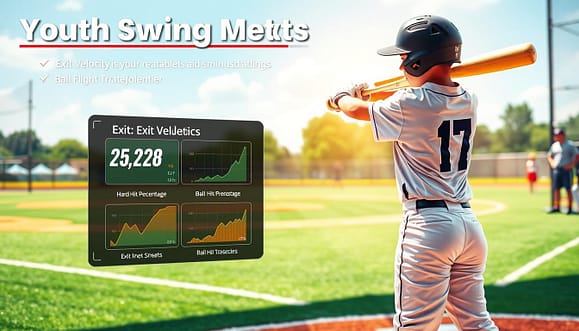
Tracking hard-hit percentage shows real skill. It separates good hits from lucky ones. It’s like getting a trophy for real achievement, not just showing up.
Ball flight analysis is the final piece of our hitting puzzle. It shows if we’re hitting line drives or fly balls. It’s about hitting with purpose, not just power.
We make these swing metrics easy for young hitters to understand. We use:
- Pocket radar units for instant feedback
- Spray charts to see patterns
- Simple data that kids can grasp
These numbers help us teach young players. Low exit velocity youth means they need to work on their swing. Bad spray patterns show they need to adjust their approach. Unpredictable launch angles mean they need to work on timing.
We’re not making little data experts. We’re using facts to help young players improve. This way, we avoid relying on opinions that can be wrong.
The best thing about these swing metrics? They help everyone. Whether you’re a 10-year-old or a high school player, the feedback is valuable. It’s like having a coach who’s always ready to help, every day.
Watching exit velocity youth improve is exciting. Kids love to see their numbers go up. It motivates them to swing with purpose, not just for the sake of swinging.
Station design to reduce lines
Ever watch youth baseball practice and feel like it’s the DMV’s athletic division? The endless queues, the bored faces, the waste of time? We’ve applied industrial engineering to solve baseball’s biggest problem: standing around.
Our batting practice plans turn chaos into order. Each player has a role to play at the same time. No more waiting for your turn like it’s the last pizza at a team party.
- Tee work stations with specific swing goals
- Soft toss stations with different angles
- Front toss stations with changing speeds
- Live batting practice with quick feedback
Each station has an 8-12 minute rotation. This keeps players engaged and gets quality reps. It’s like baseball’s version of interval training – lots of work with little rest.
Our system has clear transition rules. Coaches know what to do at each drill. Players know their goals before they bat. Practice flows smoothly, like a Tokyo subway during rush hour.
| Station Type | Player Capacity | Time Allocation | Primary Focus |
|---|---|---|---|
| Tee Work | 4 players | 10 minutes | Mechanical precision |
| Soft Toss | 3 players | 8 minutes | Timing development |
| Front Toss | 2 players | 12 minutes | Pitch recognition |
| Live BP | 1 batter + catcher | 12 minutes | Game simulation |
The magic is in the transitions. While one group does live batting practice, another does tee work. The rotation keeps going smoothly. No more waiting or watching the clock.
These plans turn wasted time into chances to improve. Players get more swings in 60 minutes than in three old-style practices. Focus stays sharp, so quality doesn’t drop.
Remember, standing around only improves one skill: standing around. Our design makes every minute count for real baseball improvement.
Adjustments for age and maturation
Teaching eight-year-olds like they’re MLB stars is a big mistake. We know that kids grow at different rates. Treating them all the same is like making the same recipe for everything.
For the youngest hitters (6-9 years), we focus on fun and basic movements. It’s like building a foundation before adding details. We use games, short drills, and lots of movement. This keeps them engaged and learning.
For middle age groups (10-13), we add more technical lessons but in a fun way. They learn complex ideas through games and challenges. At this age, they can understand “why” things work, but fun is key.
Older hitters (14+) get detailed biomechanical lessons. Here, we dive into advanced topics like launch angles and exit velocity. They’re ready for more complex training.
Good coaching adjusts for each player’s growth. Early maturers face different challenges than late bloomers. We tailor training to each player’s needs, not just follow a set plan.
| Age Group | Focus Areas | Teaching Method | Success Metrics |
|---|---|---|---|
| 6-9 years | Basic movement patterns, engagement, fun | Games, short stations, high movement | Participation, effort, basic form |
| 10-13 years | Technical foundation, sequence understanding | Challenge-based learning, competition | Consistency, technique improvement |
| 14+ years | Advanced mechanics, metrics, specialization | Data-driven training, individualized plans | Performance numbers, specific outcomes |
This method lets us meet players where they are, not where we wish they were. Treating every hitter the same is like making identical robots. We aim to develop unique athletes.
Parent education and at-home micro-doses
Parental ‘coaching’ often turns into a game of telephone. ‘Keep your eye on the ball’ can become ‘swing like you’re trying to kill it’ quickly. We’ve created a system to help parents become better guides.
Our pre-clinic sessions are not lectures but deep discussions. We spend 15 minutes explaining why we focus on movement quality first. Parents learn that growth is messy before it looks good.
We give parents specific tools to avoid common mistakes. We teach them to look for certain things instead of giving opinions. What to look for becomes more important than what to say.
At-home micro-doses are our secret to fighting information overload. These are not extra workouts but quick reminders of what we learned in clinic. Think of them as mental and physical flashcards for muscle memory.
Our micro-dose menu includes:
- Tee work with specific technical focuses (no random swinging)
- Dry swing drills that ingrain movement patterns without outcome pressure
- Visualization techniques that develop approach more than mechanics
We give clear instructions on how to communicate during home practice. Saying “Swing harder” is not helpful. Instead, we teach parents to use cues that actually help.
The magic happens when clinic lessons and home practice match up. Two hours of quality coaching can’t undo twenty hours of poor instruction. Our program helps make this alignment happen.
Parents become true partners in their child’s development. They stop judging every swing like art critics and start seeing patterns like scientists. This change is both beautiful and helps improve performance.
Staffing, safety, and equipment
Ever seen a youth sports clinic that looked like Lord of the Flies? We’ve set up our operation to avoid that chaos. Our team isn’t just about filling spots; it’s a well-coordinated orchestra of roles.
The lead instructor is like the conductor, setting the pace and direction. Station coaches are like section leaders, experts in their areas. Assistants help with smooth transitions and give each player personal attention. This setup ensures the best coach-to-player ratio, something even Montessori teachers would approve of.
Our safety measures are top-notch. Batting cage procedures are taken very seriously. Equipment checks are done with Swiss watch precision. We keep an eye on everything around us because getting hit by a stray baseball isn’t fun.
We believe in using the right tool for the job. No more gimmicks. Instead, we focus on:
- Age-appropriate bat weights for better swing mechanics
- Quality training aids that show real improvements
- Technology that gives feedback without needing an engineering degree
This approach creates what parents really want: a place where kids can learn without worrying about getting hit. It’s much better than seeing coaches chasing after wild pitches while parents worry.
| Staff Role | Primary Responsibility | Impact on Safety | Player Ratio |
|---|---|---|---|
| Lead Instructor | Overall flow & instruction quality | Sets safety culture standard | 1:20 |
| Station Coach | Domain-specific training | Implements station safety protocols | 1:6 |
| Assistant | Individual attention & support | Preventive accident monitoring | 1:3 |
When staffing, safety, and equipment come together, magic happens. It turns chaos into something parents call “a place where someone knows what they’re doing.” And that trust? That’s the real win.
1-, 2-, and 4-session templates
Think of our templates as blueprints for making better ballplayers. The 1-session version gives you the best of the best. It’s a quick fix for when time is short but results are key.
The 2-session template is the bare minimum for learning. Day 1 finds and fixes problems. Day 2 teaches and makes sure it sticks. It’s not just hoping for the best—it’s a solid plan.
The 4-session plan is the whole package. It starts with the basics, then moves to technique, approach, and application. It’s like our baseball practice plan that turns ideas into action.
Each plan has set times, station changes, and ways to measure success. We’re focused on results, not just hoping. We don’t believe in waiting for miracles. We’re all about making it happen.