Welcome to the big leagues of player development. Here, we’re building athletes, not medical case studies. It’s like Moneyball meets pediatric orthopedics.
I’ve seen too many teenage Tommy John surgeries. It makes me question our baseball IQ. The best youth pitching programs know that command and velocity aren’t enemies.
They’re the yin and yang of lasting success. Places like IMG Academy and U.S. Baseball Academy get this balance right.
They create dominant pitchers who throw hard now. And they won’t be tomorrow’s surgical statistics. It’s not rocket science – it’s smarter baseball.
Safety framework with age-based pitch counts/workload caps
Imagine managing Wall Street like we’ve managed pitch counts. We’d face another big crisis. It’s not about being soft, but smart with young arms.
Research from National Pitching and U.S. Baseball Academy shows we’ve been wrong for decades. Most youth pitching injuries come from chronic overuse, not sudden trauma. It’s like a slow, damaging process.
The pitch count guidelines aren’t random. They’re based on how young arms develop. It’s like how drinking is safer for adults than teens.
Science guides us on how much to pitch:
- 9-10 year olds: 50 pitches max per game, 75 per week
- 11-12 year olds: 75 pitches max, 100 weekly limit
- 13-14 year olds: 75-90 pitches, depending on maturity
- 15-18 year olds: 90-105 pitches, with strict recovery rules
These pitch count guidelines make better pitchers. It’s like investing in arm health, with small steps leading to big gains.
We’re using these rules with precision. Each pitcher has a dashboard for tracking. It’s like Moneyball for kids’ health, and it works.
There are strict recovery times based on how many pitches are thrown. Throw 35+ pitches? Rest for a day. 50+? Rest for two days. It’s simple, based on how our bodies work.
Parents like knowing their kids are safe. Kids stay healthy. Coaches get to work with pitchers who have bright futures. Everyone benefits from pitch count guidelines.
This method would make Bill James proud. It’s not about being soft. It’s about making the most of young pitchers’ futures. That’s worth careful management.
1–4 week camp templates
Creating camp templates is like being a master conductor, not just a garage band guitarist. You’re guiding velocity development through different stages, not just turning up the volume too high.
A one-week camp is like a brilliant sonata—it’s intense and focused. Players often want more after it’s over. Four-week programs are like full symphonies, with each week adding to the overall performance. We aim for growth, not just a quick peak.
IMG Academy shows us how to build skills like musical themes. Week one lays the foundation. The next weeks add complexity while keeping the basics strong. This avoids the problem of peaking too early and then getting worse from overwork.
It’s like Hemingway’s slow build-up, not Michael Bay’s fast explosions. Slow, steady growth is always better than a quick burst.
| Camp Duration | Primary Focus | Intensity Progression | Key Outcomes |
|---|---|---|---|
| 1 Week | Fundamental mechanics | High initial intensity | Immediate skill acquisition |
| 2 Weeks | Mechanics + early command | Moderate build-up | Skill reinforcement |
| 3 Weeks | Command development | Cyclical intensity | Consistency building |
| 4 Weeks | Full pitch design integration | Wave-like progression | Sustainable velocity gains |
Each template follows three key rules:
- Week one never exceeds 70% intensity
- Skill complexity increases as fatigue management improves
- Every session includes measurable velocity development markers
The magic is in how we sequence the progression. We’re not just building arm strength—we’re building athletic smarts. Players learn to use their bodies efficiently and sustainably.
Four-week camps are great for velocity development. They allow for proper loading and unloading, avoiding burnout. The last week often sees 3-5 mph gains that last because they’re built on a solid base, not just a rush.
Remember, templates are guides, not strict rules. Adjust them as needed, but keep the structure that prevents overuse and promotes real growth.
Mechanics Modules: Building the Pitching Machine That Doesn’t Break
Think of pitching mechanics as your personal energy transfer system. It’s like the Tesla of athletic motion, making Elon Musk nod in approval. We’re not making pitching robots. Instead, we’re building efficient human machines that throw hard without breaking.
The magic happens in three core modules that work together like a symphony orchestra. Each section has its solo moment but must harmonize with the others.
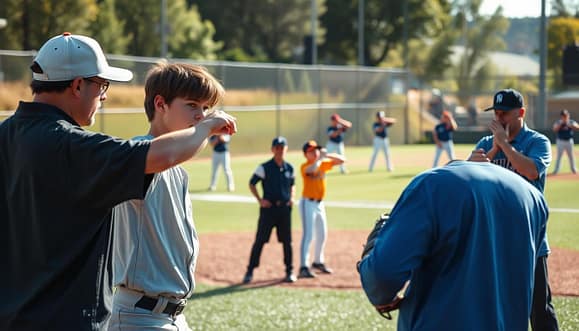
Your lower half is the George Washington of pitching mechanics – the foundation everything else stands upon. Without proper lower-body engagement, you’re trying to build a skyscraper on quicksand.
This module focuses on developing what we call “ground force production.” It’s about how well you can push against the rubber and transfer energy upward. The best pitchers don’t just throw with their arms – they launch from their legs.
Key lower-half drills include:
- Single-leg balance progressions
- Hip-loading sequences
- Drive leg engagement patterns
- Stride length optimization
The Conductor: Trunk Timing Module
If the lower half is your foundation, trunk timing is your kinetic chain’s conductor. This module coordinates the orchestra of movement between your lower and upper body.
Poor trunk timing is like having a Ferrari engine with a bicycle transmission. All that power goes nowhere useful. We work on sequencing – ensuring hips lead shoulders, which lead arm action.
The trunk timing module incorporates:
- Separation drills (hip vs shoulder timing)
- Rotational sequencing exercises
- Core activation patterns
- Kinetic chain synchronization
The Braking System: Deceleration Module
Deceleration is the pitching equivalent of a Ferrari’s carbon-ceramic braking system. What good is generating elite velocity if you can’t control the crash?
This often-overlooked module focuses on what happens after ball release. Proper deceleration patterns reduce arm stress and prepare you for fielding position. It’s the difference between a controlled landing and a crash landing.
Deceleration training includes:
- Follow-through patterns
- Arm deceleration drills
- Lead leg blocking techniques
- Post-release body control
These three modules work together to create what we call efficient energy transfer. When synchronized properly, they produce more velocity with less effort and significantly reduced injury risk.
| Mechanics Module | Primary Focus | Key Benefits | Common Drills |
|---|---|---|---|
| Lower-Half | Ground force production | Increased velocity foundation | Single-leg balances, hip loading |
| Trunk Timing | Kinetic chain sequencing | Improved energy transfer | Separation drills, rotational work |
| Deceleration | Arm stress reduction | Injury prevention, recovery | Follow-through patterns, braking drills |
Proper mechanics aren’t just about performance enhancement. They’re the most effective injury prevention program available. And the best part? This program doesn’t cost extra – it’s built into your command training approach.
When these modules work in harmony, you create what pitching coaches dream about: repeatable, efficient mechanics that produce consistent results. It’s not about being robotic – it’s about being reliably excellent.
The beauty of this system? Improved mechanics directly translate to better command training outcomes. When your body moves efficiently, your pitches find their targets more consistently.
Remember: good mechanics aren’t a constraint. They’re the framework that allows athleticism to express itself fully. They’re the architecture that turns raw talent into pitching artistry.
Command and Basic Pitch Design (FB/CH)
Command in pitching isn’t just about throwing strikes. It’s about creating a mix of deception that makes batters doubt their choices. It’s like the difference between playing simple tunes and complex symphonies. Both use the same tools, but only one leaves everyone in awe.
Fastball command is like the foundation of your pitching. It’s not just about throwing it over the plate. You need to place it where batters can see it but can’t hit it well. The best pitchers use their fastball like a painter uses brush strokes, each one deliberate and building towards a masterpiece.
Changeup design is like psychological warfare on the mound. It’s the unexpected twist in your pitching story, the guest who ruins the party. A good changeup doesn’t just change speed. It changes the whole conversation between pitcher and hitter.
We mix IMG Academy’s specialized bullpen design with National Pitching’s scientific analysis. This blends data insights with the artistic touch that makes great pitchers. We aim to create pitchers who see movement patterns as suggestions, not rules.
The following table shows how different approaches balance the art and science of pitch design:
| Approach | Data Emphasis | Feel Development | Best For |
|---|---|---|---|
| IMG Academy Method | High-tech metrics | Game situation replication | Advanced pitchers |
| National Pitching System | Movement pattern science | Natural arm action | Developing arms |
| Traditional Coaching | Minimal data | Repetition-based feel | Beginner levels |
| Hybrid Approach | Selective metrics | Situation adaptability | Most age groups |
Great bullpen design sessions teach pitchers to read hitter reactions, not just focus on mechanics. The best changeup isn’t the one with the most drop. It’s the one that makes the best hitter look foolish. This requires developing “pitch empathy” – understanding what each pitch feels like and what the batter sees.
We avoid making young pitchers into data analysts who can’t get outs. Instead, we create artists who use data as their palette but feel as their brush. The balance between Trackman numbers and gut instinct is the sweet spot of modern pitching.
Remember: movement patterns suggest, but game situations demand. A pitcher who understands this distinction owns the mound, not just stands on it.
Velocity Safely (Med Balls, Plyos, Sprints by Age)
Velocity development isn’t about making pitching robots. It’s about creating athletes who throw baseballs. It’s like teaching someone to recite Shakespeare versus understanding iambic pentameter.
We mix National Pitching’s methods with IMG Academy’s strength training. We’re not just building arms. We’re making complete athletes.
Medicine balls help build kinetic energy. They teach the body to transfer force from the ground up. But we’re not talking about max-effort throws.
Plyometrics boost explosive power. Box jumps, bounds, and hops work fast-twitch muscles. These movements help with mound explosion.
Sprints work the entire kinetic chain. They make throwers different from pitchers.
Progression is key. A 12-year-old’s med ball work is different from an 18-year-old’s. It’s like giving middle schoolers Young Adult novels instead of War and Peace.
Our training respects biological development. We match intensity to age. Treating developing arms like major league commodities is absurd.
Recovery is part of every session. We train smart, not just hard. Active recovery and rest prevent injuries.
| Age Group | Med Ball Focus | Plyometric Intensity | Sprint Distance | Recovery Emphasis |
|---|---|---|---|---|
| 12-13 years | Light rotational throws | Low box jumps | 10-20 yard bursts | 48-hour rest between sessions |
| 14-15 years | Moderate weighted throws | Medium height boxes | 20-40 yard sprints | Active recovery days |
| 16-18 years | Heavy ballistic work | Max effort jumps | 40-60 yard sprints | Advanced recovery protocols |
The table shows our progression philosophy. Notice how recovery protocols get more intense with age and workload. Younger athletes need more rest.
Older players can handle more advanced recovery techniques. This isn’t one-size-fits-all training. It’s customized athletic development.
Velocity comes from better movement, not forced overload. The body learns to express power naturally through proper movement.
Smart training leads to sustainable velocity gains. It builds pitchers who throw hard because they move better. Not because they’re pushed too hard.
Bullpen flow and feedback loops
If the bullpen were a Broadway show, flow design would be your choreography. Feedback loops would be your director’s notes between scenes. It’s not just a warm-up area; it’s a lab where we perfect pitches and build confidence.
Flow design creates rhythms that mimic game situations without the pressure. It’s like a pacing mechanism that prevents mental fatigue. We’re not just throwing; we’re practicing with purpose.
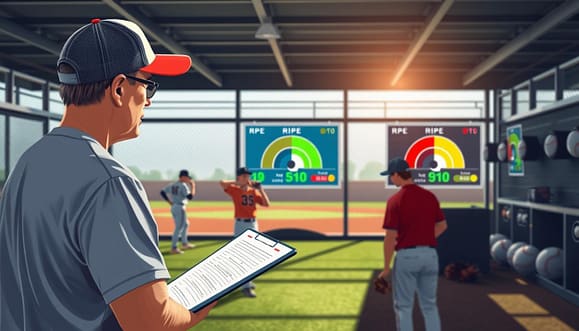
Feedback loops turn subjective feelings into actionable data. That’s where the RPE scale becomes your secret weapon. Instead of guessing if you’re “feeling good,” we use measurable exertion levels.
We’ve mixed IMG Academy’s bullpen management with National Pitching’s feedback systems. The result? Quality repetitions that beat quantity every time. Overuse injuries don’t care about your good intentions; they care about smart practice environments.
Your RPE scale translates between body and brain. It turns “I think I’m working hard” into “I’m at 7 out of 10 exertion level.” It’s not rocket science; it’s just smarter baseball.
Arm care and between-session recovery
While everyone else is binge-watching Netflix, your arm is quietly building its championship season in the background. Recovery isn’t the boring part of pitching – it’s where the real development happens when nobody’s watching.
Think of your body like a high-performance sports car. You wouldn’t put regular gas in a Ferrari, so why treat your arm with anything less than premium recovery protocols? We’ve studied what makes NBA training staffs so effective and applied those principles to young pitchers.
Sleep is your secret weapon. During deep sleep, your body releases growth hormone that repairs muscle tissue and strengthens connective tissues. Aim for 8-10 hours of quality sleep, specially after intense throwing sessions.
Your recovery toolkit should include:
- Consistent sleep schedule (even on weekends)
- Dark, cool sleeping environment
- No screens for at least an hour before bed
Hydration isn’t just about drinking water during practice. Proper fluid balance affects everything from muscle recovery to joint lubrication. We’re talking about strategic hydration that would make a NASA engineer proud.
Active recovery techniques separate good throwing programs from great ones. Light movement increases blood flow to sore muscles without adding stress. Think of it as giving your arm a gentle massage from the inside.
Effective between-session recovery includes:
- Light cardio (walking, cycling) 24 hours after throwing
- Dynamic stretching instead of static holds
- Contrast therapy (alternating heat and cold)
The best throwing programs understand that development happens in the 23 hours between sessions, not just the one hour on the mound. Your recovery protocol shouldn’t look like an afterthought – it should look like something an Olympic athlete would follow.
Remember: Fancy gadgets and magic potions don’t build durable arms. Consistent recovery habits do. Your future self will thank you for treating those between-session hours with the respect they deserve.
Video and simple measurement options
Forget trying to build perfect pitching robots. We’re making self-aware athletes who know their own moves. Video analysis isn’t about finding a perfect mechanical form. It’s about giving pitchers a personal film critic in their pocket.
Without video, you’re lost like someone with a 1987 compass. With it, you have Waze guiding you on your pitching form.
Simple tools become your bullpen’s fact-checker. They help you see beyond “feel-based” opinions. That coach who says your stride length changed? The radar gun and tape measure don’t argue—they show the facts. We’re talking about basic tools here:
- Smartphone video (slow-mo is your new best friend)
- Blast Motion or Pocket Radar for objective feedback
- Simple measuring tape for stride length
- Stopwatch for timing sequences
The magic happens when you mix long toss programs with video feedback. Throw a ball 250 feet, then watch how your body did it. It’s like getting instant replay for your mechanics.
This isn’t about complex analytics. We’re not asking 16-year-olds to do spin efficiency math. We want technology that answers simple questions: “What actually happened versus what I thought happened?”
Integrating long toss with video creates a feedback loop. Feel meets fact. Pitchers get that “aha” moment when they see their video and understand proper acceleration.
Remember, we’re not making data analysts. We’re building pitchers who use information. The tools just make the invisible visible, helping them improve.
The best part? This approach meets players where they are. They’re already recording for Instagram—why not get some mechanical insights too?
So yes, use the technology. But use it wisely. The pitcher who understands his own movement through video analysis? That’s the athlete who owns his development.
Parent communication
Parent conversations can be a game-changer or a major obstacle. I’ve seen many pitching careers ruined by parents who don’t understand the game. The focus on radar guns is like judging a book by its cover – it’s flashy but not meaningful.
We take a page from IMG Academy’s playbook. We turn parents from worried fans into informed allies. By explaining why mound progressions are key, we all benefit.
- Progress Reports that focus on growth over speed
- Injury Prevention Education that shows how today’s care leads to tomorrow’s success
- Conversation Scripts for when parents worry about speed
We give parents “developmental binoculars” to see beyond today’s game. They learn how mound progressions lead to lasting speed, not just quick numbers.
The key is open communication. We make them part of the journey, not just spectators. When they get the why, they become our biggest supporters.
Our sessions cover arm care and the science of mound progressions. We share data and listen to their worries. Sometimes, the best coaching happens in these talks.
Parents learn to value the journey over quick wins. They see that growth isn’t always linear. They trust the process because they understand it.
The best pitching programs are built on trust and shared knowledge. When everyone speaks the same language, growth happens on and off the mound.
Coach staffing and roles
Creating a coaching team for your youth pitching program is not about hiring former pros. It’s about finding educators who know development is a long journey. They understand it’s not a quick sprint, but a marathon with occasional detours.
The best programs work like a well-rehearsed orchestra. Each coach knows their role, timing, and when to lead or support others. Confusion among staff can confuse players faster than a wild pitch reaches the backstop.
Learn from IMG Academy and U.S. Baseball Academy’s coaching structures. You need three main roles that work together like a fastball, changeup, and curveball:
- Mechanical Experts: The engineers who know biomechanics better than their coffee orders
- Tactical Specialists: The strategists who see the game like chess with 90-foot squares
- Mental Performance Coaches: The psychologists who help pitchers deal with the mental challenges of the mound
Your program thrives when these roles work together like a double play. The mechanical expert fixes the delivery. The tactical specialist develops pitch sequences. The mental coach builds resilience against third-inning meltdowns.
You’re not hiring for resumes. You’re hiring for philosophy implementation. A coach who can only repeat your principles but can’t teach them is useless.
Look for educators who ask questions and celebrate small improvements. Find coaches who understand long-term development means sometimes taking steps back to move forward.
The magic happens when your team works with precision like a Broadway show but flexibility like jazz. They need to know the script but also how to improvise when a young pitcher’s mechanics are like a newborn giraffe’s first steps.
Your program’s strength depends on its weakest coach. So, choose staff who complement each other’s strengths and cover each other’s weaknesses. The best coaching staffs are not just teachers—they’re architects building athletes one pitch at a time.
After-camp in-season maintenance plan
Think the camp’s finale means the work is done? That’s like thinking the credits are the best part of the movie. The real show begins when everyone goes home, armed with new skills but facing old routines.
Our maintenance plan follows National Pitching’s development philosophy with IMG Academy’s structured follow-ups. We’re building sustainability, not just flash-in-the-pan improvements. Smart pitch count guidelines become your season-long GPS, preventing development detours.
Remote check-ins keep mechanics sharp without overwhelming young arms. In-season throwing programs sync with team commitments, because nobody needs conflicting coaching voices. Thoughtful pitch count guidelines ensure workload management aligns with developmental goals.
The transition back to games becomes smoother when maintenance is baked in, not bolted on. This isn’t about creating baseball robots – it’s about developing athletes who understand their craft.
Great camps launch rockets. Great maintenance plans ensure they reach orbit. Because in youth sports, the most impressive transformations aren’t measured in weeks, but in seasons.