Let’s start with a radical concept: your workout isn’t about how much you can lift, but how well you can move. I’ve seen many people treat the gym like a competition, focusing on lifting heavy. But they move like a newborn giraffe on ice skates.
The truth? Movement competency is your foundation. It’s the difference between building on solid ground versus quicksand. Adding progressive overload comes second, like adding fancy trim to a house that’s not ready.
Focus on quality patterns before adding speed or resistance. Prioritize proper form over heavy loads. This isn’t just about getting strong. It’s about building athletes who move with purpose and power, not just those who lift heavy while looking awkward.
Readiness and screening by maturation stage
Remember that scene in “The Sandlot” where Smalls couldn’t throw to save his life? That’s what happens when we treat all young athletes like carbon copies instead of recognizing their unique developmental timelines.
Kids aren’t just small adults – their bodies and minds develop in predictable stages that demand different approaches. The 12-year-old who’s hit puberty looks completely different from his teammate. Their training should reflect this biological reality, not some arbitrary calendar date.
Consulting with your child’s pediatrician is vital before starting any strength program. This isn’t bureaucratic red tape – it’s intelligent injury prevention through proper screening. We’re not searching for the next Bryce Harper; we’re preventing the next Tommy John surgery before it happens.
Biological age trumps chronological age every time. Nothing screams “I don’t know what I’m doing” like putting a kid through advanced plyometrics when he’s not ready. Proper screening identifies these gaps before they become problems.
Effective screening focuses on three key areas: movement quality, psychological readiness, and physical maturation. Each requires different assessment tools and informs different programming decisions.
| Maturation Stage | Physical Characteristics | Screening Focus | Injury Prevention Priorities |
|---|---|---|---|
| Pre-Puberty (8-11) | Rapid growth, limb coordination challenges | Basic movement patterns, enjoyment factor | Foundation building, coordination development |
| Early Puberty (12-14) | Growth spurts, awkward movement patterns | Movement quality, strength imbalances | Technique mastery, gradual loading |
| Late Puberty (15-18) | Near-adult physiology, hormone changes | Strength baselines, recovery capacity | Progressive overload, sport-specific training |
The table above isn’t just academic theory – it’s your roadmap to intelligent injury prevention. Each stage demands different screening approaches and different training emphases.
Early maturers might look ready for advanced training but often lack the movement quality to support it. Late bloomers might appear behind but frequently develop better movement patterns that serve them long-term. Screening helps identify these nuances.
Psychological readiness matters as much as physical readiness. The kid who dreads weight room sessions won’t benefit from them, regardless of his biological age. Effective screening assesses both body and mind.
This approach transforms injury prevention from guesswork to science. Instead of crossing fingers and hoping for the best, we’re building athletes who develop properly and avoid the common overuse injuries that derail young careers.
The goal isn’t creating super-athletes by age 14. It’s building durable athletes who peak at the right time – and enjoy the process along the way. That’s what intelligent screening and maturation-aware programming delivers.
Big rocks: hinge, squat, push, pull, carry, sprint
Think of these six movements as your baseball training Avengers. Each brings a unique superpower to the field. They’re not just lifts; they’re athletic translators that convert gym work into diamond dominance.
The Power Generator: Hinge Movements
Your posterior chain isn’t just some anatomical term. It’s the engine behind every explosive swing and powerful throw. Single Leg RDLs teach balance and hip stability while building that critical power pipeline from heels to hands.
Why does this matter? Because baseball is rotation, and rotation lives in the hips. A strong hinge pattern means more bat speed, harder throws, and fewer lower back issues. It’s the difference between warning track power and clearing the fences.
The Foundation Builder: Squat Variations
Goblet squats aren’t just for show. They build the leg strength and mobility needed for explosive starts and stable fielding positions. Think of them as your defensive foundation and batting stance enhancer rolled into one movement.
Young athletes develop proper depth and form without loading the spine excessively. The result? Better fielding range, more powerful jumps at the wall, and cleaner transitions from load to swing.
The Upper Body Balance: Push and Pull
Push-ups and band pull-aparts create the yin-yang of shoulder health. One builds pressing strength while the other reinforces scapular stability. Nobody wants a young pitcher with the structural integrity of a house of cards.
This balanced approach prevents the rolled-forward posture that plagues so many players. It maintains throwing velocity while reducing injury risk. Smart training beats flashy every time.
The Stealth Trainer: Carry Variations
Suitcase carries look deceptively simple but deliver grip strength, core stability, and anti-rotational benefits in one package. They’re the Swiss Army knife of baseball conditioning – multiple tools in a single movement.
Strong grips mean better bat control. Anti-rotational core strength maintains power transfer from lower to upper body. It’s walking that makes you better at everything else.
The Game Changer: Sprint Mechanics
Proper sprint mechanics turn routine grounders into infield hits and doubles into triples. It’s not just about raw speed – it’s about efficient force application that conserves energy while maximizing output.
Quality repetition ingrains proper arm action, knee drive, and posture. The result? Faster home-to-first times and more stolen bases without wasted motion. Because in baseball, tenths of seconds separate safe from out.
| Movement Pattern | Primary Baseball Benefit | Sample Exercise | Progression Tip |
|---|---|---|---|
| Hinge | Rotational power generation | Single Leg RDL | Add tempo pauses at bottom position |
| Squat | Lower body explosiveness | Goblet Squat | Increase depth before adding weight |
| Push | Upper body pressing strength | Push-up Variations | Elevate feet before adding resistance |
| Pull | Scapular stability | Banded Pull-aparts | Decrease band resistance for more reps |
| Carry | Grip and core stability | Suitcase Carry | Increase distance before weight |
| Sprint | Speed efficiency | Acceleration Drills | Focus on technique before intensity |
These six movements form the foundation of baseball-specific strength. Master them first, then worry about the fancy stuff. Because in training as in baseball: fundamentals win games.
Speed and acceleration drills tailored to baseball
Baseball players need a different kind of speed than track athletes. They must be quick in tight spaces and fast from a stand-still. It’s about quick starts and sharp turns, not just running fast.
Baseball requires unique movements that regular speed training doesn’t cover. Infielders need to burst laterally, outfielders to run efficiently to fly balls, and base runners to jump quickly. It’s all about movement science for baseball.
Movement patterns that actually matter
Good baseball speed training focuses on three key areas: quick first steps, lateral bursts, and controlled stops. The best drills are game-like, not track-like. They build the speed and agility needed for the field.
Agility ladders and cone drills are key, but they must be tailored for baseball. We design drills that mimic real game situations. The goal is to improve functional movement, not just footwork.
Med ball throws and quick start drills help players use their lower body power. This creates the explosive energy needed to be fast in baseball.
| Drill Type | Primary Benefit | Equipment Needed | Age Appropriateness |
|---|---|---|---|
| Lateral Shuffle to Sprint | Multi-directional acceleration | Cones, agility ladder | All ages (modified intensity) |
| Secondary Lead Explosion | First-step quickness | Baseballs, bases | 13+ (game situation understanding) |
| Angle Pursuit Drills | Route efficiency and closing speed | Cones, baseballs | 15+ (advanced spatial awareness) |
| Reaction Ball Drills | Quick response and acceleration | Reaction balls, open space | 10+ (all skill levels) |
The best programs mix traditional speed training with baseball-specific drills. Players practice game situations, not just running. This way, they develop the speed and agility needed for the game.
Remember, baseball speed is about playing fast, not just running fast. The drills that matter most are those that help players bridge the gap between athleticism and baseball smarts.
Safe power development: med balls and low-impact plyos
Watching young athletes do high-impact plyometrics is scary and unnecessary. Their bodies are growing and need care, not too much stress. It’s like watching toddlers try parkour.
Medicine balls are great for learning power without hurting joints. They’re light (2-4 pounds) and help build explosive strength safely.
Medicine Ball Mastery for Young Athletes
The med ball slam helps with vertical power and keeps feet on the ground. It’s a controlled way for young athletes to build strength without harm.
Rotational med ball throws improve the power needed for hitting and throwing. It’s a way to build skills while getting stronger.
These exercises help build power without hurting joints. They’re a smart way for young athletes to grow strong without injury.
Low-Impact Plyometric Progressions
Low-impact plyos are a safe start to explosive movements. They teach how to use force without hurting joints.
Begin with two-foot hops in place. Then move to lateral bounds and single-leg hops. But only when you’re ready, not just because it’s time.
This step-by-step method helps athletes get stronger without getting hurt. It’s about building athletes, not breaking them.
The aim is to make athletes better tomorrow than today. Safe power training helps achieve this goal without the need for physical therapy.
Core and anti-rotation emphasis for throwers and hitters
Many people mix up core training with just getting a six-pack. But baseball is about more than looks. It’s about using your body to generate power.
Your core is like a transmission system. It connects your lower and upper body. If it fails, power doesn’t go where it should.
Why Anti-Rotation Beats Six-Pack Obsession
The best players control their rotation, not just make it. They keep their form even when tired. This is because they have strong trunk stability.
Think of a pitch or swing as a chain of energy. It starts from the ground, goes through the hips and core, and ends in the arm or bat. Any weakness in this chain means lost power. Good core stability keeps the energy flowing.
The Anti-Rotation Arsenal
Don’t waste time on endless crunches. These exercises are key for rotational stability:
- Activated Bird Dog: Teaches cross-body patterning while resisting rotation – exactly what happens during throwing and hitting motions
- Suitcase Carry: Forces your obliques and deep core muscles to prevent lateral bending, mimicking the load management of a swing follow-through
- Pallof Press: Creates incredible anti-rotation tension that directly translates to maintaining posture during rotation
- Dead Bug Variations: Develops anterior core stability while maintaining pelvic positioning – critical for power transfer
These exercises help your body resist unwanted motion. They let you rotate explosively where it matters. This is how batting averages rise and fastballs gain speed.
The key to being great is delivering power, not losing it. Serious core stability ensures your energy goes into the baseball, not wasted.
Sample 12-week off-season program by age
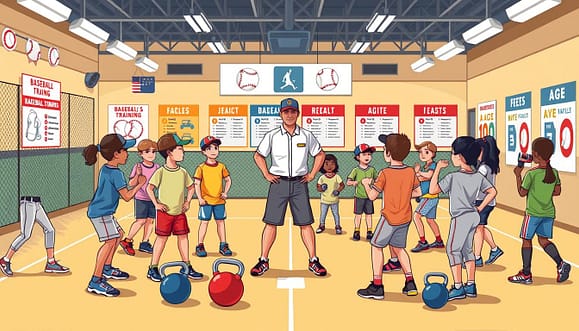
The off-season is like a blueprint for making better athletes. It’s not just waiting for spring training. Each age group needs its own plan, just like different buildings need different blueprints.
Training should match the athlete’s age. Growth isn’t always steady, so the off-season program must adjust.
7-9 Year Olds: Movement Literacy Phase
For young players, it’s all about learning to move. It’s not about heavy weights yet. It’s like teaching the alphabet before writing.
Their weekly plan focuses on mastering bodyweight exercises:
- Monday: Animal movements and coordination games
- Wednesday: Bodyweight squats and push-up progressions
- Friday: Core stability and recovery activities
10-12 Year Olds: Technical Proficiency Phase
At this age, we focus on technical skills and structured workouts. They’re ready for more but need variety.
Weekly plans add more defined patterns:
- Monday: Lower body focus with goblet squats and hinge patterns
- Wednesday: Upper body work with push and pull variations
- Friday: Integrated core and recovery work
13-15 Year Olds: Capacity Building Phase
This age is all about growth spurts. We manage these changes while building strength.
The program balances strength and mobility:
- Monday: Heavy lower body focus
- Wednesday: Upper body strength and power
- Friday: Core anti-rotation and recovery
| Age Group | Primary Focus | Session Duration | Key Exercises |
|---|---|---|---|
| 7-9 | Movement Quality | 30-40 minutes | Bodyweight squats, crawling patterns |
| 10-12 | Technical Mastery | 45-55 minutes | Goblet squats, push-up variations |
| 13-15 | Strength Capacity | 60-75 minutes | Barbell squats, loaded carries |
Remember, it’s about getting better, not just doing more. The best program meets athletes where they are.
This 12-week plan helps athletes grow gradually. It keeps things interesting. Boredom is the enemy of a good off-season program.
In-season microdosing to maintain without draining
Strength coaches turn into mini-pharmacists in the season. They give athletes just enough to keep improving without harm. It’s not about setting new records. It’s about keeping things stable.
Think of in-season lifting like keeping your car running smoothly on a long trip. You’re not doing major repairs at every stop. You’re just making sure everything is fine for the next part of the journey.
The Minimal Effective Dose Philosophy
We aim for the perfect balance of keeping strong and feeling fresh. It’s not about being 100% strong and exhausted. It’s about being 95% strong and only 20% tired. A fresh athlete at 95% is better than a tired one at 100%.
Recovery is key during the season. Warm-ups and cool-downs are not just extras. They’re essential parts of a smart in-season lifting plan.
Here’s what smart microdosing looks like in practice:
- Reduce volume by 50-60% from off-season levels
- Maintain intensity at 70-85% of 1RM
- Focus on movement quality over quantity
- Schedule sessions 48+ hours before games
- Listen to body feedback like a coach listening to pitch calls
Athletes who get this become stars in September. Those who don’t? They’re tired zombies by mid-season, wondering why their stats fell.
Good program design is what sets pros apart from amateurs. Nothing shows a lack of baseball knowledge like a pitcher dominating after a tough leg workout.
Coordinate with skill work and arm care
Strength training and baseball skills are like two stars working together. They’re not rivals; they’re teammates aiming for victory.
When strength training and baseball practice go hand in hand, amazing things happen. You might find that your bat feels lighter. Your throws seem stronger without extra effort. It’s like your car has a secret turbo boost.
The daily dance of drills and dumbbells
Good planning means your heavy lifting days don’t clash with big games. It’s all about timing—mixing intense days with skill days smoothly.
Here’s a weekly plan:
- Monday: Heavy lower body + light skill work
- Tuesday: Arm care focus + batting practice
- Wednesday: Active recovery + defensive drills
- Thursday: Upper body strength + controlled throwing
- Friday: Power development + game simulation
Arm care isn’t optional—it’s insurance
Young pitchers shouldn’t treat their arms like rental cars. That’s how injuries happen. Good arm care keeps them playing.
Make sure to include these in every practice:
- Band pull-aparts between batting rotations
- Shoulder stabilization drills during water breaks
- Wrist strengthening while reviewing game footage
The best programs blend strength training into baseball practice. Your gains should boost your field performance, not just be separate achievements.
When strength, skill work, and arm care come together? That’s when training becomes real. The difference is huge—it’s the leap from just showing up to truly performing.
Equipment tiers from bodyweight to full weight room
You don’t need a fancy college weight room to become a baseball star. Some of the best training for young athletes uses simple, affordable equipment. The secret is knowing how to use it well.
Coaches often focus on expensive machines but overlook the value of a resistance band. The right equipment depends on the athlete’s level and needs, not just its price.
The Minimalist Setup: Bodyweight Brilliance
Bodyweight exercises are key for young baseball players. They help athletes learn movement patterns without extra weight. This lets them focus on proper form first.
Push-ups strengthen the chest for throwing. Squats boost power for batting. Planks improve core stability. And the best part? You don’t need any special equipment.
The Progressive Overload Package: Bands and Light Weights
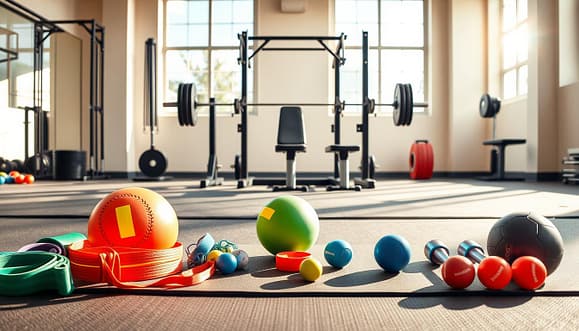
Once athletes master bodyweight exercises, resistance bands are a great choice. They offer more challenge without harming joints. This is perfect for growing athletes.
Band-resisted squats and rotational exercises enhance hitting power. Shoulder exercises with light weights protect and strengthen throwing arms. Remember, it’s about quality, not quantity.
Older youth athletes might use light dumbbells (5-15 pounds). These are great for loaded carries and single-arm exercises. Always choose quality over quantity.
The Full Arsenal: Weight Room Access
For more mature athletes, barbells and machines can be useful. It’s not about lifting as much as possible. It’s about building specific strength for baseball.
Squat racks and bench presses boost power and strength. Deadlifts improve hitting and fielding power. But always use these tools under expert guidance to avoid injury.
Supervision and careful progression are key. These tools are powerful but need proper use to help athletes perform better on the field.
| Equipment Tier | Age Group | Key Exercises | Cost Estimate |
|---|---|---|---|
| Bodyweight Only | 8-11 years | Push-ups, Squats, Planks | $0 |
| Bands + Light Weights | 12-14 years | Band Resisted Rotations, Light Dumbbells | $50-100 |
| Full Weight Room | 15-18 years | Barbell Squats, Bench Press, Deadlifts | Gym Membership |
The right equipment progression matches athletic growth. Start with bodyweight exercises to build movement quality. Then, add resistance bands for more challenge. Use full weight rooms only after mastering basic patterns.
It’s not about the equipment itself but how it’s used. A well-planned training program with minimal gear beats expensive machines any day.
Your budget doesn’t define your success. What matters most is your knowledge. Invest in learning first, then in equipment. Your athletes will see better performance and fewer injuries.
Culture and safety: spotting, supervision, progression rules
The weight room is where dreams are made or broken. It’s not just about personal records. It’s about building a career. The culture you create is more important than any training plan.
Safety goes beyond just having spotters. It’s about creating a place where proper form is praised and reckless lifting is frowned upon. It’s about being professional, not just a weekend athlete.
The Art of Intelligent Supervision
Supervision means more than just watching. It’s about noticing small changes in form. It’s about seeing when someone is lifting too much.
Good coaches don’t just spot weights. They spot problems before they become injuries. They know the most important thing is their attention and the culture they’ve built.
Progression Rules That Actually Work
Progression rules are not just suggestions. They are the safety nets that prevent young athletes from overdoing it. We’re not just training weightlifters. We’re preparing baseball players for the future.
A smart progression system looks like this:
| Level | Technique Standard | Weight Increase | Supervision Required |
|---|---|---|---|
| Beginner | Master form with PVC pipe | No increase until form perfect | Constant visual supervision |
| Intermediate | Consistent technique under fatigue | 5% max weekly increase | Spotter on all compound lifts |
| Advanced | Perfect technique at 85% 1RM | 2.5% max weekly increase | Coach present for max efforts |
Building a Safety-First Culture
Culture is more important than any training plan. A culture that values safety is key. Without it, you’re building a place that’s more likely to hurt than help.
The best weight rooms share three key traits:
- Technique is celebrated more than weight moved
- Athletes police each other’s form
- Coaches value safety over ego
We’re not training for trophies. We’re training for October baseball. The culture you build today will determine who’s left standing when it counts.
Track strength KPIs that transfer to on-field play
If you’re not tracking important metrics, you’re just guessing. Hope isn’t a good training plan.
The right KPIs focus on how strength translates to the field. Does throwing a med ball fast relate to hitting the ball hard? Does squatting deeper help your swing power?
Analytics and athletics come together here. We celebrate faster fastballs and longer hits, not just weight room records.
Training benefits include faster throws, more powerful hits, and better movement. Track your progress by gradually increasing weights and reps.
Games aren’t won in the weight room. They’re won on the field. Your training should reflect that.