Most preseason events are chaotic. They seem like a mix of scrimmages, focusing more on using up Gatorade than anything else.
But we can improve. Imagine this as a strategic gathering, not just a preseason jamboree. It’s a chance to gather baseball intelligence in a fun way.
Your goal is to create an event that boosts three key areas. Coaches should make quick decisions, players get quality practice, and the staff gets useful feedback. It’s like the difference between a casual jam and a well-planned album.
By using the structured review methods of top programs, we see this day as a key starting point. It’s about setting a clear direction for the season, not just about hard work.
Goals of a Jamboree
A jamboree is more than just playing games. It’s a chance to test your team’s skills and make important decisions. It’s not about winning a trophy. It’s about learning, testing limits, and building instincts.
Your goals should be clear, measurable, and honest. Inspired by Rugby Canada, we focus on three key areas.
First, Decision Speed. This is about quick thinking during games. Can your shortstop make a fast throw while a runner is coming? Can your coaches make quick decisions during a game?
It’s like a rugby player looking for a gap while avoiding a tackle. Your athletes need to read and react fast. The jamboree puts pressure on them like no practice can.
Rugby Canada says being good under pressure is key. Successes and challenges here help figure out who can handle the pressure.
Second, Quality Reps. We’re not just counting swings. We want high-intensity, game-simulated repetitions.
It’s like the difference between scrolling social media and reading a book. One numbs you, the other sharpens your mind. Every at-bat and fielding chance should feel like a real game.
This builds muscle memory for big game moments. It’s about quality, not just how many times you do something.
Third, Empirical Evaluations. Move from “he looks good in BP” to “he went 2-for-4 against live pitching.” The jamboree is your chance to see players in real action.
This is about finding talent in its purest form. Just like Rugby Canada, your notes should be based on real performance, not just looks.
Was that double a lucky hit or a solid line drive? Did the pitcher handle a tough situation well? Your evaluations are key to shaping your season. It’s a reality check.
Together, these goals turn a simple event into a strategic tool. You’re not just playing ball. You’re running an experiment where every inning is a chance to learn, and every player is a key player.
Choosing Format: Round Robin vs. Timed Games
Before you schedule games, you must decide: do you want a fair vote or a precise schedule?
This choice is key for your scrimmage festival. It determines the day’s flow. Make the wrong choice, and you’ll face chaos. Make the right one, and you’ll manage a smooth event.
The Round Robin is the classic choice. It’s like a fair election in sports. Every team plays every other, and a winner is crowned. It’s seen as fair and traditional.
But, it has a flaw. A long game can ruin the schedule. It takes time away from other games, focusing on the winner.
The Timed Game is the opposite. It’s like a well-oiled machine. Games end after a set time, like 75 minutes, or a certain number of innings.
This format is about balance. It ensures each team gets a fair chance. It’s like a controlled workout.
This approach is smart and safe. It follows rules to keep athletes safe. For example, the KSHSAA has rules for practice times and rest.
This thinking also guides the timed-game format. It helps protect pitchers and athletes. It’s not just about playing games; it’s about a controlled test.
| Feature | Round Robin Format | Timed Game Format |
|---|---|---|
| Primary Goal | Crown a champion; feel of a tournament. | Maximize controlled reps for all teams. |
| Time Management | Unpredictable; one long game disrupts all. | Precise; the clock is the ultimate boss. |
| Pitcher Workload | Harder to control; competitive drive takes over. | Easier to mandate and monitor. |
| Best For | Traditionalists, end-of-event bragging rights. | Evaluators, player safety, maximum efficiency. |
So, which do you choose?
Go for the round robin if you love tradition and a clear winner. Your day will have a storybook feel.
Choose timed games if you want data and safety. It’s for those who value efficiency over romance.
Your choice shows what you value most. Do you want a single game’s story or the health of the scrimmage festival? The clock is waiting.
Station Rotations for Skill Reps
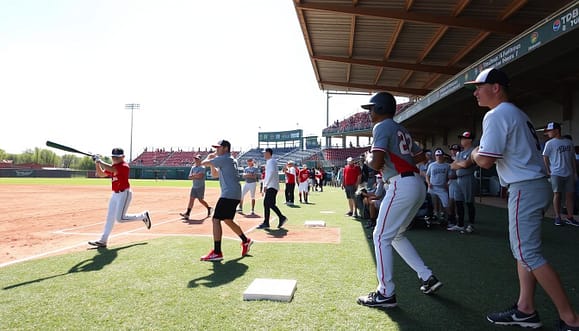
Imagine a Chautauqua of core skills: a lively circuit of drills that turns extra space into a baseball IQ lab. While timed games take center stage, these station rotations are the intellectual highlight. They’re like organized walkthroughs, inspired by the KSHSAA journal’s teaching guide. It’s a chance to practice without the pressure of a real game.
The game is the ultimate test. Stations are where you study. Your aim is to improve skills like ground balls or stolen bases, not just to keep players busy. This turns idle time into valuable learning.
Make each station clear and focused. Avoid vague tasks like “take some cuts” or “field some grounders.” Every action should answer a specific question. What does your BP station aim to achieve? Is it mastering hit-and-run plays or hitting the ball to the opposite field?
Defense stations should mimic game situations. Roll balls isn’t enough; create high-pressure scenarios with live runners. Practice bunt defenses and first-and-third rundown situations to build instinctive decision-making.
Baserunning stations test players’ smarts, not just speed. They learn to read a dirt-ball steal or understand tagging up on a fly ball. Use drills like “no man’s land” to see who thinks on their feet.
- Focus Over Volume: It’s better to do 10 perfect reps than 30 sloppy ones.
- Live Elements: Add a pitcher, catcher, or runner to make drills more realistic.
- Immediate Feedback: Coaches should correct mistakes right away, making each rep a lesson.
- Clock Management: Keep each station short, 12 to 15 minutes, before moving on.
| Station Type | Primary Focus | Sample Live Drill | Key Metric to Capture |
|---|---|---|---|
| BP Stations | Situational Hitting & Contact Quality | Oppo-Field Hitting vs. Shifted L-Screen | % of balls hit to target zone; Hard-hit rate |
| Defense Stations | Pressure Decision-Making & Execution | First-and-Third Rundown Drill with Live Runners | Seconds to complete play; Correct decision % |
| Baserunning Stations | Instincts & Risk Assessment | Dirt-Ball Read & Steal Attempt | Successful steal %; Lead distance at pitch release |
This method does more than fill time. It creates a festival within the festival. It’s not just drills; it’s an audition for key moments in the season. The data collected here is often more telling than game results. It’s where your team’s depth chart begins to take shape.
Pitch-Count and Catcher Workload Policy
Your event’s success depends on a key document: the workload policy. Forget the idea of pushing players too hard too fast. We follow the KSHSAA’s football heat rules, which are all about safety and gradual exposure.
We don’t rush from no activity to full games in one day. It’s the same with baseball. We don’t jump from off-season to full effort right away.
This is where your event shows its true colors. Without a strict pitch-count policy, it’s not worth it. We’re building muscle, not causing harm. Our goal is to increase reps, not risk injuries.
Set a limit on pitch counts—like 15, 20, or 25 pitches per game. Make sure everyone knows about it. Then, enforce it like a casino pit boss watching the blackjack table.
Make sure there’s enough rest between games. This careful plan helps build strong velocity later, not exhaust it now. Learn more about building healthy velocity here.
Don’t overlook the catcher workload. They’re in a squat, catching foul tips, and making throws all game. Your policy must include inning limits or breaks for them. It’s just as important as wearing protective gear.
Why focus so much on this? It shows everyone that player care is key. Enforcing pitch count and catcher rules means you’re looking out for the long term, not just the game.
Use a gradual approach to pitch counts. Start slow and build up. This isn’t being weak. It’s being wise. It shows your program values long-term growth over quick wins.
Schedule Builder and Field Flow
Creating the day’s schedule is like choreographing a dance. Every move must be perfectly timed. A skilled schedule builder keeps everything running smoothly.
It’s not just about listing game times. You’re building an entire system. You need transition time, official activities, and team prep. For example, a game ending at 10:45 AM on Field A must allow the next team to warm up.
Buffer zones are essential. Add ten minutes between each activity. This allows for extra time for pitches, meetings, and moving players and gear. Without it, you’ll face chaos.
| Time Block | Field 1 | Field 2 | Transition Activity | Buffer Zone |
|---|---|---|---|---|
| 9:00 – 9:50 AM | Team A vs. Team B | Pitching Station | Team C to LF Warm-up | 9:50 – 10:00 AM |
| 10:00 – 10:50 AM | Team C vs. Team D | Team A vs. Team B | Team B to Bullpen Cool-down | 10:50 – 11:00 AM |
| 11:00 – 11:50 AM | Team E vs. Team F | Team C vs. Team D | Catcher Rotation to Station 3 | 11:50 – 12:00 PM |
This table is more than data; it’s a detailed plan. The transition activity column is as important as the games. It answers the “what next?” for everyone.
Field flow is like the stage directions. You need to create paths for teams to move safely. Where does a team go after a game? Where does the next team warm up?
Be as detailed as the VHSL handbook. Don’t just say “warm up over there.” Say: “After your 10:15 AM game on Field B, proceed to the designated bullpen area behind the left-field fence for your pitcher’s cool-down and catcher rotation.”
Plan your field like a heist movie. Mark important areas and paths. This helps keep everything organized.
When your schedule builder and field flow plans work together, magic happens. Chaos turns into a smooth, predictable flow. Players get their practice, coaches get their feedback, and you get to enjoy the show.
Umpire/Volunteer Assignments & Briefings
Your umpires and volunteers are the heart of your event. They’re not just helpers; they’re the key to making your plans work. Treat them with the respect they deserve from the start.
It’s important to give clear assignments early. This is the foundation of good umpire coordination. Make sure everyone knows their role, like who’s handling the scoreboard or keeping players hydrated. Clarity is key to a smooth event.
Think of it like a contractor needing a blueprint. Your team needs a clear plan. Send out a detailed document a few days before. It shows you value their time and are organized.
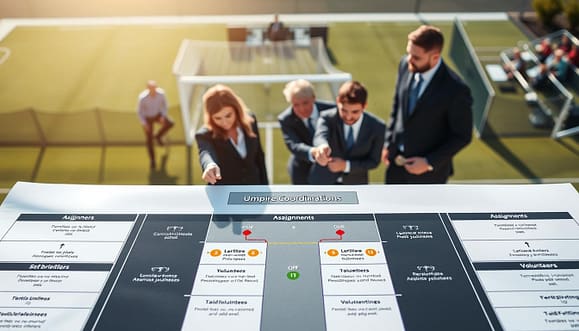
The briefing is like your launch code. Follow the KSHSAA’s “Pre-Activity Time-Out” guidelines. This is your chance to check everything before the game starts. Get all umpires, volunteers, and key staff together.
Discuss everything important. Go over the schedule, field layout, and rules. Make sure everyone knows where the first-aid kit and AED are. Also, review the plan for evacuating in case of lightning.
Also, talk about how you’ll communicate. Will you use a group text or walkie-talkies? Who’s in charge? A well-informed team is a strong team. An unprepared team can cause problems.
Good staff coordination makes your event run smoothly. It’s the difference between a successful event and a disaster. For more tips, check out official league resources for helpful guides and protocols.
Data Capture: Checklists, Timed Drills, Notes
Leaving the field without data is amateur. Professionals collect evidence. With every swing and throw tracked, relying on vibes is outdated. Data capture connects what we see to what we can do.
The Kansas State High School Activities Association requires online concussion reports. This isn’t just rules; it’s a way to gather safety data. Their FAQs document holds valuable knowledge. Baseball needs this approach too. Your games are a chance to gather data.
The Checklist: Your Anti-Chaos Protocol
Chaos hinders evaluation. A checklist fights against it. It’s not for shopping. It’s a plan for station completion and equipment checks.
Did every pitcher do their bullpen? Check. Were fungos hit for infield drills? Check. Is the radar gun ready? Check. This tool stops forgotten moments. It makes plans happen.
Timed Drills: The Objective Truth Serum
Gut feelings are unreliable. Stopwatches are not. Timed drills at stations offer objective metrics that cut through bias.
- 60-yard dash: Pure speed. No debates.
- Catcher pop time: From glove to glove. The clock is the scout.
- Infield to first: For that slow roller. How quick is the transfer?
This isn’t about shaming players. It’s about setting standards. That kid who looks slow might be quick. The data reveals the truth.
| Drill | Average HS Time | Elite Target | Primary Measurement Tool |
|---|---|---|---|
| 60-Yard Dash | 7.2 – 7.5 seconds | Sub 6.9 seconds | Laser Timer / Hand Stopwatch |
| Catcher Pop to 2B | 2.1 – 2.3 seconds | Sub 2.0 seconds | Stopwatch (Glove to Glove) |
| Infield Charge & Throw | 4.0 – 4.3 seconds | Sub 3.8 seconds | Stopwatch (Ball Hit to 1B Catch) |
| OF Relay to Home | 4.5 – 5.0 seconds | Sub 4.3 seconds | Stopwatch (Catch to Catcher Tag) |
Structured Notes: From Ramblings to Searchable Assets
Not all data is numbers. Observations are valuable. But “Player looked good” is vague. You need a system for coaches notes.
Use a shared digital doc or clipboards. The goal is structure. Force a format:
“Player X: Showed plus arm strength from OF in relay drill; struggled with backhand slow roller at 3B; had two competitive ABs with a line-drive out to RC.”
See the difference? You’ve made your notes searchable. Later, when making your depth chart, you can find all players with “plus arm” from the outfield. Your notes become valuable, not just a diary.
So, capture everything. Checklists ensure events run smoothly. Timed drills give you numbers. Structured notes add context. Together, they turn a day of baseball into a detailed player evaluation report. Don’t just watch; document it.
Heat/Hydration and Lightning Plans
Your heat and lightning plans are like your event’s immune system. They’re vital but often unseen until needed. It’s not about rules; it’s about making sure everyone can have fun. The KSHSAA requires a Emergency Action Plan (EAP) to keep everyone safe.
Heat is a slow burn. Your hydration plan can’t just be a water cooler. It needs to be more like the KSHSAA’s acclimatization plan. It’s not optional.
Water breaks should happen every 20-30 minutes. Have shaded areas for rest. And don’t forget a cooling station with cold towels and ice packs. A kiddie pool for quick leg cooling is a must.
Coaches and volunteers need to know the signs of heat issues. It’s not about being a doctor; it’s about knowing the basics. Your safety plan turns panic into action.
Lightning is sudden and dangerous. Your plan should be quick and automatic. If you see lightning, count to 30 before starting again. Everyone must be in the storm shelter before ten seconds pass.
This shelter is a specific, safe place. It’s where everyone goes when there’s lightning. The KSHSAA says to have a plan and share it. This way, there’s no debate or risk of tragedy.
Break your safety plan into two parts. The table below is your guide.
| Plan Component | Heat/Hydration Protocol | Lightning Protocol |
|---|---|---|
| Primary Trigger | Temperature & Humidity Index (Check local weather) | Visual sighting of lightning or audible thunder |
| Immediate Action | Call for mandatory water break. Move athletes to shade. | Sound air horn/alert. Announce “SEEK SHELTER NOW.” |
| Designated Safe Zone | Shaded rest area & cooling station with towels/pool | Pre-identified sturdy building (e.g., gym, concrete restrooms) |
| Post-Event Reset Rule | Wait until core body temps normalize (approx. 30 mins in shade) | Wait 30 minutes from the last observed lightning flash/thunder |
| Communication Duty | Station manager monitors athletes for signs of illness | Event director monitors weather radar & restarts clock |
This table is your guide. Print it, laminate it, and share it. A good safety plan is invisible but always working. It makes your event safe and smooth.
Good communication is key. Brief everyone at the start. Show them where the cooling station and storm shelter are. This turns your plan into a culture. It’s what makes you a responsible host, not just lucky.
Post-Event Eval Meeting + Depth Chart Update
The final out is recorded. The dust settles on your meticulously planned scrimmage festival. The real work starts now.
Think of the post-event eval meeting as your director’s commentary. Hold it within 48 hours, while memories are raw and impressions are sharp. We’re not doing a victory lap. We’re conducting a forensic audit, Rugby Canada-style. Their annual reports don’t shy from honest reviews of successes and challenges. Neither should you.
What was the masterpiece? Maybe the station rotations delivered insane reps. What was the blooper reel? Perhaps the transition to the BP cages caused a pedestrian traffic jam worthy of a city sidewalk. Did the umpire coordination hold up, or did it devolve into a game of telephone?
This honest reckoning has one tangible output: the depth chart update. This is where you synthesize every checklist, every timed drill result, every scribbled note from the scrimmage festival — much like the analytical storytelling found in classic baseball literature. Players move up, down, or sideways based on live evidence, not preseason hype.
The festival was the live-action experiment. The updated chart is your published findings. It transforms a fun day into the foundational document for your entire preseason strategy. The scrimmage festival is over. Your real season begins.