Let’s talk about youth development. Too many coaches treat kids like they’re just parts of a machine. They forget that kids are growing and need to adapt.
Elite hitters have one key skill: adjustability. They change their attack angle based on where the ball is coming from. It’s like they’re playing a game of chess, always ready for the next move.
Why is this important? Baseball is fast, happening in just milliseconds. A player who can change their swing from -5 to +15 degrees? That’s the difference between a ball going up and a ball going straight.
We’re not making robots. We’re teaching kids to solve problems and use their bat speed youth skills wisely. It’s about being smart, not just strong.
The future is for hitters who can adjust, not just the strongest ones. It’s about being smart and adaptable.
Lower-half and posture fundamentals
What makes a Ferrari different from a Ford Pinto in baseball? It’s all about the foundation. The lower half is like the engine of the swing. Posture at launch is like the transmission, making power flow smoothly or getting stuck.
Poor posture at launch is like racing the Daytona 500 with the parking brake on. Studies show that good posture at contact leads to better swing angles. The right hip hinge is key for rotational acceleration.
Think of it like golf versus baseball. Good posture gives you power and balance. It’s about having a wide base and a strong hip hinge.
The best hitters form a “power triangle” with their body. This includes bent knees, a hip hinge, and a tilt in the spine. It’s like poetry in motion when done right.
Here’s what makes pros different from amateurs in posture at launch and rotational acceleration:
| Posture Element | Optimal Position | Common Fault | Result on Contact |
|---|---|---|---|
| Hip Hinge/Torso Tilt | 15-25 degrees forward | Upright or over-hinged | Poor power transfer |
| Back Leg Position | Long with slight bend | Straight or collapsed | Limited rotation |
| Knee Flex | Athletic bend (both knees) | Straight or stiff | Reduced ground force |
| Spinal Angle | Maintained through rotation | Early extension | Weak contact |
Getting this right isn’t about being a yoga master. It’s about starting rotational acceleration from the ground up. The data shows that proper posture at launch turns strength into speed.
It’s like driving a Ferrari with the top down versus pushing it uphill. Your choice, slugger.
Barrel path, plane, and attack angle ranges
Think swing mechanics are a one-size-fits-all equation? Think again. The data shows hitting is more like jazz improvisation than a classical symphony. And the numbers back it up.
The Geometry of Impact
Vertical attack angles go up as the contact point moves further out front. Horizontal attack depends on both impact location and bat angle. It’s a mix of physics and art.
High pitches need flatter bats at contact. Low pitches require more vertical approaches. The best swing plane changes with the pitch.
Great hitters are like skilled pilots, adjusting their approach. They know the whole attack angle spectrum, not just one path.
The best part? There are many ways to hit well. It’s not about finding one perfect swing. It’s about mastering the adjustments.
Timing windows and variability drills
Ever wonder how great hitters seem to move in slow motion? They’re not always quicker; they just know how to use time better. Coaches often focus on mechanics, but the real secret lies in those tiny moments between seeing the pitch and swinging.
Studies show that overload-underload training does more than build strength. It changes how our brain and body work together. That 9.5% boost in bat speed isn’t just about muscle size. It’s about learning to react faster and adjust swings quicker.

The Science of Temporal Training
Temporal training is all about playing with time to improve hitting. The best hitters aren’t just fast; they’re skilled at predicting and using early signs to gain time.
Imagine hitting is like improv comedy, with a 95mph fastball as your partner. You can’t pause when the punch is coming at you.
Here’s why variability drills are so good:
- They help adapt to different pitch speeds
- They teach the body to spot timing windows quicker
- They build neural paths for quicker adjustments
- They stop overthinking that messes with timing
Practical Drills for Expanding Timing Windows
The trick is to mix things up in a controlled way. It’s not just about throwing different speeds. It’s about creating challenges that make you better at timing.
Try these drills to get better:
- Controlled stride sequencing – Work on moving smoothly without rushing
- Variable toss drills – Mix fast and slow pitches in the same set
- Recognition training – Use colored balls or calls to make quicker decisions
- Overload-underload bat rotations – Switch between heavy and light bats during drills
The magic is in learning to handle different timing windows at once. It’s not just about reacting; it’s about predicting and adjusting fast.
Being early is something you can adjust to. Being late is a big problem. The goal is to be smart with time, not just fast.
What to measure and how with simple tools
Forget about spending like NASA. The real magic is in knowing which numbers matter. I’ve seen coaches outsmart teams with just an iPhone video, beating $20,000 gadgets. It’s all about measuring the right things, not everything.
The four angles that tell the real story
Vertical Attack Angle (VAA) and Horizontal Attack Angle (HAA) show how your bat meets the ball. Vertical Bat Angle (VBA) and Horizontal Bat Angle (HBA) reveal your bat’s exact position at impact. These angles are the heart of hitting analysis.
You don’t need fancy tech. A smartphone on a tripod and free apps can give you top insights. The trick is knowing what to look for in the footage.
| Metric | What It Measures | Ideal Range | Simple Measurement Tool |
|---|---|---|---|
| Vertical Attack Angle | Bat’s upward/downward approach | +5° to +15° | Slow-motion video |
| Horizontal Attack Angle | Bat’s inside/outside approach | -2° to +2° | Side-view video |
| Vertical Bat Angle | Bat tilt at contact point | Varies by pitch | Pause video at contact |
| Horizontal Bat Angle | Bat direction at contact | Toward center field | Overhead view video |
Performance metrics without the price tag
Exit velocity shows how hard the ball flies off the bat. Pocket radars under $200 give you pro-level numbers. No more wondering about raw power.
Launch angle becomes easy to estimate with bat angles and ball flight. You’ll spot patterns that hint at success.
Bat speed is important, but context is key. A 70mph swing that hits the sweet spot every time beats an 80mph swing that misses. Quality beats quantity every time.
The real skill is linking these numbers to actual results. That’s where coaching smarts kick in. It’s not just about having numbers. It’s about understanding what they mean for each hitter.
Individual Differences (Stance, Hand Set, Stride Styles)
Hitting a baseball isn’t the same for everyone. It’s like jazz, where the basics stay the same, but each person adds their own twist.
Top hitters show big individual differences in how they set up. Some look like they’re waiting for a bus, others like they’re ready to jump. Yet, they all stick to the basic rules.
The Stance Spectrum
Every MLB game shows a wide range of starting positions. Some hitters open up, others close in. Some bend low, others stand straight. But they all balance equally before swinging.
Think of stances as personal marks. Ichiro has a wide base, Judge stands tall. Both are effective because they meet the same basic needs.
Hand Position Variations
Hand placement is also very creative. You’ll see high hands, low hands, and different bat angles. But all successful hitters keep their front shoulder lower than the back during the load.
This setup is key for power, no matter where the hands start.
Stride Mechanics Mastery
Stride mechanics are where individual differences really shine. This is the part that makes hitting so interesting.
Some hitters take small steps, others big ones. Some step in, others out. The secret is in the controlled motion that keeps them balanced.
This balance is key for timing and power. Great stride mechanics help hitters hit hard without losing control.
| Hitter Type | Stance Characteristics | Hand Set Preferences | Stride Approach |
|---|---|---|---|
| Power Hitter | Wider base, more crouch | Higher hand position | Moderate to long stride |
| Contact Hitter | Narrower base, upright | Variable hand height | Short, quick stride |
| Switch Hitter | Mirrored stance sides | Consistent slot position | Similar timing both sides |
| All Fields Hitter | Balanced, neutral | Middle height hands | Controlled, direct stride |
The table shows how different hitters use stance, hand set, and stride styles to stand out. Each type sticks to the basics but adds their own flair.
Good hitting coaches know this. They help hitters find their best moves, within the basic rules.
The best hitters make it look simple. Their individual differences are their strengths. That’s the beauty of hitting.
Age-specific progressions
Teaching an 8-year-old like they’re a college prospect is like giving a toddler calculus homework. It’s not right and won’t help. The data shows clear progressions that separate the little leaguers from the future pros.
Foundation First: The Under-10 Crew
Younger players need simpler stances with less movement because they lack body control. It’s like building a house – you start with the foundation, not the chandeliers.
For the 6-10 age group, focus is on movement patterns, not mechanical perfection. The bat speed youth development here is about coordination, not power. We’re teaching them how to move, not how to crush fastballs.
The Middle School Transformation
Around ages 11-14, something magical happens. Growth spurts turn Bambi into Godzilla, and suddenly that bat speed youth metric starts looking interesting.
This is where advanced hitters can handle more complex load patterns and timing mechanisms. The research on horizontal attack angle expectations across levels shows this progression.
High school hitters show wider variance and higher HAA above expectation than college and pros. Efficiency comes with maturation and quality reps – not forced mechanics.
High School and Beyond: Refining the Engine
By ages 15-18, we’re working with athletes who understand their bodies better. The bat speed youth focus shifts from development to optimization.
Here’s where the data gets fascinating: college and pro players show more consistent attack angles. They’ve moved from learning the swing to owning it.
The progression isn’t linear either. We see dramatic improvements during growth spurts when properly supported by age-appropriate training. It’s about meeting kids where they are developmentally, not where we wish they were.
Practical Progression Guidelines
- Ages 6-10: Focus on contact quality and basic rotation patterns
- Ages 11-14: Introduce load sequencing and timing mechanisms
- Ages 15+: Refine attack angles and power development
Remember: the bat speed youth journey isn’t a sprint. It’s a carefully choreographed dance between physical development and skill acquisition. Get the progression right, and you’ll develop hitters, not just repair swings.
90-minute small-group station map
Setting up hitting practice is like conducting a symphony. Each station has its role in the performance. Rotational acceleration is the key that keeps everything in sync.
Our 90-minute plan follows Hitting Performance Lab’s 3-step method. It mixes isolated skill work with integrated training. This approach turns mechanical drills into swings ready for the game.
The Three-Station Rotation Symphony
Each station runs for 25 minutes, with 5-minute breaks in between. This short time lets players hydrate and reset without losing focus. The real magic happens when stations communicate well.
Station 1: Rotational Power Lab
Here, we focus on building power. Medicine ball throws and resistance band rotations help develop hip-shoulder separation. It’s like building up a spring’s energy – more torque means more power.
Station 2: Decision-Making Dojo
At this station, we work on quick decision-making. We use pitching machines, coach tosses, and video simulations. Our goal is to make hitters think fast, like on Twitter.
Station 3: Contact Quality Zone
Here, we focus on barrel control. Tee work helps turn rotational power into controlled swings. It’s where mechanics meet results, blending physics with poetry.
| Station | Primary Focus | Key Drills | Equipment Needed | Coaching Cues |
|---|---|---|---|---|
| Rotational Power | Hip-shoulder separation | Med ball throws, band rotations | Medicine balls, resistance bands | “Create torque”, “Load and explode” |
| Decision Making | Pitch recognition | Variable timing drills, flips | L-screen, baseballs, trainer | “See it early”, “Trust your eyes” |
| Contact Quality | Attack angles | Tee work, front toss | Batting tee, net, baseballs | “Match plane”, “Square contact” |
Each station helps the next. The rotational acceleration from Station 1 boosts bat speed in Station 3. Station 2’s pitch recognition improves timing for all.
Groups of 3-4 hitters per station work best. This size allows for both peer learning and individual coaching. It’s the perfect balance for coaching.
The stations are connected, not separate. They create a training environment that mirrors game demands. This way, hitters are ready to perform under pressure.
Communicate changes without overload
Ever seen a young hitter’s eyes glaze over when a coach gives seven adjustments at once? It’s like trying to explain quantum physics to a golden retriever. The coach might mean well, but it just doesn’t work.
Information overload can really hurt player development. I’ve seen careers ruined by too many cues. The key to coaching is knowing what not to say.
The One-Thing Principle
Studies show that focusing on outcomes works better than mechanics. The brain learns movement patterns faster when we focus on what we want to achieve.
I follow the “one-thing” principle. I find the biggest thing holding them back and work on that until it’s fixed. The Hitting Performance Lab found that quality practice focused on specific constraints beats endless repetition.
Here’s how to do it:
- Start with video analysis to find the main issue
- Choose one external cue that addresses the constraint
- Allow 3-4 training sessions before reassessing
- Celebrate small wins to keep motivation up
Creating Clarity in Chaos
The best training environments for youth hitters aren’t about the tech or loud instructions. They’re places where players can focus on one thing without distractions.
Think of it like a great movie director. They give actors one clear direction, not many. They trust the actor to do their best.
This method makes quality practice real and easy to follow. It’s about finding clarity in a world full of noise. It’s like finding a signal in static.
Good hitting adjustments should be simple, like turning a dial. The simpler the message, the faster the improvement.
Drill cards and video examples
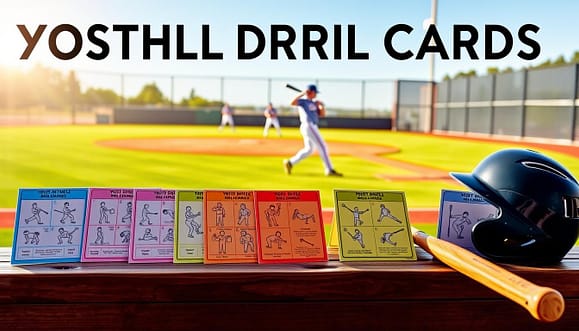
Welcome to the TikTok-ification of hitting instruction. In today’s world, if your coaching materials don’t grab attention fast, you’ve lost. That’s why we’ve made our drill cards and video examples super engaging.
We show, not just tell. Young hitters would prefer watching a 15-second TikTok over reading a long manual. Our visual resources make complex movements easy to understand.
Why Visual Learning Crushes Verbal Instructions
The brain gets visuals 60,000 times faster than text. This is a coaching superpower. Our video examples show multiple angles and slow-motion, helping hitters understand the feel they’re chasing.
We call this “visual kinesthetic awareness.” It helps players see and feel proper movement. It’s like a GPS for their muscle memory.
SwingBuild Program: The Gold Standard
Our SwingBuild program takes video instruction to the next level. Each drill compares elite hitters, showing the movements we’re trying to develop. It shows the what and the why behind each movement.
The program includes video examples throughout, giving hitters instant access to professional demonstrations. This approach is great for developing vertical adjustment drills that make hitters great.
Drill Card Design Philosophy
Our drill cards have three key principles:
- Instant comprehension – If it takes more than 3 seconds to understand, it’s too complicated
- Movement sequencing – Clear progression from start to finish positions
- Error contrast – Shows both correct and common fault patterns
Each card uses color-coding, simple icons, and minimal text. They’re like cheat codes for hitting development.
| Resource Type | Primary Use | Average View Time | Player Retention Rate |
|---|---|---|---|
| Basic Drill Cards | Fundamental Movements | 45 seconds | 92% |
| Advanced Video Examples | Skill Refinement | 2.3 minutes | 88% |
| Side-by-Side Comparisons | Error Correction | 1.8 minutes | 95% |
| Slow-Motion Breakdowns | Movement Analysis | 3.1 minutes | 84% |
Players engage longer with materials that show, not tell. Our video system for bat selection has cut equipment questions by 73%.
In today’s world, your coaching materials must compete with TikTok, Instagram, and YouTube. Our visual resources are designed to win that battle. They give players the visual kinesthetic awareness they need to improve their swings without overwhelming them with words.
Troubleshooting common faults
Fixing swing issues is like solving a mystery. It’s not just about quick fixes. It’s about finding clues in launch angles and how weight moves.
The Diagnostic Framework
Data is key, but it needs to be understood. When attack angles are off, it’s a sign of deeper issues.
High attack angles often mean bad posture and poor hip-shoulder separation. Low angles might show early barrel deployment or bad weight transfer.
Think of metrics as clues, not solutions. They guide you but don’t fix everything.
Common Root Causes
Most swing faults come from three main causes. Poor posture at launch leads to many compensations.
Early barrel deployment is like showing your hand too soon. And bad weight transfer is like pushing a car on ice.
These causes show up differently in each hitter. The same bad posture might cause casting in one and lunging in another.
Systematic Approach Beats Random Adjustments
Changing the grip won’t fix everything if the real problem is lower. It’s like changing oil for transmission issues.
Fixing the cause, not just the symptom, is key. This way, you avoid creating new problems.
Good troubleshooting means asking “why” until you find the real issue. Why is the attack angle high? Because posture is bad. Why is posture bad? Because the hitter isn’t loading right. Now we’re getting somewhere.
Evaluation rubric and re-test cadence
Coaching young hitters without a solid rubric is like trying to guess a reality TV show’s plot. It’s dramatic but pointless. Data helps cut through the noise.
The Rubric That Doesn’t Lie
My favorite rubric looks at swing metrics backed by research. It includes attack angle, rotational acceleration, contact quality, and timing consistency. These are numbers like exit velocity and bat speed that tell a clear story.
When to Re-Test: The Cadence Conundrum
How often to re-test depends on the player’s age and skill level. Young players need checks often to stay interested. More advanced hitters can wait longer to let changes take hold. It’s about finding the right rhythm, not rushing.
Data is important, but it’s not everything. The best coaches also use their observations. They mix numbers with their feel for the game. This way, they can truly understand the beauty of a good swing.