Brigade Training Schedule
Brigade Training is committed to providing a structured and effective training program for its members. The Brigade Training schedule is designed to ensure that each member receives the necessary training to excel in their role and contribute to the overall success of the Brigade.
Our training program includes a variety of modules and sessions, each carefully crafted to address specific skills and knowledge areas. From foundational training to advanced courses, Brigade Training offers a well-rounded curriculum that covers all aspects of the training program.
Our experienced trainers are dedicated to delivering high-quality training sessions that are engaging, informative, and tailored to the needs of each member. They bring their expertise and passion for training to every session, ensuring that members receive the best possible learning experience.
By following the Brigade Training schedule, members can stay on track with their training progress and make the most of their time. The schedule is designed to be flexible, allowing members to balance their training with other commitments and responsibilities.
At Brigade Training, we believe that continuous learning and development are essential for growth and success. That’s why we regularly update our training program to reflect the latest industry trends, best practices, and technological advancements.
Whether you’re a new member or an experienced professional, Brigade Training offers a supportive and inclusive environment where you can learn, grow, and thrive. Join us today and embark on a journey of professional development and personal growth.
Brigade Training Schedule Overview
| Training Module | Duration | Frequency |
|---|---|---|
| Foundational Training | 1 week | Every 3 months |
| Advanced Courses | 2 weeks | Every 6 months |
| Specialized Training | 1 week | Every 12 months |
Our Brigade Training schedule is designed to provide a structured and organized approach to training. By following the schedule, members can ensure that they receive the necessary training to excel in their roles and contribute to the overall success of the Brigade.
Weekly templates for 3–5 day schedules
We see the weekly schedule like a composer sees a musical score. Every part has a purpose. Random practice is just noise. But structured repetition is the melody that makes champions.
Our youth baseball weekly plan templates are carefully made, not just thrown together. They follow the natural process of getting better: stress, recover, adapt. If you miss a beat, the whole thing falls apart.
A 3-day schedule is like a minimalist song. It’s intense and focused, with lots of room for rest and other things. The 5-day schedule is like a full symphony. It has more parts, more detail, and more skills.
Which one is best? That depends on the athlete, their age, and the time of year. We just give them the music to play.
The table below is more than just a list. It’s a tool to see how each template helps athletes grow.
| Schedule Type | Weekly Rhythm | Primary Focus | Best For |
|---|---|---|---|
| 3-Day Template | Stress | Rest | Skill | Rest | Stress | Rest | Rest | Maximum recovery, strength building, power development | Younger athletes (10U-12U), multi-sport players, early off-season |
| 5-Day Template | Skill | Stress | Active Recovery | Skill | Stress | Rest | Rest | Skill automation, high-volume technique work, advanced motor learning | Older athletes (13U+), single-sport focus, in-season refinement |
| Hybrid 4-Day | Stress | Skill | Active Recovery | Stress | Rest | Rest | Rest | Balanced approach, integrating new skills under fatigue | Transition periods, athletes moving between schedule intensities |
Notice the “Active Recovery” part. It’s not a day off. It’s a low-intensity, high-focus session on mobility or mental reps. This is where the body learns to recover, not just rests.
We publish the whole season’s plan in January. No surprise rehearsals. No last-minute changes that mess up family plans. This predictability boosts performance.
When an athlete knows the plan, they feel less anxious. When they feel less anxious, they focus better. The weekly plan becomes a known entity, not a source of stress. The training becomes the challenge, not the schedule.
So we don’t just give out calendars. We give a compositional framework. The 3-day, 4-day, and 5-day templates are different instruments in the same orchestra. Each plays its part in the longer season-long crescendo.
The result? Development that feels inevitable, not accidental. A youth baseball weekly plan that turns chaotic effort into composed achievement.
Dynamic warmup and mobility: shoulder/hip/spine
Static stretching is outdated. Today, we focus on the shoulder, hip, and spine for rotational power. We see our turf as a place to improve, not just stretch.
A stiff spine slows down your bat. A locked hip weakens your throws. Our mobility routines reboot your body for better performance. It’s like updating your body’s software before a big game.
Every move on our turf has a purpose. We use agility ladders and defensive drills for hip mobility. Pitching lanes and bullpens help with shoulder care. This way, everything works together.
| Body Area | Sample Exercise | Primary Benefit | Equipment Needed |
|---|---|---|---|
| Shoulder | Band External Rotations | Stabilizes the rotator cuff for throwing velocity and health. | Resistance Band |
| Hip | Walking Spiderman with Reach | Unlocks hip flexion and internal rotation for powerful rotation. | Turf Surface |
| Spine | Segmental Cat-Cow | Builds dissociated, segmental control for a fluid swing. | Yoga Mat |
| Integrated | Rotational Medicine Ball Throws | Connects hip drive to spinal rotation to shoulder launch. | Light Medicine Ball, Wall |
The table is more than a list. It’s a guide for connecting movements. Shoulder care is part of a bigger chain, starting from the ground.
Why does this matter? Traditional warm-ups often ignore the spine and hip. Our mobility routines focus on these areas as key to power. This makes our bodies ready to express force, not just absorb it.
We skip static stretches for movement. Our warmup is the first performance set of the day. It prepares us for the game ahead, making it the best investment for today and tomorrow.
Age-appropriate S&C: strength, speed, power
Think of youth baseball strength and conditioning as building a skyscraper. You start with the foundation, then the steel frame. Only after that do you add the fancy details.
Putting a 12-year-old under a heavy barbell is not coaching. It’s dangerous and irresponsible. Age-appropriate training focuses on the right developmental stage for growth.
For 10U athletes, the weight room is a discovery zone. Strength means mastering their bodyweight. Can they do a push-up or hold a plank? These are the basics.
Coordination is key. Can they skip or hop on one foot? These skills are more important than heavy lifting at this age. First-step explosiveness is built through games, not just exercises.
For 14U+ players, the game changes. The foundation is set. Now, we focus on translating strength into baseball power. It’s about moving that weight fast, not just lifting it.
Speed development gets more complex. Linear speed is important, but baseball is about quick bursts. We focus on acceleration and changing direction fast. It’s not about running long distances.
Power is the final goal. It’s strength plus speed. We use medicine ball throws and rotational cable work to build this. It’s about being explosive, not just strong or fast.
The goal is to improve force production on the field. Can they use their gym work in games? Does their strength help them hit the ball harder? The scoreboard is the only judge that matters.
This approach changes the way we think about training. We’re not just chasing numbers. We’re building a physical vocabulary for athletes to express their talent. The heavy bar will come later. First, we give them the tools to carry it.
Skill blocks by week: hitting, pitching, defense
Imagine trying to learn French, calculus, and guitar all at once. That’s what baseball practice can feel like for young athletes. Their brains get mixed up, and they don’t make progress.
Our Brigade Baseball training programs take a different approach. We focus on one skill each week. This way, athletes can really get better without getting confused.
It’s like watching a documentary series on mastering a skill. Each week, we explore a new skill deeply.
Hitting Mechanics & Power Development
This isn’t just about hitting balls in a cage. It’s about analyzing every detail of the swing. We look at it like a film critic examines a scene.
We focus on the load, weight transfer, and bat path. We’re not just teaching athletes to hit. We’re teaching them why they hit well. This leads to real power.
Pitching Fundamentals & Arm Care
Pitching is like poetry on the mound. The windup and delivery are all about energy and control. We teach athletes to think about every move.
We combine mechanics with mindfulness. Every drill has a purpose. We protect the arm so athletes can keep pitching strong.
Defensive Mastery & Baseball IQ
Fielding is more than just catching the ball. It’s about reading the game ahead. This block helps athletes become instinctive defenders.
They learn to move smoothly and think strategically. Players start to see the whole game, not just their position.
We rotate through hitting, pitching, and defense each week. This builds a rhythm of improvement. Skills grow, and confidence soars.
Our weekly skill blocks are the key to success. It’s not just more practice. It’s better practice. Athletes see real results in their swings, pitches, and plays every week.
Workload management: RPE, pitch counts, recovery
In youth baseball, the key to success isn’t just about getting faster. It’s about knowing when to stop. We’re changing how we treat young arms, moving from overuse to smart management. Workload management is our new strategy.
Think of it like managing money. You wouldn’t spend all your savings without checking the balance. Athletes’ bodies are just as important.
RPE—Rate of Perceived Exertion—is our secret. It’s not just about numbers. It’s about asking athletes how they feel. Their honest answer is priceless.
Pitch counts are not just rules. They’re safety nets. We follow them to avoid injuries. The right number is the one that keeps mechanics sound.
Recovery is not just rest. It’s a key part of training. We plan it as carefully as we plan practice. Good sleep, food, and stretching are essential for recovery.
Athlete monitoring is more than just watching. It’s a conversation between coach, player, and data. We work together to improve performance safely.
Our goal is data-driven performance tracking. We want players to see real gains without burning out. If we can’t measure it, we shouldn’t be doing it.
This approach fights the old “grind” culture. We used to praise kids who threw too much. Now, we praise those who know when to rest. That’s smart, not weak.
True workload management helps young athletes grow while keeping them safe. It turns being careful into a powerful teaching tool. Sometimes, the best pitch is the one you don’t throw.
Testing and retesting: velo, pop time, bat speed, 30-yd dash
In the world of youth baseball, testing days are key. They help us see if our training is working. It’s like a quarterly review for your athlete’s growth.
Fastball velocity, catcher pop time, bat speed, and the 30-yard dash are important. They show if our training is a hit or a miss. Without these numbers, we’re coaching blind.
The first test is just the start. It’s the retest that really shows progress. One velocity reading is a single point. But two readings, after training, show a trend.
Was that 3 mph increase in velo real? Or was it just a good day? The retest tells us.
This process turns “I feel faster” into real numbers. Like shaving 0.2 seconds off your 30-yard dash. It’s a clear, measurable goal. It focuses on beating your own best, not others.
We track four key areas in our tests. Each tells a story about an athlete’s growth.
| Metric | Tool Used | What It Measures | Benchmark Improvement |
|---|---|---|---|
| Fastball Velocity (Velo) | Radar Gun | Pure throwing arm speed & power | +2-3 mph per 12-week block |
| Catcher Pop Time | Stopwatch / Swift | Footwork, transfer speed, arm strength | -0.05 to -0.10 seconds |
| Bat Speed | Blast Motion / HitTrax | Rotational power & swing efficiency | +3-5 mph (contact quality check vital) |
| 30-Yard Dash | Laser Timer / Stopwatch | Linear speed & acceleration | -0.1 to -0.3 seconds |
Look at the last column. We set goals that match the athlete’s age. It’s about steady progress, not quick fixes.
After the numbers are in, we analyze them. We look for patterns. Did bat speed increase but at the cost of contact percentage? Did faster pop times come from quicker feet or a sloppy transfer? Data without context is just noise.
We schedule testing days every 8-12 weeks. This lets adaptations happen but also lets us adjust if needed. We treat the data like a detective solving a case.
A spike in velocity but less control tells us to focus on stability. Improved dash time but no change in pop time means we need more agility drills. Every metric gives us clues for the next step in training.
The environment is important, too. We test in the same conditions every time. This ensures we’re measuring the athlete, not the situation.
This isn’t about creating competition. It’s about giving feedback that motivates. When a player sees their numbers improve, it shows their hard work is paying off. It makes abstract ideas like “power” and “speed” real achievements.
The retest proves if our training is working. With a strict testing plan, the data always tells the truth.
Video breakdown workflow and feedback
Video breakdown is like forensic science for baseball mechanics. It shows what really happened, frame by frame. Unlike our eyes, video doesn’t lie or forget.
In our Brigade Baseball training programs, we treat video analysis like a film director. Every swing and throw is captured. Then, we dive into the details.
Our process is simple: Capture, Analyze, Feedback. We film from different angles and use high-speed cameras. Then, we compare the footage to ideal models. After that, we share specific feedback.
This method is key to our Brigade Baseball training programs. Our feedback is detailed and actionable. We point out specific issues with voice-over narration.
This approach makes mechanics refinement clear and fixable. Mechanics refinement is no longer a mystery. Athletes see their movements clearly and understand the reasons for corrections.
| Coaching Aspect | Traditional Approach | Video-Enhanced Approach |
|---|---|---|
| Feedback Specificity | “Your swing looks off today.” | “Your bat path drops 3 inches early in zone 4.” |
| Correction Timeline | Days or weeks of trial and error | Immediate visual reference for next rep |
| Athlete Comprehension | Relies on coach description alone | Sees and understands the issue personally |
| Coach-Athlete Dialogue | One-way instruction | Collaborative problem-solving session |
This isn’t criticism—it’s a team effort with evidence. Athletes learn to analyze their own performance. This skill benefits them for life.
Having professional coaching with video evidence makes a big difference. Coaches’ instructions are clear when athletes can see the problem. For example, “Stay closed” means more when you’ve seen yourself opening up.
This method is the best in professional coaching through Brigade Baseball training programs. We’ve moved from stories to facts. The game is now clearer and more improvable.
Individual Development Plans and goal sheets
An athlete’s journey without an IDP is like a road trip without GPS—you might get somewhere, but rarely where you intended. The Individual Development Plan is a strategic guide. It turns dreams into actionable plans.
Forget generic wish lists and hopeful thinking. Our Brigade Baseball training programs see the IDP as a living document. It evolves like a season itself. We focus on specific goals, not vague wishes.
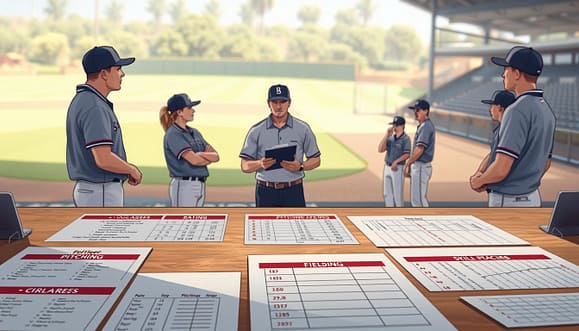
The magic happens when we focus on process outcomes. We create goal sheets that target what a player can control. For example, “maintain a 70% strike rate on my curveball” is a specific goal.
This approach changes how athletes work. When they understand the why behind each drill, they commit fully. The IDP gives them the reason.
Our goal sheets break down big goals into smaller, achievable targets. They are specific, measurable, and within the athlete’s control. We focus on mechanics, consistency, and mental approach, not just winning.
This document is the athlete’s stake in their career. It’s co-created, reviewed, and updated regularly. The IDP is a collaborative effort, not something done to athletes.
Athletes become active architects of their growth. They track their progress against personal benchmarks. This creates lasting motivation.
The IDP brings clarity to the chaos of youth sports. It filters out distractions and aligns daily effort with long-term goals. This roadmap is key to our approach to athlete growth.
When an athlete can explain their current focus from their goal sheet, we’ve done more than just develop skills. We’ve shaped their mindset. That’s the real victory in our Brigade Baseball training programs.
Nutrition and sleep guidelines for youth
In youth sports, we often focus too much on mechanics. We ignore the power of food and sleep.
Think about it. Perfect form and endless film study won’t help if you eat badly. And sleeping little? It’s like trying to fix your car while it’s moving.
We don’t push kids to eat less. Instead, we teach them to see food as performance fuel. We explain that protein helps muscles heal and carbs give energy.
It’s simple physics. You need to put in as much energy as you use, plus grow. Athletes need the right food at the right time.
Sleep is like the pit stop for nutrition. This is where growth hormone peaks and muscles repair. The brain also solidifies skills learned during practice.
Not enough sleep means your body can’t repair itself. It’s a key part of getting better at sports. For teens, their bodies naturally want to sleep later. Fighting this is hard.
| Performance Fuel | Performance Drain | Why It Matters |
|---|---|---|
| Lean protein with every meal | Processed snacks between meals | Provides amino acids for muscle repair and sustained energy |
| Complex carbs 2-3 hours before activity | Sugary drinks for quick energy | Ensures stable blood sugar for focus and endurance during play |
| 8-10 hours of quality sleep | 5-6 hours with screen time before bed | Maximizes growth hormone release and neural pathway formation |
| Hydration throughout the day | Drinking only when thirsty | Maintains joint lubrication, temperature regulation, and cognitive function |
| Consistent meal timing | Skipping breakfast or lunch | Prevents energy crashes and supports metabolic efficiency |
The table above is about being aware, not perfect. Eating fast food after a game is okay. But know it affects tomorrow’s recovery. Staying up late on your phone? That’s like taking from your performance bank.
We teach kids to listen to their bodies. Thirst can feel like hunger. Fatigue from sleep or overtraining is the same. Learning these signals is like understanding your car’s dashboard.
Parents are key, but not as food police. They should stock good food and enforce bedtimes. It’s about making healthy choices easy.
The athlete who sleeps and eats well doesn’t just recover better. They learn faster, grow stronger, and build lasting habits. That’s true development, far from the field.
Coordination with school/rec coaches
Think of us as the offseason R&D lab where athletes get their firmware updates before returning to their school team’s mainframe. We’re not an island. The player’s development ecosystem includes their school squad, maybe a rec league, and our facility. Smart growth requires diplomatic coordination, not territorial pissing matches.
For our high school athletes, this philosophy is non-negotiable. As our program emphasizes: “It’s our priority to ensure every Brigade player is fully prepared for high school tryouts.” We’ve sent upgraded models back to programs at The Woodlands, Tomball Memorial, and other local powerhouses. The goal isn’t to create conflict but to build a better athlete.
Here’s how we approach this delicate dance:
- Communication Channels: We establish appropriate lines with school coaches. This isn’t daily texting. It’s strategic check-ins about goals, workload, and development focus areas.
- Workload Alignment: If a school coach has a pitcher on a specific throwing program, we don’t counter-program. We augment. We work around their schedule, not against it.
- Progress Reporting: We share relevant data—velocity gains, mobility improvements, technical adjustments—that helps the school coach understand what we’ve been building.
- Conflict De-escalation: When disagreements arise (and they do), we default to one question: What’s best for the athlete’s long-term health and progress?
The objective is synergy, not supremacy. A player shouldn’t feel torn between loyalties. They should feel supported by a unified front. When we improve an athlete’s arm care routine, that benefits their school coach. When a school coach develops game IQ, that makes our technical work more effective.
For younger rec league athletes, the approach adapts. Here, coordination might mean educating volunteer parents on proper throwing mechanics or explaining why we’re limiting pitch counts. The principle remains: we’re part of a larger system.
The only win that matters here is the player’s advancement. Everything else—egos, territories, credit—is just noise. By treating school and rec coaches as partners, we create a coherent development pathway. This ensures everyone is rowing in the same direction.
Parent dashboards and milestone reports
The most valuable thing in youth sports isn’t talent or trophies. It’s the trust between coaches, athletes, and parents. When trust is lost, we see sideline whispers, second-guessing, and late-night texts. Our solution is to use technology for radical transparency.
Our parent dashboard is like the Bloomberg terminal for your child’s sports growth. No more guessing what happened at practice. Every workout, test result, video highlight, and coach note shows up in real-time. It makes athlete monitoring clear and easy to understand.
This isn’t about making parents hover over every detail. It’s about making them informed partners in their child’s growth. When a parent sees their 12-year-old has improved exit velocity by 8% and mastered the backhand pick, they can say “he’s doing great” with real evidence.
Our milestone reports are based on a simple idea: what gets measured gets managed. We replace vague reports with clear, data-driven insights. Imagine getting a report that shows batting average improvements and how they relate to strength gains and mechanical changes.
The data source we follow says trust is built by showing up every day with integrity, consistency, fairness, and empathy. Our dashboards show up every day with progress, building empathy through understanding.
Here’s what you’ll find in a typical milestone report:
- Quantitative metrics (exit velocity, pop time, 30-yard dash improvements)
- Skill mastery checkpoints (mechanical adjustments confirmed via video)
- Workload management data (RPE trends, recovery indicators)
- Coach observations and next-phase recommendations
This approach turns parental anxiety into a partnership. Parents can ask informed questions like “I noticed the focus on hip mobility last week—how’s that translating to pitching velocity?”
Good athlete monitoring does more than track progress—it builds the foundation for long-term development. When everyone looks at the same data, conversations become strategic. The parent becomes part of the team, not just a spectator.
In today’s high-pressure youth sports, transparency is key. Our dashboards show more than numbers—they tell the story of growth, struggle, and achievement. They open up the black box of athletic development for everyone to see.
That’s how you build trust. Not with promises, but with proof. Not with mystery, but with measurable milestones.
Case study: 10U–12U month with KPIs
What does a month of focused training do for a 10-12 year old athlete? We explored this by following twelve players for four weeks. It wasn’t about winning games. It was about growing their athletic skills.
Our approach was simple yet often overlooked. We measured, trained, and measured again. Without data, you can’t manage progress. We traded vague improvements for clear, measurable results.
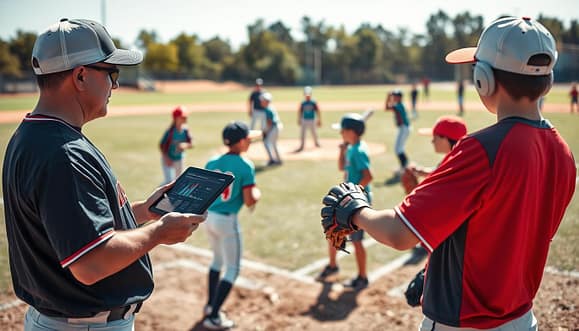
Week One was all about setting a baseline. We didn’t do fancy drills. We just measured throwing speed, 30-yard dash times, and bat speed. This gave us a clear starting point. The numbers were honest, even if they were tough to hear.
Weeks Two and Three focused on improving specific skills. We worked on rotational power and precise footwork. We also did plyometrics, like low-box jumps, to keep things age-appropriate.
Every session was based on how hard it felt. We kept it at a 6-8 intensity level. We made sure to include recovery time, not just as an afterthought.
Week Four was the retest. This is where we saw real progress or faced harsh realities. We tracked development, not just wins.
| Week | Primary Focus | Key Activities | Measurable KPI Target |
|---|---|---|---|
| 1 | Baseline Establishment | Velocity testing, 30-yd dash, bat speed measurement | Establish initial metrics for all athletes |
| 2 | Rotational Power & Footwork | Med ball drills, infield defensive patterns, light plyometrics | Improve movement quality & exercise technique |
| 3 | Skill Integration & Load Management | Combined drills, controlled scrimmage situations, RPE tracking | Maintain RPE 6-8, execute skills under fatigue |
| 4 | Re-test & Analysis | Repeat Week 1 tests, data comparison, individual feedback | Quantify improvement across core metrics |
The results were impressive. Bat speed increased by 3.2 mph on average. The 30-yard dash time dropped by 0.4 seconds. The most significant improvement was in double-play turns, rising from 58% to 79%.
These numbers aren’t just data. They prove a method works. It’s the difference between hoping a kid improves and knowing exactly how much they did, and why.
The main takeaway is clear. For 10U-12U athletes, success isn’t just about winning. It’s about measurable gains in athletic ability. This study shows how to focus on what you can control, measure what matters, and watch real growth happen.
Downloadables: planner, IDP, testing log
Theory is just watching. But when you apply what you’ve learned, you’re in the game. After thirteen sections on baseball training, we’re giving you the tools to play.
Think of this as your playbook. Use the weekly training planner to organize your work like a pro. The Individual Development Plan template helps you set goals. And the testing log tracks your progress, from speed to bat speed.
Knowledge isn’t just for keeping to yourself. It’s for sharing. These documents are your chance to help your youth baseball program grow.
Your metrics are ready. Your development plan needs your touch. Your weekly schedule needs your plan. Now, it’s time to create something.