Imagine a youth sports field. You might see a perfect, professional field or a rough, uneven area. The look of a field often depends on how well it’s set up.
Getting the base distances right is key. For Little League, bases are 60 feet apart. For younger players, it’s 35 to 46 feet. If these distances are wrong, kids learn the game incorrectly.
A great field starts with solid ground, not just paint. It’s like civil engineering for kids. The right outdoor play area has a slight slope to keep water away from home plate. Is your field even or uneven? It makes a big difference by the third inning.
Before painting lines, focus on the field’s foundation. The distance between bases is a promise to the game’s geometry. The ground is the base of every play and victory.
Temporary vs Permanent Mounds/Fences
The pitcher’s mound is key in baseball, where games are won or lost. Choosing between a permanent and portable mound is a big decision. For youth leagues, it’s about finding a balance between budget and field use.
Building a permanent mound is a big commitment. It needs a special mix of clay and sand, a certain height, and good drainage. But is it right for fields that host different sports?
A portable mound is more flexible. It’s like a multi-tool for baseball fields. It’s there for games and practice, then gone for other sports. This makes it perfect for fields that host many activities.
When it comes to fencing, a chain-link fence is a big statement. But for youth leagues, portable fencing is better. It’s not just a barrier; it teaches players about the field’s limits.
A flimsy fence can be dangerous. It needs to be strong and easy to set up. It should stand up to players and balls without becoming a hazard.
Base distances are also important. The distances between bases and from home plate to the rubber are set rules. Temporary setups must follow these rules. A portable mound or fence must be placed carefully to ensure fair play.
Portable systems can be adjusted for different age groups. But they must be set up correctly. A fence at the wrong base distances changes the game’s feel.
In the end, the choice isn’t about quality. A permanent mound is ideal for pitchers. But for youth sports, a portable solution is often the best choice. It’s flexible and works well for fields that host many activities.
Dugout & Warm-Up Zones: Cones, Signage, and the Parental DMZ
The dugout is more than a place to sit. It’s the command center for your young athlete. The LKLL manual makes it clear: zones are essential for order.
The warm-up area is key, not an afterthought. It’s where the game starts before the first pitch. The dugout command center needs clear zones for everyone.
Cones and signs are like velvet ropes. They mark the Parental DMZ. This area lets parents cheer without coaching.
The LKLL manual teaches about organization and safety. A well-marked warm-up zone keeps drills safe and efficient. It also ensures players have a clear path to the field.
To keep things in order, chalking is used. It defines where everyone can be. This chalking is like a social contract.
Before the game starts, the real work is done with chalk and cones. It’s a simple yet effective way to keep things in order.
Chalking/Striping: The Geometry of Fair Play
Forget the paint-by-numbers approach. Chalking a baseball or softball field is more than a chore. It’s a temporary public art form. It’s a meditation on geometry that defines the game’s laws.
A crisp, white line isn’t just a boundary. It’s the physical manifestation of the rules. It’s the line between a fair ball and a foul, an out and a home run.
This isn’t about slapping down some lime and hoping for the best. It’s a ritual. The third base line isn’t just a guide for the runner. It’s a 90-foot declaration of intent.
A wobbly, wavering line isn’t just sloppy—it’s a philosophical crisis on grass. Is the ball fair or foul? The answer should be in the geometry, not in a cloud of dust and guesswork.
So, how do you achieve this geometric purity? It’s not magic, just good technique. Here’s the sacred geometry of a proper field layout:
The Tools of the Trade:
- The String is Your God: For a laser-straight foul line, a taut string line is your non-negotiable first step. This is your foundation. Stretch it tight from home plate to the foul pole, and don’t let it sag. The earth is not flat, but your foul line should be.
- Template is King for Boxes: The batter’s box is a sacred rectangle. Don’t eyeball it. Use a template or a rigid, measured frame to chalk the box. A lopsided batter’s box is an affront to the very geometry of the game.
- The Art of the Arc: For on-deck circles or the arc behind home plate, use a string and a stake. Tie one end at the center point, and use it as a giant compass. Your circles should be perfect, not egg-shaped suggestions.
The third source of our data is right: this isn’t about aesthetics. It’s about integrity. A clean, accurate field of play is the ultimate sign of respect. It shows respect for the players, the rules, and the game’s geometric heart.
A perfectly chalked field doesn’t just look professional. It whispers to every player that here, the rules are clear, the lines are true, and the game is fair.
Infield Maintenance: The Sacred Ritual of the Drag and the Drag Mat
Forget the pre-game warm-up. For a youth baseball groundskeeper, the real ritual is with a metal drag mat and a hose. It’s not just raking dirt; it’s transforming earth into a game canvas. Infield care is about making a playing surface predictable, safe, and fair. This process perfects or neglects the field’s soul.
You’re not just dragging. You’re creating a Goldilocks zone of soil. The LKLL manual has strict rules for a reason. Its cross-hatch pattern prevents ruts and ensures a consistent surface. It’s like weaving a firm carpet for ground balls.
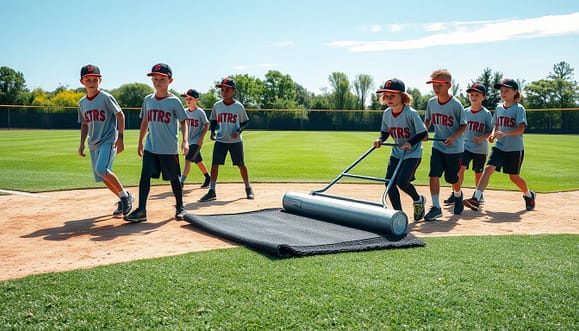
The LKLL’s golden rule is 1/4 to 1/2 inch of loose material. This “crumb” layer is your infield’s shock absorber. It makes the difference between a true hop and a bad hop, a clean play and a ball to the collarbone.
This is where infield care becomes a science. Watering isn’t just about dust control. It’s a precise tool. A light mist before a game prevents dust. But the real art is in pre-game watering to achieve the perfect moisture gradient.
The “lip” where infield meets outfield grass is critical in infield care. A well-maintained lip is a smooth transition. A neglected one is a 90-degree wall that can injure players. Edging and raking this zone is a safety check.
Think of the drag mat as your primary tool, not just equipment. A heavy, mat-style drag smooths and redistributes material. The post-game drag resets the field, erasing the chaos of the game.
This isn’t maintenance; it’s respect. Respect for the game, players, and the craft of the game. A well-kept infield shows you value quality play, player safety, and game integrity. You’re not just a groundskeeper; you’re a soil scientist and the guardian of the hop. So, remember: you’re not just dragging. You’re preparing a stage for the next great play.
Outfield Care: More Than Just a Lawn
The outfield is more than just a green space. It’s a living, breathing part of the game. It can change the game’s pace and outcome. Managing it well is key to success.
Choosing the right mowing height is critical. Cutting it too short makes the turf weak. But growing it too long makes the field uneven. The ideal height is between 1.5 and 2.5 inches for most grasses.
Choosing the right grass is also important. For busy areas, you need a grass that can handle a lot of use. Cool-season grasses work best in the north, while warm-season grasses are better in the south.
Portable fencing plays a big role in outfield care. It marks the field and keeps players safe. A well-anchored portable fence is essential for safety and to keep the game in bounds.
Outfield care is about three things: mowing, turf selection, and portable fencing. When done right, the outfield becomes a top-notch playing area. It’s not just grass; it’s where the game’s biggest moments happen.
Weather Plans: Because Mud Happens
Rain doesn’t mean the game is over. In youth sports, a storm is just a test in hydrology. Your field’s performance in rain is all about your planning.
A good weather plan doesn’t fight the rain. It guides it to the exit. This way, your field stays playable.
Forget trying to beat Mother Nature. A smart weather plan works with her. Start with a good tarp and then focus on drainage and absorption.
Modern field management is about managing moisture. It’s not just about drying the field after the storm. It’s about making moisture management a key part of your field’s design.
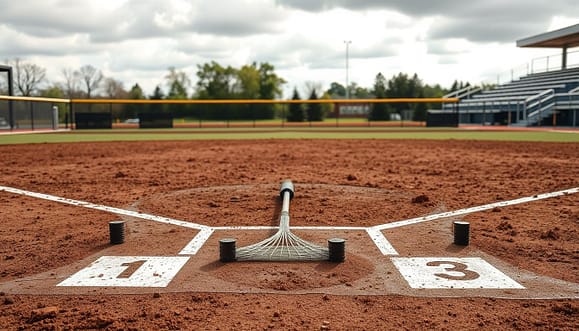
When it rains, don’t panic. A proactive plan can turn a wet field into a playable one fast. Smart materials and physics are key here.
The Toolbox for a Soggy Situation
It’s not just about waiting for the field to dry. Field managers have tools for wet weather. They manage the water you can see and the water you can’t.
| Tool/Material | Primary Use | Key Benefit | Best For |
|---|---|---|---|
| Puddle Pillows | Surface Water Absorption | Acts like a giant, thirsty sponge, wicking water up and away from the playing surface. | Infield skin, base paths, and warning track areas. |
| Calcined Clay | Moisture & Soil Conditioning | Absorbs excess moisture, dries quickly, and improves footing. Think of it as kitty litter for the ball field. | Infield mix, high-traffic mud zones, and around base distances where players pivot. |
| Portable Infield Mix | Patching & Leveling | Used to fill low spots and divots that hold water, creating a level, consistent surface. | Pitcher’s mound, batter’s box, base paths. |
| Drainage Tile & Sand Root Zones | Subsurface Drainage | Permanent infrastructure that whisks water away from the root zone, preventing a “bathtub effect.” | Foundational for permanent fields and high-end installations. |
The “puddle pillow” technique is not a hack. It’s applied capillary action. It sucks water out of puddles, improving the soil’s drainage.
Beyond the Tarp: The Subsurface Game
A tarp keeps new water off. But managing soil moisture is the real challenge. Fields with sand-based root zones and drainage tile are key.
These fields are not just a luxury. They’re a way to keep water out. They give water a polite exit.
When the forecast turns bad, don’t cancel. Activate your plan. It’s not about fighting the rain. It’s about understanding its journey.
Managing a field in the rain is a dance of materials and gravity. When the rain stops, your field will be ready to play.
Practice Circuits: The Art of the Juggling Act
Managing multiple youth teams on one field is like conducting an orchestra with kazoos. The biggest challenge isn’t teaching kids to catch or hit. It’s the logistical ballet of running a productive practice on a single diamond with many young athletes.
The secret isn’t a bigger field; it’s a better algorithm. This is where the practice circuit, the high-intensity interval training of youth sports, transforms chaos into choreography.
The core concept is simple: create 3-4 distinct stations. Groups of 5-6 players rotate through each station in 15-20 minute blocks. This isn’t just about keeping kids busy; it’s about maximizing touches.
While one group works on hitting off a tee, another practices fielding grounders. A third works on base-running technique, and a fourth reviews signs and strategy. The result? Every player is engaged, active, and learning for the entire practice.
The table below outlines a sample 90-minute practice circuit, a template you can adapt. Think of it as the playbook for your practice playbook.
| Station | Focus Area | Key Equipment | Coach Focus |
|---|---|---|---|
| Hitting Station | Batting tee, soft toss, live pitching progression | Bats, tees, L-screens, protective nets | Mechanics, hand path, consistent contact |
| Infield/Outfield | Fielding grounders, fly balls, cut-offs | Buckets of balls, fungo bats, cones | Footwork, glove work, communication |
| Base Running | Leads, steals, sliding, situational runs | Bases, stopwatch, agility ladders | Speed, technique, situational IQ |
| Strategy & Film | Signs, bunt defense, situational plays | Whiteboard, tablet for video | Baseball IQ, mental game, communication |
This is where your prior infield care pays dividends. A well-maintained infield—firm, level, and free of hazards—can handle the constant traffic of a multi-station circuit. That infield care you’ve invested in (the dragging, watering, and leveling) now supports the controlled chaos of four different activities happening simultaneously.
A poorly maintained infield turns into a dust bowl or a mud pit, creating safety hazards and ruining drills. Good infield care isn’t just aesthetics; it’s the literal foundation for this entire, beautiful, chaotic system.
So, the next time you see 40 kids swarming a single diamond, don’t see chaos. See a circuit. See a well-oiled machine where every player is engaged, every minute is productive, and the sacred dirt of the infield—the product of diligent infield care—supports the beautiful, organized chaos of youth baseball at its best.
Pre/Post-Practice: The Before and After of It All
The crew’s work is a never-ending cycle of getting ready and fixing things. The pre-practice checklist is not just a suggestion. It’s like the pre-flight checklist.
It includes the final chalking of the lines and the last drag of the infield skin. Every base, bag, and rake is in its spot. This makes an empty diamond ready for play.
The post-practice drill is the opposite of the setup. Equipment is counted, and the infield is healed after a game. This is where a system, like the LKLL’s crew roles, really helps. It makes sure everyone knows their job.
Assigning tasks, like who handles the chalking cart, makes volunteers work like a precision team. This before-and-after work is the game’s behind-the-scenes. It’s the league’s promise to the field: we’ll use it and leave it ready.
This work is what makes the game possible. It’s the quiet effort that turns a field into a place for play.