Welcome to the dugout, coach. Getting your youth baseball or softball team ready can be tough. It’s like trying to manage a bunch of cats while avoiding chainsaws. Before you get lost in all the gear lists and league rules, take a deep breath.
This isn’t just a list of things to buy. It’s a plan to get everything you need for the season. We’re building a strong base for the season, not just checking off boxes.
Don’t let the overwhelm get you down. This guide is your detailed plan for youth bats, gloves, and more. We’ll cover the basics and the important details. We’ll talk about the safety gear and the organizational tips that make the season run smoothly.
We’ll look at the must-haves, like youth bats with the USA Bat stamp and helmets with the NOCSAE seal. We’ll also see what the league might offer. This is about more than just gear. It’s about making the season safe, fun, and well-organized. Let’s get into the details.
League & Safety Standards: Your Rulebook Decoded
The league rulebook is more than just rules. It’s the guide for the game. Ignoring USA Bat and NOCSAE helmet standards is a big mistake. It’s like trying to hit a fastball with a whiffle ball bat.
The rules are in place for two main reasons: safety and fairness. They come from years of experience, aiming to keep the game safe and fair. As a coach, knowing the rulebook is your top priority.
I learned the hard way. My first season, I almost used a bat that was too hot for our league. The umpire looked at me with a mix of pity and disappointment. Don’t make the same mistake. Knowing the standards is key to a successful season.
The USA Bat Standard: More Than a Stamp
The USA Baseball stamp on a youth bat is not just a logo. It shows the bat meets certain standards. This ensures the bat doesn’t give hitters an unfair advantage. It makes the game fair for everyone.
A bat without the stamp is illegal and a waste of money. It’s about fairness and consistent play for all players.
The NOCSAE Seal: More Than a Hard Hat
The NOCSAE seal on a helmet is all about safety. It’s not optional. A helmet without this seal is not safe. It’s like wearing a plastic shell with a chin strap.
The seal means the helmet can handle high-velocity impacts. Also, helmets and youth bats with shiny surfaces are banned. This is to prevent glare from blinding fielders. Safety is about being visible.
Shared Equipment & The Coach’s Duty
Leagues often provide shared gear like helmets and tees. It’s your job to check if it’s in good condition. A broken helmet is useless.
Here’s a quick checklist for your league-mandated gear inspection:
| Equipment | Standard to Verify | Coach’s Quick Check |
|---|---|---|
| Team Helmets | NOCSAE seal, no cracks, secure padding | Look for the stamp. Shake it—nothing should rattle. |
| Catcher’s Gear | Full set: chest protector, shin guards, helmet with cage | Check for worn straps and cracked plastic. |
| Batting Tee | Sturdy base, adjustable height, straight post | Ensure it doesn’t wobble. A wobbly tee teaches bad mechanics. |
| First-Aid Kit | Stocked and accessible | Check for expired supplies monthly. |
Learning the rulebook is not just about following rules. It’s the foundation for a successful season. It’s what makes a team stand out. So, read the rulebook, know it, and own it. Your players and your record will thank you.
Player Gear: bat sizing, gloves, helmets, pants, cleats
Choosing the right gear for a young player is more than just picking out clothes. It’s about solving a physics problem with growth spurts and motion laws. The right equipment boosts confidence and keeps players safe. Getting it wrong can be frustrating and might make a kid lose interest in the game.
Every piece of equipment—bat, glove, helmet, and cleats—must fit together perfectly. This ensures the whole system works well.
Choosing a bat isn’t a guess. It’s based on height, weight, strength, and swing mechanics. A bat that’s too heavy or too light can cause problems. The right bat should feel balanced, not heavy.
A 7-year-old should use a 29-inch, 18-ounce bat. This size helps them develop a strong swing. The bat should feel like an extension of their arms, not a heavy club.
Gloves are essential for catching, not just for storing hands. Buying a glove too big is a mistake. For tee ball, a 9- to 10-inch glove is best.
Infielders and pitchers need smaller gloves, while outfielders need larger ones. A good fit means the webbing closes over the ball easily. This prevents dropped balls and keeps confidence high.
Helmets are a must-have. A helmet that moves during a slide or collision is dangerous. It must fit snugly and have the NOCSAE stamp. A face mask or jaw guard is also a smart safety choice.
Pants and cleats are important but often overlooked. Pants should be durable and flexible. Cleats must be rubber or TPU to avoid injuries.
Choosing the right gear is about creating a safe and solid foundation. When everything fits right, a player can focus on the game. This builds confidence and skill, one hit at a time.
Team Gear: tees, low‑flight/compression balls, throw‑down bases, coach‑pitch screen
Forget the bat for a moment. The real heroes of youth baseball are the gear that makes practice happen. The tee, safety ball, and throw-down base are key, but often overlooked. Good team gear makes practice safe, efficient, and productive.
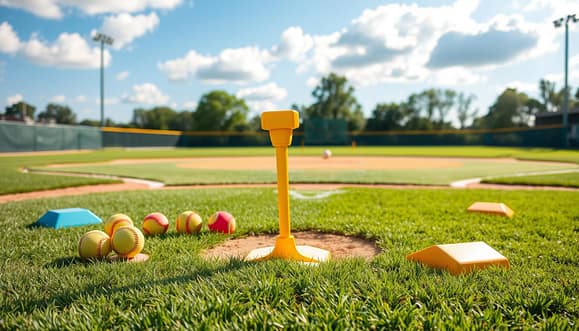
The batting tee is a coach’s best friend. Not all tees are the same. A sturdy tee, like the Tanner Pro or Tanner Jr., can handle a lot of hits. It helps players develop a strong swing through endless practice.
For T-Ball and Coach Pitch, hardballs are too tough. Low-compression balls are a better choice. They’re safer and help players feel more confident without fear of getting hurt.
Throw-down bases and a portable L-screen are essential. They turn any area into a real baseball field. Using a traffic cone as home plate was a mistake. A coach-pitch screen and bases make drills and games possible anywhere.
| Gear | What It Solves | Pro Tip |
|---|---|---|
| Durable Batting Tee | Wobbly, flimsy tees ruin swing mechanics. A heavy-base, flexible-stem tee (like a Tanner) provides the consistent, stable contact point needed to build a repeatable swing. | Get one with a replaceable rubber top—it will take a beating. |
| Low-Compression Balls | Eliminates fear, reduces injury risk, and keeps the ball in the practice area. Essential for safety and building confidence. | Buy in bulk. You’ll lose more to the woods than you think. |
| Throw-Down Bases | Instantly creates a practice infield anywhere. Far superior to using gloves or cones as bases. | Look for sets with metal grommets, not just plastic stakes, for durability. |
| Coach-Pitch Screen | Protects the adult pitcher/coach and allows for consistent, safe batting practice from a realistic distance. | Get one with a wide, stable base to handle those line drives. |
Think of this gear as your coaching staff. A good tee builds strong swings. The right compression balls make hitters fearless. Portable bases and a screen create a real practice area. This gear is the backbone of every drill and play this season.
Field Gear: chalker, tape, measuring rope, cones, buckets
The field is the stage for every hit, catch, and slide. Its condition and layout are key for a fair game. You need the right field gear to make it happen.
A reliable chalker is essential for clear lines. A jamming chalker on a hot day is a nightmare. A smooth chalker defines fair and foul areas.
Precision is vital. A coach once tried to pace out baselines without a measuring tool. The result was a lopsided diamond. A tape measure or measuring rope is cheaper than arguments.
For official guidelines, many refer to state athletic guidelines. They provide a framework for field setup.
Bright orange cones are essential for marking areas. They outline foul territory, practice areas, and safe zones. Their color is a clear signal of boundaries.
The 5-gallon bucket is more than a container. It’s a portable dugout for balls, helmets, and more. It holds everything together.
This gear is not about vanity. It’s about creating a professional and safe environment. It turns a patch of grass into a field of dreams.
Protective & Medical: L‑screens, first‑aid, ice, AED access
An L-screen is not just a suggestion; it’s a shield. Your first-aid kit should have more than just band-aids. This gear is about being ready for the unexpected, not being paranoid.
It’s not just about protecting players. It’s about keeping the whole team safe from preventable injuries. This includes the coaches and the entire season.
The L-screen is like your personal armor. A 5-ounce baseball from 50 feet away is dangerous. The L-screen shows you’re prepared for the game’s risks.
It protects you from serious injuries like concussions or broken noses. Your pitching arm is vital. Protect it well.
Beyond the Band-Aid Box: The Serious First-Aid Kit
Your medical kit should be ready for anything. A skinned knee is one thing, but you need to be ready for more. Your kit must go beyond just adhesive strips.
Your first-aid kit should be a trauma-lite kit. It’s not about being alarmist; it’s about being prepared. At a game, a coach had a suspected cardiac issue.
The team with a plan and knew where the AED was saved the day. Knowing where the AED is at your field is not optional. It’s a must.
Your Medical Kit: The Non-Negotiables
Stock your kit for real-world incidents:
- Trauma Shears: For cutting away fabric, not for looks.
- Instant Cold Packs: For the immediate treatment of impact injuries.
- QuikClot or Hemostatic Gauze: For serious bleeding control until EMS arrives.
- Space Blanket: Shock is a real concern, even on a warm day.
- CPR Mask & Nitrile Gloves: Your barrier in an emergency.
Have a clear, written emergency action plan. Who calls 911? Who directs EMS to the exact location? Who has the AED? Who has the first-aid kit? Assign these roles before the first pitch.
Helmets: The Primary Non-Negotiable
Let’s be blunt about helmets. They are not accessories; they are the single most important piece of protective gear. A proper helmet, fitted correctly and bearing the NOCSAE seal, is as non-negotiable as a glove for a fielder. It’s not just about the batter. Base coaches, base runners, and catchers all require this fundamental piece of equipment. It’s the one piece of gear you never, ever compromise on.
| Item | Purpose | Why It’s Critical |
|---|---|---|
| L-Screen | Coach Protection | Prevents serious injury to the coach during batting practice, ensuring you can keep coaching. |
| Trauma-First-Aid Kit | Immediate Response | Allows for stabilization of sprains, breaks, or bleeding before EMS arrives. |
| AED & Location Knowledge | Cardiac Emergency | In a sudden cardiac event, the first 3-5 minutes are everything. Know where the AED is and how to use it. |
| Instant Cold Packs | Immediate Injury Care | Reduces swelling and pain for impacts, sprains, and contusions immediately. |
This isn’t about living in fear of the worst. It’s about the profound responsibility we accept when we coach. It’s the difference between reacting to chaos and managing a situation. Your L-screen is your shield, your medical kit is your first response team, and your plan is your playbook for the unthinkable. Because the goal isn’t just to play the game; it’s for everyone to go home safe.
Organization: bins, labels, loaner gear log
A youth baseball dugout after a game looks like a tornado hit. Gloves, helmets, and youth bats are everywhere. Your job is to keep it organized, not to be the fun police.
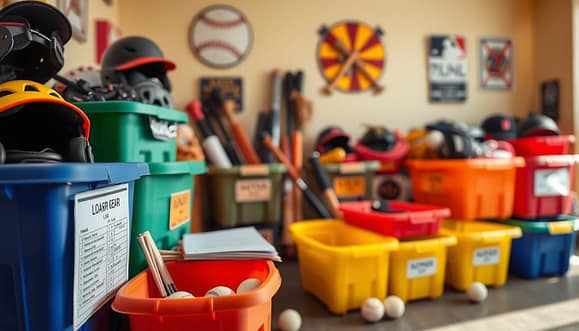
Forget the “pile it in the corner” method. Use storage bins to keep things tidy. Label each bin for different items like batting helmets and game balls. This makes finding what you need quick and easy.
A loaner gear log helps track who has what. It’s not about mistrust, but about keeping things straight. No more lost helmets or missing bats.
Labels are your friend. Use a label maker to tag every piece of gear. This makes it clear that everything belongs to the team. It helps build a sense of responsibility.
With bins, labels, and a log, you’ll save time. Your team will practice more and search less. You’ll be the calm, organized leader everyone needs.
Quantity Planner by Roster Size
Choosing the right amount of youth sports equipment is key. It’s not about having one of everything for everyone. It’s about planning for needs, breakage, and the quick disappearance of baseballs and kids’ attention.
For a team of 12-15 players, the gear matrix is essential. It helps avoid mid-season equipment problems. Always plan for more than you need, and have extra for lost items.
Here’s the basic gear list for a 12-15 player team. It’s your guide for a safe and fun season.
| Gear | Why You Need It | Quantity for 12-15 Players |
|---|---|---|
| Helmets | Every batter and base runner needs one. Sharing helmets is not safe or clean. | 12-15 |
| Bats | Every kid needs a bat that fits. You’ll need different sizes and weights. | 6-8 |
| Practice Balls | They get lost or damaged fast. You’ll need a lot for practice. | 2-3 dozen |
| Game Balls | Keep a fresh set for games. Dirty balls are hard to see and look bad. | 3-4 new balls |
| Catcher’s Gear | A full set is needed. It includes a helmet, chest protector, shin guards, and a glove. | 1 set |
| Fielding Helmets | Coaches and pitchers need helmets too. It’s about safety. | 4-6 |
This table is your starting point. But remember, the real strategy is in the details. Plan for lost bats and balls. Practice balls will disappear quickly.
I once had to use pinecones as balls for practice. Don’t make the same mistake. Always have more than you think you’ll need.
Here are some key points for your quantity planner:
- Factor in Loss: Balls and bats get lost or broken. Plan for extra to avoid shortages.
- Size Matters: Bats and helmets must fit right. One size doesn’t fit all.
- Game vs. Practice: Keep game balls separate. Use practice balls for drills.
Your equipment list is your defense against chaos. It’s not just about having enough. It’s about being ready for anything.
Buying Smart: bundles, used gear checks, warranties
Getting gear for your team is more than just shopping. It’s like playing a game of chess. Saving money on a bat means you can buy better compression balls or a durable L-screen. The right choices can make all the difference in your season.
Preseason bundles can seem like a great deal. But, it’s important to read the fine print. A good bundle should include things you really need, like a quality tee and compression balls. Avoid bundles with too many items you won’t use.
When looking at used gear, be like a detective. This is not just a quick look. It’s a detailed check.
- Bats: Check the barrel and handle for cracks. A bat should ring when tapped, not thud. A bad bat is unsafe and won’t perform well.
- Gloves: The webbing is key. If it’s frayed or stiff, the glove won’t work. A glove that feels broken-in is good; a stiff one is not.
- Helmets: This is a must. Look for the NOCSAE stamp and a recent manufacture date. A helmet with cracks is a big risk.
Warranties are like insurance for your peace of mind. A warranty can save you from expensive mistakes. Companies that offer good warranties are showing they trust their products. This means you’re making an investment, not just a purchase.
Printable: Season‑Start Equipment Checklist
This is your last, physical checklist. It’s not just a list; it’s your pre-flight checklist. Print it, post it, and double-check it.
It includes everything. Player gear like bats, gloves, helmets, and cleats. Team gear includes batting tees, L-screens, bases, and game balls. Field gear has the chalker, rakes, and rags.
Don’t forget the first-aid kit, ice packs, and extra pencils for the scorebook. It’s all listed here.
This checklist is your final meeting. Use it to pack the car, check the shed, and secure the concession stand. The season begins when you mark the last item.