I once visited a place where the light was so low, it felt like they were saving candles for the 1800s. It showed me that creating an indoor facility is more than just walls and a net. It’s about combining all the right parts perfectly. It’s not just about a cage and a pitching machine.
Real planning, like the guides for baseball field development, starts with a clear vision. This vision should mix safety, flow, and function together.
Imagine it as a three-dimensional puzzle. The layout is more than just where to put the batting cages. It’s about how everyone moves safely and efficiently. It’s about the flow of people and the function of the space.
Bad HVAC makes it hot, and dim lighting makes it hard to see. Every detail, from the HVAC sound to the lighting foot-candles on the batter’s eye, must be planned. It’s not just building; it’s a dance of bats, balls, and top performance.
Ignoring this balance is like building a ship without a rudder. You might stay afloat, but you won’t navigate the competition well. The key difference between a simple warehouse and a top training center is this careful, analytical design. Let’s explore the details.
Space Planning: Lanes, bullpen, open fielding zone, plyo corner
Creating an indoor baseball facility is like solving a complex puzzle. Every inch matters, as a wrong move can ruin the whole setup. It’s not just about fitting cages; it’s about making a high-energy, safe space for practice.
You’re not just building a room with nets. You’re setting up zones for different activities. The four main zones—lanes, bullpen, open fielding zone, and plyo corner—must work together smoothly. It’s like designing a factory floor for athletes, focusing on flow and cage dimensions.
The Lanes: The Heart of the Hitting Zone
This is where the magic happens. A standard 70-foot cage is the starting point. The spacing between cages is key. You need enough room for a full swing and for a coach to stand safely.
Cramped lanes can harm swings and equipment. Think of each lane as a separate batting cage, needing its own space for safety.
The Bullpen: The Pitcher’s Laboratory
The bullpen is a special area for pitchers. It needs a long, safe lane for pitching. A strong netting gauge and backstop system are essential to handle fast impacts.
This area is for both live pitching and mechanical drills. It should be far enough from hitting lanes to avoid interference.
The Open Fielding Zone: Grounders and Fly Balls
This area focuses on defense. It has a high ceiling for drills like ground ball and pop-up practice. The turf type here is important for realistic play.
The surface should drain well and withstand wear from cleats and dives. This zone is where defensive skills are honed.
The Plyo Corner: The Athleticism Lab
This area is like a gym for athletes. It’s for exercises like medicine ball slams and box jumps. The floor needs to be shock-absorbent and clear for throws.
This zone is about building athleticism, not just baseball skills.
Good space planning connects these zones as one system. The cage dimensions and turf type affect the flow of drills. It’s a puzzle, but solving it makes a facility, not just a shed.
Cage Dimensions & Dividers: The Blueprint for Productive Chaos
Forget the open field. The real test of a baseball facility’s mettle happens within the cage. It’s not just about putting up nets. The cage dimensions and dividers are key to your training environment. Get it wrong, and you’ve built a glorified closet. Get it right, and you’ve created a high-performance lab for hitting.
So, what’s the magic formula for cage dimensions? It’s a geometry problem with psychological implications. A cage that’s too narrow feels like a shoebox, ratcheting up the pressure and ruining a hitter’s confidence. Too wide, and you lose the focused, intimate intensity that makes cage work effective. The sweet spot for a professional-grade batting cage is typically 12 to 14 feet wide, 14 to 16 feet high, and 70 feet in length. This provides a realistic hitting tunnel for a righty/lefty batter, a pitcher’s mound for a machine or live arm, and enough room for a backstop.
But raw cage dimensions are just the static shell. The real genius—the Swiss Army knife of facility design—is the roll-up net. Think of them as the movable walls of your training facility. One minute you have a 70-foot tunnel for a full pitching machine session. With a simple pull, the roll-up net glides across, creating two 35-foot tunnels for two players to work simultaneously, or a dedicated soft-toss area. This isn’t just about space; it’s about flow. It allows a facility to run a youth clinic in one lane while a college prospect works on opposite-field hitting in the next, with zero interference.
Let’s talk numbers with a quick reference. While the “regulation” parcel of land for a full field is a 560-ft square, your cage is a microcosm of that. Here’s a breakdown of common setups:
| Purpose | Recommended Width | Recommended Length | Primary Use Case |
|---|---|---|---|
| Youth/Rec League Practice | 12 ft | 55-60 ft | Multi-use space for drills and lessons. |
| High School/College Hitting | 14 ft | 70 ft | Full-length batting practice, machine work. |
| Professional/Elite Training | 14-16 ft | 70-80 ft | High-velocity pitching simulation, biomechanics analysis. |
| Multi-Lane Facility | 12-14 ft (per lane) | 70 ft | Commercial facility with roll-up dividers. |
The divider system is where your investment pays daily dividends. Unlike fixed nets, a quality roll-up net system with a heavy-duty netting gauge (think a tight, #21 or higher netting gauge for durability) allows for on-the-fly reconfiguration. A coach can section off a lane for tee work, open it up for long-toss, or create a small area for infield practice. This flexibility is the difference between a static, single-purpose room and a dynamic, revenue-generating asset. The netting gauge isn’t just about stopping a ball; it’s about longevity. A higher gauge number means a thicker, more durable twine, essential for withstanding the daily barrage of 90+ mph line drives without becoming a safety hazard or a maintenance nightmare.
In the end, it’s a simple equation: precise cage dimensions create safety and focus, while agile roll-up nets create opportunity and profit. One gives you a cage. The other gives you a facility that can adapt, grow, and generate value long after the last pitch of the day.
Netting & Screens: Gauge, impact zones, L-screen specs
Your facility’s netting is like its immune system. It keeps danger in and lawyers out. I’ve seen many facilities, and the difference between safety and trouble often comes down to netting thickness.
Netting gauge isn’t just about thickness. It’s about how well it absorbs energy. A 90 mph line drive has a lot of energy. Your netting is the only thing between that energy and harm. We’re not just hanging up fishing nets here.
The gauge number—like 0.1mm, 0.15mm, or 0.2mm—isn’t a suggestion. It’s physics. Thinner gauges might save money but fail against fastballs or line drives. I’ve seen 0.15mm nets stop most hits, while 0.1mm nets are too thin.
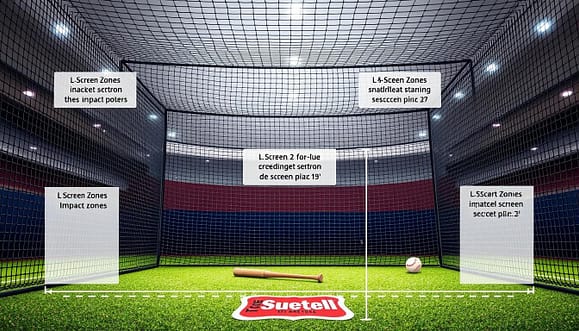
Impact zones need careful planning. The backstop and 10-foot “kill zone” need thick netting. But side and ceiling nets can use thinner netting. It’s about using resources wisely, not just buying the thickest net everywhere.
The L-screen is more than just netting. A good L-screen is a coach’s ally or enemy. I’ve seen screens that collapse easily and others that could withstand a meteor. The best size is 4′ x 6′ to 6′ x 8’—big enough to protect but not too big.
| Gauge (mm) | Best Use Case | Impact Resistance | Cost per sq. ft. |
|---|---|---|---|
| 0.10mm | Ceiling Nets, Low-Traffic Areas | Low (Up to 60mph) | $1.20 |
| 0.15mm | Side Walls, Ceiling, General Use | Medium (Up to 85mph) | $2.50 |
| 0.20mm | Backstop, High-Impact Zones | High (90+ mph) | $4.75 |
| 0.25mm+ | Professional/High-Velocity Use | Extreme (Pro-level) | $8.00+ |
The L-screen is your defense. I’ve seen coaches get hit by ricochets because their screen was weak. The best L-screen is 4′ x 6′ steel, 1.5″ tubing, with 0.20mm netting. Anything less is not enough.
Don’t overlook the frame. Aluminum is light but dents. Steel is heavy but lasts. The best frame is powder-coated 1.25″ steel with a 1/8″ wall. It’s not pretty but stops hard hits.
Before buying “heavy-duty” netting, think: Is it just string, or does it stop fastballs?
Turf & Flooring: infill vs non-infill, shock pads, maintenance plan
The choice of turf can make all the difference in sports. It’s not just about looks or smell. It’s where every move happens. A bad choice can ruin the whole experience.
Think of turf as the base of your sports setup. It’s like choosing between a fast car and a rugged one. We’ll look at the turf debate closely, like analyzing a tricky ground ball.
Infill vs. Non-Infill: The Turf Wars
Choosing between infill and non-infill turf is big. It’s like picking between a fancy car and a rugged one. Each has its own benefits.
| Turf Type | Best For | Shock Pad Required? | Maintenance Level | Player Feel |
|---|---|---|---|---|
| Monofilament Nylon | High-traffic areas, cages | Recommended | Moderate | Firm, responsive |
| Polyethylene | Multi-sport, general use | Highly Recommended | Low | Soft, natural |
| Hybrid Systems | Multi-use facilities | Required | High | Variable |
| Dual Fiber | High-performance zones | Mandatory | High | Tournament-grade |
The turf type affects everything from how balls bounce to how they roll. Monofilament nylon is great for busy cages. Polyethylene is durable and easy on the wallet.
The Shock Factor: More Than Just Padding
Shock pads are key to preventing injuries. They’re like the suspension of your facility. Without them, playing is like running on a hard floor.
When planning your cage dimensions, remember the shock pad. A bit more padding can make a big difference. Different cages need different padding.
The Maintenance Plan That Doesn’t Require a PhD
Keeping your turf up doesn’t need to be hard. It should be as easy as daily batting practice:
- Daily: Brush against the grain to keep fibers upright and prevent matting. Think of it as hair care for your field.
- Weekly: Grooming and debris removal. Those infill pellets love to migrate to the edges.
- Monthly: Deep sanitization. This isn’t just cleaning—it’s germ warfare.
- Seasonally: Groom, drag, and redistribute infill. Your turf type determines frequency.
Remember, your turf type dictates your maintenance, not the other way around. A high-pile, infilled system needs different care than a short-pile putting green.
The right turf can turn your facility into a top-notch sports lab. It’s the difference between playing on a bad floor and a great one. Choose wisely for your players’ health and your budget.
Lighting Targets (Foot-Candles), Glare Control, Camera Mounts
Forget the old dim, flickering lights of batting cages. Lighting an indoor baseball facility is about using light like a movie director. It’s not just about making the space bright; it’s about creating a visual experience. Every curveball spin and pop fly should be clear, without a shadow of doubt.
Get it wrong, and you end up with a dark, shadowy place. Get it right, and you create a stage where every player shines like a star.
Let’s talk about foot-candles. This isn’t about candles for a medieval castle. It’s a scientific measure of light. For fast-paced areas, you need precision. Aim for 50-75 foot-candles in general areas and 100+ for the batter’s box and pitcher’s mound.
But more light isn’t always better. Quality is key, not just quantity. Uncontrolled glare is the enemy. A high line drive into a light fixture can blind a fielder fast.
Uniform, shadowless light is what you aim for. Use indirect lighting and strategic placement to avoid harsh shadows. Think of it like a film set, where the subject is perfectly lit from all angles.
And what do you do with this perfect scene? Film it, of course. This is where cage dimensions and camera mounts matter. High-speed cameras are needed to analyze a hitter’s swing or a pitcher’s release point. Camera mounts must be secure and positioned for the best shot.
They need to be out of the way of balls but offer a clear view. It’s like installing security cameras for a high-stakes heist, where the loot is the perfect swing.
We’ve moved beyond just seeing the ball. It’s about creating a controlled, high-fidelity visual environment. Proper lighting foot-candles ensure clarity, and glare control provides comfort and safety. Strategically placed camera mounts turn practice into data. It’s the difference between playing in a well-lit garage and a perfectly lit soundstage.
The right lighting design doesn’t just help you see the game; it helps you understand it.
Ventilation/HVAC, air turnover, dust/pellet control
If your HVAC system is like the lungs of your facility, poor air quality is like an asthmatic wheeze. You’ve carefully planned your cage sizes and lighting foot-candles. But the air quality is just as important for your athletes’ performance.
Every hit and scuffed turf fiber adds to the air’s particulates. Without a strong HVAC system, your facility feels like a terrarium. The goal is air turnover, exchanging indoor air for fresh, filtered air at least 8-10 times per hour.
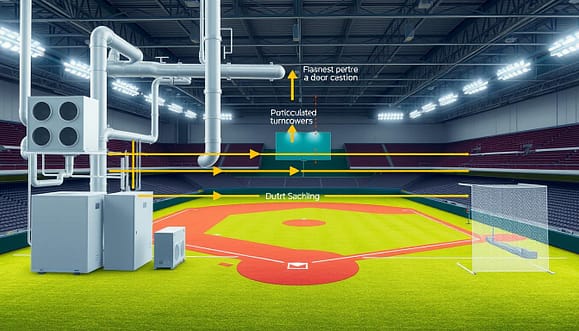
This isn’t just about comfort; it’s about performance and safety. Dust and rubber pellets in the air are harmful. A high-quality HVAC system with a MERV 13 or higher filter is essential. It traps dust from turf and balls before it’s recirculated.
For pitching tunnels and areas with machines, local exhaust ventilation is key. It’s like a dedicated vacuum for the air, sucking up pellet fragments and dust at the source.
Air turnover is measured in Air Changes per Hour (ACH). For a high-activity sports facility, aim for 8-10 ACH. This requires a powerful, correctly sized HVAC system. Strategic air returns capture the heavier, dust-laden air, working with gravity.
High-output lighting generates significant heat. Your HVAC must handle this thermal load, balancing light and air quality. It’s a delicate balance: enough light to see a 90-mph fastball, but enough cool, clean air to keep the pitcher from wilting.
The dust and pellet control strategy is threefold:
- Seal the envelope: Ensure your building is properly sealed and pressurized to prevent unfiltered air and dust from seeping in.
- Targeted filtration: Use high-grade filters at air intakes and consider standalone HEPA air scrubbers in high-dust zones like turf areas.
- Humidity control: Maintain a consistent humidity level (ideally 40-60%). This keeps dust from becoming airborne and prevents a static-charged, dust-clinging nightmare.
Your HVAC system is the silent, unsung workhorse. It doesn’t have the flash of a new pitching machine or the satisfying crack of a well-hit ball. But like a great catcher calling a game, it works in the background, making every other element perform at its peak. Ignore it, and your state-of-the-art facility is just a very expensive, very stuffy warehouse.
Storage & Traffic Flow: The Choreography of Chaos
A cluttered facility is a mess of shin-bruising chaos. Bats, balls, helmets, and gear bags everywhere are not just ugly; they’re a lawsuit waiting to happen. This section is about making your facility run smoothly, like a ballet, not a mosh pit.
Your floor plan is like a stage. The training is the performance. We aim to remove all tripping hazards, both physical and logistical. Good storage and traffic flow design make your cage dimensions and training areas clear and useful.
The Backstage: Intelligent Storage Solutions
Forget the dark, overflowing closet. Modern facility storage is all about smart organization. We want to get gear off the floor and into its own home.
| Solution | Best For | Space Req. | Ideal For Facilities With… | Our Sage’s Take |
|---|---|---|---|---|
| Wall-Mounted Racks & Hooks | Bats, L-screens, PVC swing frames. | Minimal floor space, uses vertical real estate. | Limited square footage; need to keep floor clear. | The workhorse. Gets gear off the floor and visible. Labeling zones for specific gear (e.g., “L-Screens,” “Fungo Bats”) prevents the “black hole” effect. |
| Mobile Bag Trees & Carts | Team gear bags, helmets, catcher’s gear. | Mobile, requires floor space to park. | Multiple teams/clinics; need for flexible, movable storage. | The nomadic solution. Perfect for multi-use spaces. A rolling cart with hooks and shelves is a facility manager’s best friend. |
| Vertical Bat/Helmet Racks | High-volume storage of bats, helmets, and fungoes. | Minimal floor footprint, high vertical use. | High-traffic team facilities with large rosters. | Eliminates the “leaning tower of bats” hazard. A true space-saver that screams “organized.” |
| Labeled, Lidded Bins | Balls, training aids, small parts, first-aid. | Fits on shelving units or in cubbies. | Every facility. The ultimate Tetris piece for small items. | The unsung hero. Transparent bins with big, bold labels prevent the 10-minute search for a new Velcro strap. |
Orchestrating the Flow of Traffic
Storage is static; traffic is kinetic energy. Your facility’s layout must channel that energy, not fight it. Clear walkways are non-negotiable. We’re talking a minimum of 4-6 feet of clear, unobstructed pathway from the entrance to the training areas, free of bag clusters and stray equipment. This isn’t just a suggestion; it’s a critical safety protocol. Think of it as the facility’s main artery—it must remain clear for the safety and flow of athletes and coaches.
Zoning is your strategic blueprint. Physically or visually demarcate zones for specific activities: a “hot zone” for high-activity training (cages, bullpens), a “gear staging area” near the entrance for bag drop-off, and a “dugout zone” for players waiting their turn. This prevents a backstop at the entrance and a traffic jam at the water cooler.
From Blueprint to Reality: The Implementation Waltz
How do you turn a floor plan into a functional reality? Start with a traffic audit. Watch a typical training session. Where do bottlenecks form? Where do bags pile up? That’s your first problem to solve.
Next, create a “home for everything” and use the 5S methodology from lean manufacturing: Sort, Set in order, Shine, Standardize, Sustain. Every bat, ball, and L-screen has a labeled, assigned location. This is essential for safety gear and screens used for netting gauge and cage dimensions analysis. A dedicated, labeled spot for the radar gun and Pocket Radar tripod prevents the pre-session scramble.
Use the floor itself. Simple, high-contrast floor tape can define walkways, safety zones, and equipment staging areas more effectively than a hundred signs. It’s a low-cost, high-impact solution that visually guides traffic intuitively.
In the end, a facility where gear has a home and athletes flow from station to station without a cross-current of traffic isn’t just efficient—it’s a statement. It says performance, professionalism, and foresight. It’s the difference between a glorified warehouse and a high-performance training center where the only thing athletes trip over is their own untapped talent.
Safety Zones, signage, first-aid & AED placement
Let’s be honest: the difference between a top-notch training facility and a legal risk often comes down to the last 1%. You’ve worked hard on the big stuff—the turf type, the perfect lighting foot-candles for cameras, and the flawless turf. But a misplaced first-aid kit or a hidden AED can turn a minor incident into a big headline. Safety isn’t just about following rules; it’s the design that keeps the game safe.
Think of your facility’s floor plan as a stage. The show is the training, but the safety zones are the backstage crew that keeps it running. We’re not just drawing lines on a floor plan; we’re designing a flow of people and equipment that is safe and logical.
Safety Zones: More Than Just Lines on the Floor
A “safety zone” is a special area for safe activities. It’s the difference between a ball hitting a net and hitting a player. We’re talking about areas for pitchers, sliding drills, and “hot zones” where balls might go.
These zones need to be very clear. We use high-contrast, non-slip floor tape or different colored turf type to mark them. This shows that each space has a specific, safe purpose.
Safety zones also include areas for spectators and walkways. A 3-foot buffer zone around batting tunnels and pitching lanes is essential. This prevents accidents, like a coach getting hit by a fastball. It’s not paranoia; it’s physics. A well-planned zone keeps the action in and the accidents out.
The Unspoken Language of Signage
Signage is your facility’s permanent safety teacher. It speaks when you can’t. Good signage directs, warns, and informs without words.
- Wayfinding: Clear, lit signs for exits, restrooms, and first-aid stations. In a high-adrenaline environment, people need to find things fast.
- Warning & Protocol: Signs at the entrance to each cage (“Safety Helmet Required”), on the netting (“No Food or Drink”), and near equipment (“Inspect Bats Before Use”) are not suggestions. They are your first line of legal and practical defense.
- Illumination is Key: All critical safety and exit signs must be visible under all lighting foot-candles conditions. A sign in the dark is no sign at all. Ensure emergency signage is always illuminated, whether by backlighting or well-placed, shadow-free lighting.
The First-Aid Kit and AED: Your Facility’s Fire Extinguishers
You have fire extinguishers, right? An AED (Automated External Defibrillator) and a first-aid kit are no different. They are your medical fire extinguishers.
This isn’t about a band-aid and a prayer. Your first-aid station and AED need a strategic home. It must be:
- Highly Visible & Accessible: Not buried in a locked office. It should be on a main wall, in a high-traffic, central location like a lobby or main training area. Think of it as a “control center” for emergencies.
- Clearly Marked: Use the universal symbol and clear, large lettering (e.g., “AED & FIRST AID”). Everyone from a visiting 12-year-old to a new coach should be able to find it in a panic.
- On the Wall, In a Pinch: The AED and first-aid kit should be mounted together. The wall mount should be simple, secure, and have a clear, audible alarm that sounds when the AED is removed. Time is heart muscle.
Consider this your facility’s non-negotiable safety table:
| Item | Specification | Ideal Placement | Rationale |
|---|---|---|---|
| AED | FDA-approved, with clear audio/visual instructions. | Central lobby or main training floor, on a wall, at average eye level. | Central location ensures |
| First-Aid Kit | OSHA-compliant Class B (or larger) kit with trauma shears, tourniquet, and hemostatic agents. | Adjacent to the AED, or in a clearly marked, unlocked cabinet nearby. | Combined location ensures all emergency medical equipment is found together. |
| Emergency Action Plan | Laminated, single-page EAP (Emergency Action Plan). | Mounted next to AED and at all staff stations. | Provides clear, step-by-step instructions for staff during a crisis. |
In the end, your facility’s safety plan isn’t a cost—it’s your best insurance policy. It’s the silent, well-lit, clearly marked path that guides everyone from a 10-year-old rookie to a professional coach through a space that is not just high-performance, but fundamentally safe. Because the most valuable stat in your facility isn’t on the scoreboard; it’s the number of incidents that didn’t happen.
Sample Floor Plans: From the Compact Cage to the Training Complex
Your floor plan is like the DNA of your facility. It shapes every swing, pitch, and drill. Let’s create three blueprints to turn empty space into a top-notch training area.
In a small facility, every inch counts. Your cage dimensions need to be exact. Roll-up nets help make one lane work for many drills. A strong HVAC system is key to keep the space clean.
Choosing the right turf type is also important. A tough, non-infill synthetic grass can handle the constant use in a small space.
Medium facilities offer more options. You can have different areas for batting, fielding, and plyo exercises. Your HVAC system must handle air quality in each zone. You might pick a different turf type for the cage and fielding areas.
Large facilities are like the big leagues of indoor training. They have dedicated bullpens, various batting tunnels, and open turf for defensive drills. The HVAC system is a big part of the infrastructure. You’ll need durable synthetic turf for busy lanes and longer-pile turf for fielding practice.
A well-planned floor is like a top coach. It guides traffic, avoids safety issues, and makes every inch useful. A bad layout is a joke. A good plan turns your space into a precise tool.