The youth sports tryout often feels like a political campaign. The coach’s kid seems to always get the best spots. Parents whisper to each other, adding to the tension.
After the tryouts, there’s often a lot of arguing. People say it’s unfair, which can hurt the team. It’s not about making everyone equal. It’s about giving everyone a fair chance.
It’s all about clear rules for everyone. Think of it like a team constitution. Before the game, everyone should know how they’ll be judged. It’s about treating each player fairly, not just by their name.
The player evaluation template is key here. It makes the process fair and clear. Coaches want a way to manage expectations. They need a system that builds trust.
A good player evaluation template does more than just track scores. It shows everyone that the process is fair and open. It proves that success is earned, not given.
Tryout station design: hitting, throwing, fielding, speed
If tryouts were movies, a bad one would be confusing. A good one focuses on specific skills. You’re not making an action film; you’re checking athletic skills.
Each station is like an isolation chamber. It shows one part of the game clearly.
This skills testing way stops the “loudest glove” problem. It lets the best players shine, not just the flashy ones. Here are the four key stations for any tryout.
At this station, we see if a player’s swing is good or just lucky. It’s like comparing a skilled guitarist to one who just hits random notes. We check two things:
- Hitting Mechanics: How well the player moves. Is their stance right? Does their swing use power well?
- Hitting Contact: How well the player hits the ball. We look at quality and consistency.
A player with great mechanics but bad contact needs work. One with bad mechanics but good contact is shaky. This station shows which is true.
The Throwing Station: The Art of the Carry
Arm strength is obvious, but accuracy is key. The real magic is in the carry. This station checks the arm’s skill.
We look for:
- Arm Strength & Release: How fast the arm can throw.
- Accuracy & Footwork: How well the player hits targets from different spots.
- Ball Flight: How the ball moves. A good throw has control all the way to the target.
It’s like judging a public speaker. Strength and accuracy are important, but the tone is what really matters.
The Fielding Station: Grace Under Pressure
This station isn’t about making pretty catches. It’s about handling pressure well. A bad hop is like an unexpected question. How do they handle it?
The station tests infield defense in three ways:
- Footwork: The first step. Is it quick and controlled?
- Soft Hands: How well the player catches the ball. Is it quiet and secure?
- Transfer Speed: How fast the player goes from catch to throw. Is it smooth?
We use different types of throws to test infield skills.
The Speed Station: Pure Athletic Currency
Speed is something you can’t really teach. It’s natural talent. In today’s sports world, it’s very important. But how do you measure it?
There’s a debate about timed 60-yard dashes versus home-to-first times.
- 60-Yard Dash: A test of pure speed. It’s like a test score for athletes.
- Home-to-First: A test of speed in the game. It shows how well a player runs in real situations.
I suggest doing both tests. The dash shows top speed, and home-to-first shows game speed. Together, they tell if a player is fast or just quick.
Setting up these stations is like making a playlist. Hitting is the first song, throwing is the ballad, fielding is the bridge, and speed is the finale. When done right, they show a player’s full athletic ability.
The goal is a tryout that flows well and shows a player’s skills clearly. No confusion, just facts. From these facts, you’ll find the right players.
Timing and scoring standards by age group
Stopwatches treat everyone the same, no matter their age. But in youth sports, this fairness doesn’t always apply. Using the same stopwatch for a 10-year-old as for a high schooler is unfair and useless.
We need to focus on what’s right for each age group. It’s not about finding the fastest kid. It’s about finding the one who shows the most promise for their age.
Creating realistic timing standards is key. What’s “good” for a 12-year-old is different from what’s good for a 14-year-old. It depends on your league’s goals.
Is a fast fastball from a big 14-year-old better than a precise fastball from a smaller player? The stopwatch says yes. But smart coaches know it’s about more than just speed.
We need standards that fit each player’s growth stage. This way, we can spot current and future talent accurately.
Let’s create a table that shows how to measure progress. It’s like moving from a simple stopwatch to a more meaningful tool.
| Drill | 10U (Age 9-10) | 13U (Age 12-13) | 16U (Age 15-16) | Philosophical Focus |
|---|---|---|---|---|
| 60-Yard Dash | 9.5 – 10.5 seconds | 8.2 – 9.0 seconds | 7.0 – 7.8 seconds | Mechanics over raw time. Does the runner look efficient? |
| Home-to-First Time | 5.0 – 5.8 seconds | 4.5 – 5.2 seconds | 4.0 – 4.7 seconds | Explosiveness out of the box. First-step quickness. |
| Catcher Pop Time | 2.8 – 3.5 seconds | 2.3 – 2.9 seconds | 2.0 – 2.5 seconds | Clean transfer and footwork over a cannon arm. |
| Infield Throw Velocity | Not measured | 55 – 70 mph | 70 – 85+ mph | Arm action and accuracy at 10U. Arm strength emerges at 13U. |
The developmental standards column is just as important as the times. At 10U, we look for good form, not just speed. At 13U, we see physical differences and aim to find the right fit for each player.
This table is a starting point, not a rulebook. A 10.2 second dash from a 10-year-old with good form might show more promise than a faster time from someone who looks older. It’s about understanding each player’s journey.
Sample rubrics with weighted criteria
Welcome to the Moneyball moment of your tryout. Here, we move beyond just watching players. We start to see their value in your specific system. A weighted rubric turns raw skills into a clear score.
Consider this: Is a laser throw from the outfield as valuable as a well-placed bunt? Definitely not. Your rubric must reflect your team’s unique style. A team focused on power hitting will have a different scorecard than one that values small-ball tactics.
Let’s create a rubric. We’ll use common skills like hitting mechanics and pitching as our base. But we’ll assign points based on what’s most important to your team. For example, imagine evaluating a player for a 12U team.
| Skill Category | Max Points | Weight | Core Evaluation Focus |
|---|---|---|---|
| Hitting Contact & Power | 40 | 40% | Ability to make consistent, hard contact; gap power. |
| Defensive Fundamentals (Arm & Hands) | 30 | 30% | Throwing accuracy, footwork, clean fielding. |
| Base Running & Athleticism | 20 | 20% | Speed, instincts, agility on the paths. |
| Game Awareness & Coachability | 10 | 10% | Understanding situations, hustle, responsiveness. |
This approach gives hitting the most weight. Defense is important, but a bit less so. Athleticism and intangibles also get their own sections.
Let’s dive deeper. Under “Hitting Contact & Power” (40 points), you might score players on mechanics, contact quality, and power. This structured scoring system helps compare players fairly. Player A might score 32/40, while Player B scores 28/40. The difference is clear, not just a feeling.
The magic is in the weighting. A player with great defense but a weak bat might score well in defense but not overall. This isn’t a flaw—it shows their strengths.
Creating your rubric is where art meets analytics. It’s not just about measuring skills; it’s about defining what matters. This score helps you see who truly fits your team.
Role-specific add-ons: pitcher, catcher, utility
Building a team is more than just picking athletes. It’s about using special tools to figure out where they fit best. General tests show who can play baseball. But our selection criteria show where they should play it.
Imagine casting a heist movie. You need a safecracker, a driver, and a lookout. Each has unique skills. Your baseball team works the same way.
Pitchers are all about speed, but mechanics and consistency are key. Does their arm action look sustainable? Can they throw different pitches with the same accuracy?
Also, we look at pitch variety. A fastball is good, but a fastball with a great changeup is even better. And then there’s mound presence, the confidence that makes a pitcher unstoppable.
Our pitcher selection criteria module checks all these things. It finds the athlete who sees pitching as a strategic game, not just a physical challenge.
Catchers face a different challenge. We value quietness and control over showy framing. Does their mitt absorb the ball softly, or snap back harshly?
Blocking technique is also key. We look for quick drops, not dives. And the pop time, measured by how fast they throw to second, is critical.
Lastly, we consider field general IQ. Does this player lead the infield? Do pitchers trust them? This intangible can be more important than a strong arm in our selection criteria matrix.
Utility players are not just backups. They’re essential, versatile players. They need to be good at many positions, like third base and right field.
Offensively, we look for consistent hitters, not just power hitters. A .280 hitter who makes contact is more valuable than a .220 hitter with occasional home runs. They’re the backbone, not the flash.
Our utility add-on values adaptability and baseball smarts. It finds players who can fill different roles in your team’s defense.
To use these modules, you need separate stations for each role. Pitchers throw to live hitters, catchers work on blocking and throwing, and utility players practice at different positions.
Observers for these stations need to be experts. Your pitching coach checks pitchers, your best catcher evaluates catchers, and experienced players assess utility players. This expertise is essential.
Why go to such lengths? It’s about building a complete team, not just picking the best athlete. You need to find players who solve your team’s defensive puzzles. The answer lies in detailed, role-specific selection criteria.
This approach is different from just drafting for a fantasy league. It’s about building a real team that can play all nine positions every game.
Observer training and bias reduction
All the stopwatches and rubrics in the world won’t save you from the biggest variable in any tryout: the observer’s brain. You can have Olympic-grade timing and a rubric so detailed it would make a NASA engineer blush, yet collect garbage data. Why? The human element. Every evaluator arrives with a suitcase full of cognitive baggage.
Think of your typical volunteer parent or assistant coach. They’re not malicious. They’re just… human. Their brains are wired for efficiency, which means they take shortcuts. These mental shortcuts are called cognitive biases, and they turn objective evaluation into subjective noise.
The solution begins with transforming how we take coach notes. Most evaluators default to judgmental comments: “bad arm,” “slow runner,” “terrible attitude.” This is useless data. It’s like a restaurant critic writing “food bad” instead of describing the overcooked steak and bland sauce.
Effective coach notes follow a simple formula: describe, don’t judge. Instead of “bad thrower,” note “arm action is long in the back, causing release point inconsistency.” Instead of “good hitter,” write “demonstrates quick hands through the zone with level swing path.” This creates actionable data coaches can actually use.
The Bias Breakdown: Know Your Enemy
Let’s play bias bingo. You’ve probably seen all these classics without realizing their names:
- Recency Bias: The last play looms largest. A kid makes an error in station 5? Suddenly their excellent performance in stations 1-4 fades from memory.
- Halo Effect: A great hitter must be a decent fielder. Athleticism in one area creates a glow that unfairly brightens scores elsewhere.
- Affinity Bias: That kid hustles just like you did back in ’92. You’re not evaluating talent; you’re looking for your younger self.
- Confirmation Bias: You heard Johnny was the travel team star, so you see what you expect to see, ignoring contradictory evidence.
Training observers means making these invisible biases visible. Run a pre-tryout calibration session. Show video clips and have evaluators score them independently, then compare. The disagreements will be enlightening—and often hilarious.
| Bias Type | Description | Impact on Evaluation | Mitigation Strategy |
|---|---|---|---|
| Recency Bias | Overweighting the most recent performance | Inflates/deflates scores based on final impressions | Take immediate notes after each station; review all data before final scoring |
| Halo Effect | Letting one positive trait influence all scores | Creates artificially consistent scores across different skills | Use separate evaluators for different skill stations when possible |
| Affinity Bias | Favoring athletes who remind us of ourselves | Personal connection overrides objective assessment | Implement “blind” evaluations using numbers instead of names initially |
| Confirmation Bias | Seeking evidence that supports pre-existing beliefs | Ignores contradictory performance data | Require specific evidence for all scores; challenge assumptions openly |
| Groupthink | Aligning scores with other evaluators’ opinions | Creates artificial consensus, suppresses dissent | Have evaluators submit scores independently before discussion |
The Calibration Protocol
Here’s your playbook for creating unbiased observers. First, establish a common language. What does “4 out of 5” in arm strength actually look like? Show video examples. Create anchor points everyone can reference.
Second, implement a peer-review system. Have evaluators swap score sheets periodically. This isn’t about policing—it’s about creating collective accountability. When Coach Smith sees Coach Jones wrote “needs to follow through toward target” instead of “bad thrower,” they learn by example.
Lastly, embrace the “blind” setup where logistics allow. Use numbered pinnies instead of names. Have athletes rotate through stations without their names being called. It’s not always possible, but even partial anonymity reduces bias significantly.
Remember: your goal isn’t robot evaluators. It’s calibrated human evaluators. The comments in the margins should be as valuable as the numbers in the boxes. When your observers can separate what they saw from what they felt, you’ve moved from subjective noise to objective signal.
This is the peer-review process for sports. It turns your tryout from a popularity contest into a talent discovery system. And it starts with training your observers to see clearly—biases and all.
Data capture tools: sheets, apps, barcode/wristband
Data capture at tryouts has changed a lot. Coaches now have to pick between old-school methods and new tech. Your choice shows if you like to write a lot or if you’re into numbers.
Using scoring sheets is like going back in time. You need a clipboard, a pencil, and a PDF or Excel sheet. It’s easy to carry and use.
This method is simple and doesn’t need batteries or updates. You can control everything yourself. Plus, it doesn’t cost anything every month.
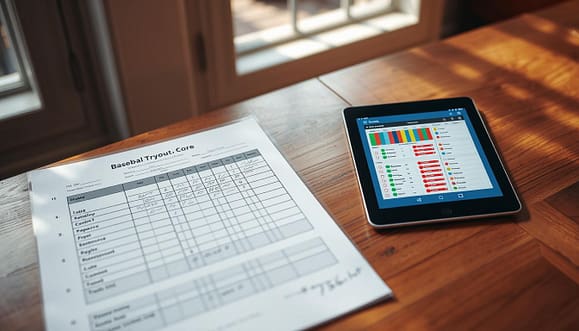
But, there’s a downside to using paper. After tryouts, someone has to type all the data into a spreadsheet. Mistakes can happen, and it takes a lot of time.
Then, there’s SkillShark, a digital solution. It lets you score on tablets or phones. The data updates instantly and is stored online.
This change is huge. You don’t have to type everything out anymore. You get results fast and can track progress over time.
| Feature | Printable PDF/Excel Sheets | SkillShark’s Digital Software |
|---|---|---|
| Scoring Method | Manual pencil-and-paper entry | Real-time digital input on devices |
| Data Compilation | Manual transcription required | Automated, instantaneous aggregation |
| Record Keeping | Static, single-event snapshots | Dynamic progress tracking over time |
| Result Sharing | Manual distribution (email, print) | Instant digital report cards |
The digital way is faster and shows data in a cool way. It works well for big tryouts. But, you have to pay for it.
Identifying players is another challenge. Even with digital tools, it’s important to match scores with players fast. That’s where smart tricks come in.
Wristbands with numbers are a simple solution. Give each player a number at the start. Score by number to avoid bias.
For those who like tech, there’s barcode scanning. Print barcodes for each player. Scan them to see their profile before scoring. It’s modern and error-free.
So, what’s better? The old scoring sheet or the new digital tools? It depends on your budget, comfort with tech, and how much you dislike typing.
Remember, the tool is just a tool. It’s how you use it that matters. Pick what lets you focus on the players, not paperwork.
Post-tryout process: ranking, callbacks, communication
The tryout is over, and now you’re left with a lot of data. It’s like trying to make sense of a Wall Street report. This is where the real work begins.
First, you need to rank the players. Gather your team, their score sheets, and that report you made. It’s not about opinions; it’s about the facts. You’ll discuss each player’s score against your criteria.
This process helps you make your final list. Then, you decide who needs a second chance. A callback is a chance to check specific skills again. It’s a detailed review before making your final decisions.
Next, you have to talk to everyone. This is where your fairness is shown. You need a plan for every outcome. The data from your reports is key for these conversations.
How do you tell players they made the team? It’s a mix of celebration and clarity. Confirm their spot and talk about what’s next. The hard part is telling those who didn’t make it. Be kind, direct, and focus on how they can improve. For tips on the initial event, check out this guide.
Lastly, send an email to everyone. Thank them for trying out, share when rosters will be posted, and offer off-season help. Clear communication is key.
| Player Outcome | Primary Goal | Key Messaging | Tool to Use |
|---|---|---|---|
| Make (Roster Spot) | Confirm & Onboard | “Congratulations! Your performance in [specific station] really stood out. We’re thrilled to have you. Next steps are…” | Auto-generated report highlight; Official team invite. |
| Cut (Not Selected) | Encourage & Develop | “Thank you for your effort. We noted your [specific strength]. To make the next roster, focus on [1-2 areas from data]. We recommend…” | Report snippet as concrete feedback; Links to local clinics or IDP inputs for personal practice. |
| Callback (Second Look) | Clarify & Decide | “We’d like a second look at your [specific skill] this Thursday. This helps us finalize our decisions.” | Targeted evaluation sheet for the callback session. |
The post-tryout process is just the beginning. It’s the first step in a player’s journey with your league. The data, rankings, and feedback all play a part in this journey. Treat this process with care and attention.
Turning scores into Individual Development Plans
If your league sees evaluation day as a final verdict, you’re missing the point. The real magic happens after the last player crosses home plate. Those detailed youth baseball evaluation forms should start a player’s journey, not end it.
Think of it this way: you’ve just done the most detailed check-up a kid will get all season. To ignore that data is like a doctor finding a weak muscle and saying “good luck.” The smart move? Use that score sheet as the first page of an Individual Development Plan (IDP).
Let’s get specific. A player scores a 6/10 on throwing accuracy. The old way just shrugs. The IDP way asks: What does that 6 actually mean? Is it a footwork issue? A grip problem? Poor hip-shoulder separation? That number becomes a prescription.
It leads to specific drills: long-toss for arm strength, towel drills for mechanics, and target work for precision. Suddenly, “6/10” isn’t just a number; it’s a workout plan.
Take the classic slow 60-time. It’s not just “needs to be faster.” It’s a guide to agility ladder sessions, explosive starts, and plyometric box jumps. The evaluation data doesn’t highlight a flaw—it points to the next skill to master.
This is where you move from gatekeeper to mentor. For players who made the team, the IDP fits right into practice. For those who didn’t? This document is your league’s most valuable gift. It shows you care about their growth, not just your roster.
I give coaches a simple, quarterly goalsheet template. It turns raw scores into 3-4 development priorities. Here’s how it works:
| Evaluation Metric | Score | IDP Priority | Sample Actionable Drill |
|---|---|---|---|
| Throwing Accuracy (OF) | 6/10 | Improve consistent strike to cutoff man | “Bucket Drill”: Hit 5-gallon bucket from 120 ft, 3x weekly |
| 60-Yard Dash | 9.8 sec | Improve first-step explosiveness | Resistance band starts, 10 reps daily |
| Batting Contact (Live Pitching) | 4/10 | Shorten swing path | Tee work inside/outside, focus on hands to ball |
This isn’t charity; it’s a long-term talent strategy. The kid you send home with a personalized plan today becomes the motivated, improved player trying out next season. You’re not just building a team—you’re growing a better talent pool for your entire league.
The process turns anxiety into aspiration. Parents stop seeing the tryout as a single, high-stakes exam. They see it as the first step in a documented development journey. The conversation shifts from “Why didn’t my child make it?” to “What should we focus on this summer?”
So, close the tryout with phone calls, yes. But then open the development workshop. Give every family—every single one—a roadmap made from the data on your youth baseball evaluation forms. That’s how you build loyalty. That’s how you become a developer of athletes, not just a selector of them. The score sheet is just the beginning. The plan is everything.
Parent transparency and appeal policy
The toughest opponent at tryouts isn’t the other players. It’s the parents’ conspiracy theories. Without transparency, rumors of favoritism and secret handshakes spread. Your defense? Radical transparency and a solid appeals process.
Think of it as pre-emptive PR. Host a mandatory parent meeting before tryouts. This isn’t optional—it’s essential. Explain the process, show sample youth baseball evaluation forms, and discuss bias reduction. When parents see the process, they’re less likely to imagine ghosts.

This meeting does two things. It makes you the authority and sets the rules. Parents who understand the scoring are less likely to question it.
Now, let’s talk appeals. Every system needs a way to handle concerns. Your appeal policy should be clear from the start. Announce it at the pre-tryout meeting. Frame it as proof of your commitment to fairness.
The structure is key. Here’s a policy that works:
- Cool-Down Period: 24 hours before any appeal can be filed. No heated confrontations. Emotion clouds judgment.
- Written Request Only: Parents submit a formal, written request. This forces clarity.
- Neutral Committee Review: Scores are reviewed by evaluators not involved in the original assessment. No single coach has final say.
- Evidence-Based Decision: The committee looks only at documented data. “I think he’s better” isn’t evidence.
This process changes the dynamic. Instead of shouting, you have a structured review. Parents become participants, not opponents.
The key? Those youth baseball evaluation forms. They prove the case. When a question arises, you point to the sheet. “Here’s the throwing velocity recorded. Here’s the fielding footwork score. Here’s how it compares to the age-group benchmark.” The document ends the argument before it starts.
This approach has a beautiful side effect: it makes appeals rare. When parents trust the process, they accept the outcome. The energy spent defending decisions gets redirected toward developing players. You’re not just running tryouts; you’re building community credibility.
In the end, transparency isn’t about avoiding conflict. It’s about winning the right conflicts on your terms. Give parents the playbook before the game starts. Then, when the final roster is posted, the only surprise should be how little drama follows.
Downloadable forms: editable PDFs and Sheets
Building a beautiful engine is pointless without a car. The same goes for fair tryouts without the right tools. This section is your pit stop for the gear you need.
I’ve gathered the exact youth baseball evaluation forms we’ve talked about. You’ll find an editable PDF of a detailed Player Evaluation Template. It has sections for hitting, throwing, fielding, and speed. There’s also room for your notes, turning numbers into a player’s story.
For coaches who love data, I’ve got a Google Sheets template too. This digital tool makes scoring and ranking easy. It turns notes into a clear leaderboard fast.
These templates are just the start. Download them, change them, and make them fit your league’s needs. The best youth baseball evaluation forms grow with your program.
Make these templates your own. Your next season’s roster will thank you for the clarity they bring.