You have 90 minutes in the gym. The players are ready, and the last whistle is fresh in your mind. You can’t just keep running drills. It’s about making every minute count to improve skills and fitness without exhaustion.
Forget endless laps and aimless games. A high-output practice is like a precise surgery. It’s not about exhaustion but a structured 90 minutes that warms, teaches, challenges, and recovers. The aim is to turn drills into a fun, age-appropriate session that enhances skills.
So, what’s the plan? It’s divided into three parts: a dynamic warm-up, skill-specific drills, and a scrimmage. The key is intentional structure. For more on creating these structured basketball practice plans, from start to finish.
Let’s explore how to make every minute of that 90-minute session valuable.
Planning Backward from Game Skills
Building a youth baseball player is not about random drills. It’s a detailed process that starts with the game-winning play and goes back to the first warm-up. It’s like building an athlete, not just running a practice.
Forget the old “drill sergeant” way. We’re not just doing youth baseball drills like herding cats. We’re architects, designing each step back from a game-winning play. It’s like planning a chess game ten moves ahead.
This isn’t about repeating drills without purpose. It’s about focusing on each cage station in your indoor practice plans. Each station is a step back from a specific in-game skill. For example, to hit an outside pitch to the opposite field, every drill should aim for that goal.
The table below shows how planning changes:
| Planning Phase | Traditional Approach | Backward Planning Approach | Game Skill Developed | Sample Drill/Station |
|---|---|---|---|---|
| 1. Foundation | Start with basic swing mechanics. | Start with the in-game swing outcome and work backward. | Hitting with 2 strikes | Two-strike approach station: Foul-off and opposite-field drills. |
| 2. Execution | Run a generic “hitting” station. | Set up a cage station that simulates a 3-2 count with a runner on 3rd. | Producing a run with a contact swing | Live at-bats with a runner on 3rd, less than 2 outs. |
| 3. Integration | Isolated fielding or hitting. | Combine skills: a defensive play followed by a situational at-bat. | Turning a double play, then hitting with RISP | Field a grounder, make the throw, then step into a situational hitting cage. |
| 4. Competition | Scrimmage with no specific constraints. | Live ABs with a specific goal: “Score from 2nd on a single.” | In-game situational awareness and execution | Controlled scrimmage with bonus runs for executing situational hitting. |
This changes your indoor practice plans a lot. That cage station is not just for hitting balls off a tee. It’s a place to work on a specific in-game skill. Your youth baseball drills become very focused. Instead of just fielding, you’re practicing a double play under pressure.
This backward planning changes how you develop skills. You’re not just doing exercises. You’re building athletes by starting with the high-pressure play. You break it down to the physical and mental skills needed.
Now, your indoor practice plans are like a curriculum. Each cage station is a chapter in a book. You, the coach, are writing the story backward from the championship-winning page. The result is a team that can perform under pressure because they’ve practiced every step many times.
Space Map: 2 Cages + Bullpen + Open Area Example
An indoor facility is not a playground. It’s a well-oiled machine. We aim to make every inch count, ensuring each move is part of a bigger plan. The goal is to maximize player-touches and quality reps. Let’s design your space like a pro.
Imagine planning a city for youth sports. We’ll transform a basic setup with two cages, a bullpen, and a turf field into a top-notch training spot. This isn’t just a layout; it’s a strategy for space optimization.
The secret lies in how we zone the space. You have three main areas, each with its own role. The cage stations focus on detailed skill work. The bullpen setup is for the pitching team’s strategy. The open area is for defense and agility training. The key is moving athletes smoothly between these zones to cut down on downtime.
| Zone | Primary Function | Key Equipment/Drills |
|---|---|---|
| Cage Stations (2) | High-volume, focused hitting. One cage for machine work, one for live/soft toss. Rotate groups every 15-20 mins. | Batting tees, L-screens, soft-toss nets, HitTrax or similar tech for immediate feedback. |
| Bullpen Zone | Pitcher/catcher development, pitch design, and mechanical work. Isolated from other activities for safety and focus. | Pitching mound, portable mound, L-screen, catcher’s gear, radar gun (for velocity, not results). |
| Open Lab Area | Defensive drills, agility work, and overflow hitting. The “lab” for new defensive alignments and footwork. | Fungo bats, tennis balls, cones, agility ladders, and a portable net for short-hop drills. |
The key idea is tactical zoning. You wouldn’t mix a chemistry lab with a woodshop. The indoor facility layout needs clear paths between zones. Place the bullpen behind a protective L-screen, with the open area as a buffer. This isn’t just a floor plan; it’s a workflow. A well-designed space, like those for indoor baseball facilities, can cut idle time by 30% or more. It turns a room into a high-output training ground where every player has a role.
U8/U10/U12 Sample Plans with Minute-by-Minute Rotations
Organizing a youth baseball practice is like conducting an orchestra. But, it’s even harder because half the musicians are on a sugar high. The key is a practice schedule as precise as a Swiss watch. We’re not just filling 90 minutes; we’re scripting a 5-act play where every minute is a line in the script.
Think of your practice space as a stage. We have 90 minutes, divided into five acts. Each act has a specific, timed purpose. The clock is your co-coach.
For the U8 group, we’re dealing with attention spans shorter than a pop fly. We use timed rotations of just 5 minutes. It’s like a baseball-themed amusement park: they hit the “Tee Work” ride, sprint to the “Ground Ball Gauntlet,” then hop over to “Fly Ball Fundamentals.” Boom, boom, boom. They’re moving before boredom even has a chance to yawn.
The U10 squad gets a 6-minute clock. Their stations require a bit more cognitive load—like a cut-off and relay station, a soft-toss station, and a situational fielding drill. The timed rotations keep the energy high and the standing-around time at absolute zero.
By U12, we’re building stamina and focus. We stretch the rotations to 8 minutes. Now the age-specific drills get more complex: bunt defenses, first-and-third defensive plays, and hitting with a 2-strike approach. The longer station time allows for more complex instruction, but the timer is always the boss.
The 90-Minute, 5-Act Blueprint
Here’s how a sample U10 practice schedule might flow:
- Act 1: Warm-Up & Dynamic Stretch (15 mins) – The non-negotiable. Jog, dynamic arm circles, leg swings. We’re waking up the body, not just killing time.
- Act 2: Skill Stations (45 mins, 3 stations x 15 mins each) – The meat of the youth baseball practice. One group is in the cage for timed rotations on the tee and soft toss. Another is in the bullpen on age-specific drills like pitcher fielding practice (PFP). A third group is on the “infield,” working double-play feeds with a timing and footwork focus.
- Act 3: Scrimmage/Situation (20 mins) – Live, but controlled. Runner on 2nd, 1 out. Infield in. Execute a run-down play. This is where practice schedule meets game reality.
- Act 4: Cool-Down & Review (10 mins) – Static stretching, water, and one positive, specific piece of feedback for each player.
This isn’t just a practice schedule; it’s a curriculum. Every minute has a purpose, every drill has a why, and the clock is the conductor of the chaos. The result? You’re not just running a practice. You’re running a program.
Hitting Progressions: Tee → Front Toss → Machine → Situational
Think of hitting progressions like a video game. You can’t beat the final boss without getting stronger first. You start with the tee, which is like the game’s tutorial.
Every swing in a real game comes from a series of hitting progressions. Each step builds on the last. Skipping a step can make your swing weak.
We start with batting tee drills. It’s like creating your character. There’s no pitcher, just you and the ball. This is where you learn your swing.
Then, we move to front toss. It’s the first time you face a moving ball. It’s like the game’s “easy” setting. You learn to time your swing here.
The pitching machine comes next. It’s like the game’s “normal” difficulty. The machine doesn’t get tired. It helps you react fast to different pitches.
Lastly, we get to the situational at-bat. This is the “boss fight.” It’s high-pressure, with runners on and two outs. You use everything you’ve learned to succeed.
This step-by-step approach is how you build a hitter. You can’t skip levels. Each step is important. The cage stations are your training grounds.
Master each level, and playing the game becomes easier. The real game, with lights on and crowd cheering, is more fun when you’re ready.
Pitcher/Catcher Block with Plyo & Receiving Drills
The pitcher and catcher form a duo that can change the game. It’s not just a team; it’s a dance of quick moves and precise timing. We’re not just building players; we’re creating a high-performance team.
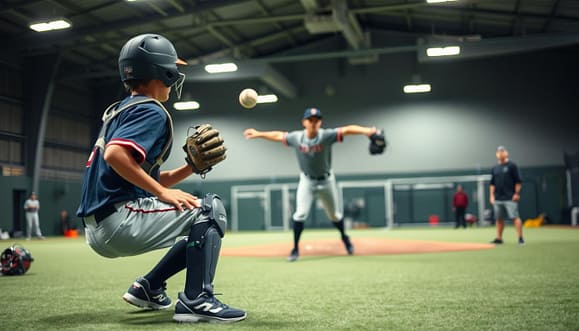
In the bullpen, pitchers are not just throwing. They’re being built into athletes. Plyometric drills give them explosive power. Think of box jumps for strong legs and medicine ball slams for a strong core. It’s not just about throwing fast; it’s about using every part of the body to throw hard.
We start with depth drops for strength, then lateral bounds for hip power. Rotational medicine ball throws mimic the pitch’s torque. Each drill is a piece of the puzzle. Our goal is to make the mound a launchpad for power.
Catchers focus on receiving, not just catching. Receiving drills make them a target for the pitcher. We teach them to catch with soft hands, making the umpire think it’s a strike. A well-framed pitch can turn a ball into a strike, winning the game.
| Plyometric Drill | Primary Focus | Sets/Reps | Pitching Benefit |
|---|---|---|---|
| Depth Drop to Box Jump | Eccentric to concentric power transfer | 3×5 | Explosive leg drive off the rubber |
| Medicine Ball Rotational Throws | Rotational power & core activation | 3×8 each side | Generating torque for velocity |
| Lateral Bounds | Hip power & lateral drive | 4×6 each leg | Stability and drive toward home |
| Single-Leg Box Squat Jumps | Unilateral power & stability | 3×8 each leg | Balance and drive leg power |
| Reactive Medicine Ball Toss | Reactive power & hand speed | 4×6 | Arm speed and fast-twitch response |
The magic happens when these pieces come together. A bullpen session becomes a dialogue. The pitcher’s power meets the catcher’s soft hands. This pitcher-catcher chemistry is more than just rapport; it’s a shared language of trust.
In our bullpen sessions, we pair plyometric drills with receiving drills. The pitcher works on explosive leg drives, while the catcher focuses on framing pitches. This is coordinated development, not parallel play. The result? A battery that works like a Swiss watch.
So, when we talk about pitcher-catcher chemistry, we’re not just talking about signals. We’re building a kinetic partnership where every pitch is a conversation. That’s the heart of baseball’s most fundamental partnership.
Defense Indoors: Short-Hop Lanes, Turns/Feeds with Nets
Practicing defense indoors is like playing chess in a small space. The walls are close, the ball moves fast, and every mistake is loud. But, this tight space is perfect for learning game pressure.
We’re not just catching grounders; we’re learning the 6-4-3 double play in a small room. Welcome to indoor defense drills, where we mix geometry and anticipation.
Forget the open field. We divide the cage into defense in lanes like a highway system. We use tape or cones to mark three lanes from the batter’s box to the net.
A grounder hit in the 5-6 hole goes to the left lane. A screamer up the middle goes to the center lane. This system makes drills repeatable, teaching us to read the game.
The key to short-hop drills is the short hop itself. Indoors, the ball moves differently. We teach kids to field bad hops and read the ball’s spin.
Short-hop drills are about solving physics problems. We set up drills where the ball is skipped or thrown to create a short hop. This forces fielders to read the ball’s spin and smother it.
Now, let’s talk about infield turns. The 6-4-3 double play is a challenge indoors. We practice the second baseman or shortstop’s footwork in a small space.
The focus is on the quality of the feed and the footwork. We use a towel or pad to practice turning in a tight circle. It’s a beautiful ballet in a small space.
We put it all together in a drill. A coach or machine hits a ground ball to the shortstop. They field, turn, and make a strong feed to first for a 6-3 putout. It’s a sequence of skills that builds muscle memory.
This isn’t just fielding practice; it’s about learning spatial awareness and defense in lanes. When we play outdoors, the indoor drills feel like a cathedral.
Compete Segment & Exit Velocities (Age-Appropriate)
The compete segment is like practice’s final exam. It’s where mechanics and mentality meet, and launch angles are tested. This is where we see what really stuck. We’re not just swinging for the fences; we’re collecting data to build better hitters.
Forget the old-school “grip it and rip it” philosophy. In today’s data age, we have better metrics than just the sound of the bat. Exit velocity isn’t just for the big leaguers; it’s a direct feedback loop for player development. It answers the “so what?” after a great swing. It’s the difference between a weak grounder and a line-drive double, and it tells a story that batting averages can’t.
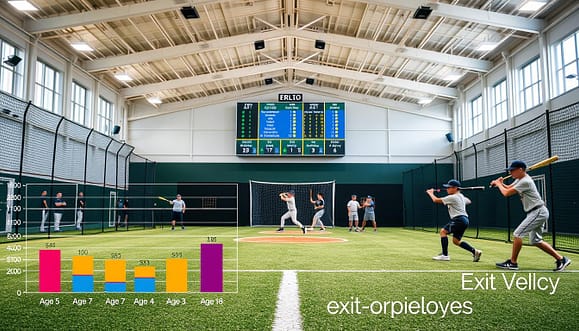
But here’s the key: not all exit velocity is created equal, and chasing radar-gun numbers with a 12-year-old is like giving a new driver a Ferrari. Our compete drills are designed to measure age-appropriate metrics that prioritize process over raw power.
Here’s the game plan. We use controlled, game-like at-bats during the compete segment. A pitcher (coach or machine) throws, a hitter competes, and we track the results. The goal isn’t to win a Home Run Derby, but to win the at-bat. We’re looking for quality of contact, not just contact.
Our compete drills create this environment. It’s “live” BP with a score. The defense is live, the base-runners run, and the scoreboard matters. This isn’t cage work; it’s a pressure-cooker that reveals who can perform when it counts.
The table below breaks down our age-appropriate benchmarks. Think of it as a developmental roadmap, not a scouting report.
| Age Group | Primary Focus | Target Exit Velo Range | Key Metric | Compete Drill Example |
|---|---|---|---|---|
| U8 / U10 | Contact & Form | 40-55 mph | Solid Contact % | “Contact King” – Points for any fair ball, bonus for line drives. |
| U12 | Driving the Ball | 55-70 mph | Line Drive % | “Gap-to-Gap” – Score based on hitting the ball to the opposite field, center, and pull side. |
| U14+ | Exit Velocity & Hard Hit % | 70+ mph | Hard Hit % (EV 85+ mph) | “Exit Velo Challenge” – Score based on hitting velocity benchmarks. |
Notice the progression? At U10, we celebrate a hard-hit grounder. By U14, we’re tracking the batting power behind that 85+ mph line drive. This isn’t about creating major leaguers at 12; it’s about setting a baseline. Is a player’s exit velocity trending up over the season? That’s a win. Did their hard-hit rate jump 10%? That’s a massive win.
So how do you run it? Simple. Set up a 15-minute block at the end of practice. Live at-bats, live defense, a coach calling balls and strikes. Keep score. A point for a line drive, two for a double in the gap. The pitcher gets a point for a strikeout. The goal is to create a game within the game where the process—making hard, quality contact—is the objective.
This is where the nerdy meets the necessary. We’re not just building athletes; we’re building ballplayers who understand the “why” behind the swing. The age-appropriate metrics from the table above aren’t ceilings; they’re guideposts. They tell a player, “This is where you are, and here’s the next hill to climb.”
In the end, the compete segment is about making practice count. It turns the cage into a laboratory and every swing into a data point. Because in the real game, when the pressure’s on, you don’t rise to the occasion—you fall to the level of your training. This is how we train for the occasion.
Trackers: Attendance, Reps, Quality Contacts
You’ve run drills and logged exit velos. But without a ledger, effort is just sweat. Practice analytics turn effort into hard proof. We track to find the story the numbers tell.
Our first metric is simple: attendance tracking. Showing up is the baseline. We log it. Next, we count rep counts for swings, grounders, and pitches.
But volume without a target is just noise. That’s where quality contacts come in. We note solid at-bats, pitches that hit their spot, and backhand plays made in the hole. A good practice app or a simple Google Sheet column for “Barrels” or “Web Gems” tells the real story.
This isn’t about creating spreadsheets for their own sake. It’s Moneyball for the travel ball set. That data is your shield against “we never work on that” and your proof of progress for the player who feels stuck.
It turns “I think I’m getting better” into “My quality contact rate is up 15% this month.” It shows that practice, measured and intentional, doesn’t just make perfect. It makes progress permanent.