Welcome to the world of youth sports planning. It’s as tough as the midday sun and as busy as a parent’s group chat.
Running a youth league is more than finding a field. It’s a mix of science, weather, and people skills. It’s like trying to manage cats in sports gear.
This guide is your strategic command center. We’re using smart thinking and humor to help you. Forget the usual advice. Think of this as a mix of Sun Tzu and a detailed, sweaty spreadsheet.
We aim to create a safe, lasting, and manageable season. Let’s move past the chaos and become strategically prepared.
Calendar Backward Plan from Key Events
Most youth sports seasons are planned like a grocery run without a list. You start with “Practice #1” and hope for the best. This is not how you plan a successful season. We’re using a method from elite sport scientists and party planners: backward design.
First, pick your must-have events. These are not just any games. Think of the championship game, big rivalry games, and showcase events. Put these dates on a calendar as your main events.
Then, plan backward. What’s needed the week before a big event? Maybe a tactical review, not hard training. A month before, focus on improving skills. This reverse planning makes your macrocycle, the season’s big plan.
This method is called periodization. It’s not just for Olympians. It helps avoid last-minute cramming before big events. Your macrocycle breaks into smaller phases for better planning.
| Amateur Forward Planning | Pro Backward Planning |
|---|---|
| Starts at Practice #1 | Starts at Championship Date |
| Reactive to schedule changes | Proactively builds around key events |
| Peak performance is accidental | Peak performance is scheduled |
| Ignores cumulative fatigue | Plans deload and recovery weeks |
| Travel is a disruptive surprise | Travel is a calculated variable |
This plan answers key questions. When do we peak? When do we rest? How does travel affect our schedule? Without a plan, you’re lost.
The result is a season that makes sense, manages energy, and plans for travel. It even tells you where to train. A good plan knows when to use an indoor facility or outdoor field. Travel days are not just commutes; they’re part of your plan. Without a backward plan, you’re just driving kids into the sun, hoping for the best.
Heat Safety: WBGT, Hydration, Shade, Cooling
Using just the ‘feels like’ temperature for planning is like using a sundial for a SpaceX launch. It’s outdated in today’s world. Heat is a tough opponent in summer sports. You need smart strategies to beat it.
The Wet Bulb Globe Temperature, or WBGT, is your best tool. It’s not like your phone’s weather app. The WBGT combines air temperature, humidity, solar radiation, and wind speed into one number.
Why is this important? The Heat Index only looks at shade and moisture. But WBGT considers the sun’s impact and the air’s humidity. It’s used by the U.S. military and safety boards because it accurately shows how hard the heat is.
First, get a WBGT meter. It’s like a warning system. Places like the Georgia High School Association make it a must. This device helps you decide when to stop or slow down.
Hydration is key. We’re talking about a system, not just a water cooler. Players should drink before they’re thirsty. Your rules should include breaks for water when the WBGT is high.
Here’s a plan for your league’s WBGT heat plan:
| WBGT Range (°F) | Risk Level | Mandatory Action |
|---|---|---|
| Below 80 | Low | Normal play. Provide water every 30 mins. |
| 80 – 85 | Moderate | Increase rest breaks to 10 mins every hour. Watch high-risk players. |
| 85 – 88 | High | Shorten practice. Heavy equipment removed. 15-min breaks every 30 mins. |
| Above 88 | Extreme | Consider postponement or cancellation. If continuing, extreme vigilance and frequent cooling. |
Shade is essential, not a luxury. You need shaded areas for breaks. Use cooling methods like misting fans and cold towels. It’s about cooling down, not just comfort.
Ignoring these safety measures can lead to serious heat illnesses. A good hydration and cooling plan makes a dangerous day safe. Your league’s safety is more important than winning.
Focus on WBGT and hydration. Demand shade. Your goal is to keep players safe, every time.
Workload Management: Pitch/Catch Limits, Rest Days
Today’s coaches have a new rulebook: tracking every throw and sprint. Think of workload as the key to growing strong athletes. Use it right, and you build a tough, resilient player. Use it wrong, and you risk burnout or injury.
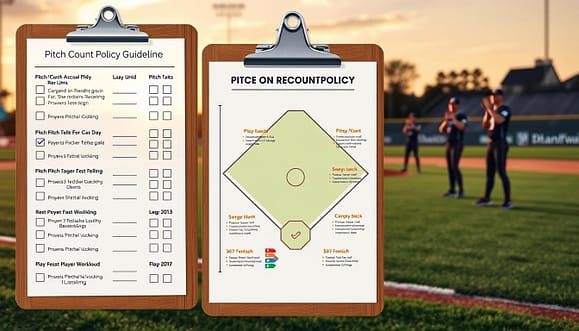
Pitchers must follow a strict pitch count policy. It’s not a suggestion; it’s a safety rule. These limits and rest days are like guardrails for player growth. They prevent injuries before they happen.
Workload management is more than just tracking throws. It’s about every sprint, jump, and quick change. Fatigue helps athletes adapt, but only if managed right.
Now, let’s talk about the Acute:Chronic Workload Ratio (ACWR). It’s a simple idea but sounds complex. It checks if the current workload is too high compared to the past four weeks.
Studies show a high ACWR ratio above 1.5 is a warning sign for injury. A ratio below 1.0 might mean you’re not challenging enough. The best range is between 1.0 and 1.5 for growth and safety.
To apply this, start by tracking everything. Count pitches, but also estimate PlayerLoad, which measures all movement stress. Watch for any sudden spikes.
Rest days are just as important as any training. Sometimes, doing less is better. A day off after a big game is an investment in your next performance.
Here’s a guide to setting your own rules. This table mixes old-school pitch count wisdom with new load-tracking ideas.
| Age Group | Max Pitches Per Game | Required Rest Days (After Max Effort) | Workload Monitoring Focus |
|---|---|---|---|
| 7-8 | 50 | 3 | Fundamental mechanics. Avoid competitive fatigue. No breaking pitches. |
| 9-10 | 65 | 3 | Introduce change-up. Begin tracking total weekly throws. |
| 11-12 | 75 | 4 | Limit breaking pitches to 15% of total. Monitor ACWR for all baseball activity. |
| 13-14 | 90 | 4 | Formalize ACWR tracking. Emphasize recovery protocols after outings. |
| 15-16 | 105 | 4 | Integrate full sport science metrics (PlayerLoad, High-IMA). Individualize limits. |
Notice how the rules get smarter as kids get older? It’s not just about more pitches. It’s about smarter, more advanced tracking.
This approach turns you from a scheduler to a scientist. You’re not just setting rules. You’re using data to protect and grow your athletes. The goal is to build them up, not break them.
The best pitch count policy keeps kids healthy, engaged, and growing for many seasons.
Practice/Game Ratios by Age and Goal
In youth sports, the practice-to-game ratio is key. Yet, leagues often get it wrong. Coaches usually say it depends on age, goal, and season phase.
Games are not the best teachers. They are high-stakes tests, not learning sessions. Practice is where skills are built. It’s science, not just opinion.
For 8U rec leagues, a 1:1 ratio works well. One practice for skills, one game for fun. It’s about learning, not winning.
But for 14U select teams aiming for championships, it’s different. They need more practice, like 3:1 or 4:1. This is their lab time.
An over-gamed schedule hurts athlete development. It leads to injuries and poor technique. Players miss out on essential drills.
| Age / Goal | Preparatory Phase | Competitive Phase | Primary Focus |
|---|---|---|---|
| 8U Recreational | 1:1 (Practice:Game) | 1:1 | Fun, Fundamental Movement |
| 12U Competitive | 3:1 | 2:1 | Skill Consolidation |
| 14U+ Select/Travel | 4:1 | 3:1 | High-Performance Skill Mastery |
Choosing the right practice-to-game ratio is more than scheduling. It shows what you value. Do you want quick wins or lasting growth?
Transportation, Carpool, and Parent Volunteer Roles
Forget the double play; the real pivot point of any youth league season is the coordinated drop-off of twelve players across six different locations. If coaching is the brain and safety the nervous system, then logistics is the league’s circulatory system. And let’s be honest, it’s where the whole operation most often clots.
The romantic ideal is a team of kids focused on baseball. The stark reality is a spreadsheet nightmare: 24 parents, 18 cars, and seven conflicting work schedules, all orbiting a single game time. This isn’t a peripheral concern. It’s a primary determinant of league sanity and parental goodwill.
Without a system, you’re left with the “volunteer vacuum.” You know the one. Where 20% of the people do 100% of the work, breeding quiet resentment in the bleachers. The solution isn’t hoping for better humans. It’s applying basic project management principles to suburban chaos.
The Anti-Chaos Carpool Protocol
A formalized carpool schedule is non-negotiable. It moves beyond last-minute text chains that inevitably fail. Here’s how to build one that works:
- Survey the Fleet: At the season’s start, collect every family’s availability, vehicle capacity, and preferred driving days.
- Create Fixed Rotations: Build a simple, repeating 2-3 week schedule. Assign primary and backup drivers for each cluster of players living near each other.
- Communicate Like a Pro: Publish the schedule in a shared, always-accessible doc (Google Sheets is your friend). Send calendar invites for game-day transportation blocks.
- Build in Redundancy: Have a designated “uber-parent” on standby for last-minute sick kids or flat tires. This is your logistical safety net.
Defining the Parent Volunteer Roster
Just as players have positions, parents need non-optional, clearly defined roles. This prevents the awkward post-game scramble where everyone vanishes except the coach. Consider these essential game-day positions:
- Field Set-Up & Breakdown Crew: Arrives early, leaves late. Tasks include bases, pitching rubber, and dragging the infield.
- Official Pitch Count Tracker: A critical safety role. This person has one job: focus solely on counts and alert the coach at limits.
- Hydration Station Manager: Oversees the water cooler, ensures cups are stocked, and monitors players for intake during breaks.
- Snack/Dugout Coordinator: Manages the post-game snacks and maintains dugout during the game.
- Post-Game Clean-Up Captain: Ensures the bench and stands are free of trash and gear. The last line of defense against leaving a mess.
Rotate these parent volunteer roles every few games. This shares the burden and gives everyone ownership. The key is clarity. When people know exactly what’s expected, they’re far more likely to execute.
A well-oiled logistical machine does more than just get kids to the field on time. It drastically reduces coaching stress, ensures critical safety and field tasks are completed, and models organizational competence for the players. It transforms a potentially chaotic situation into a demonstration of collective efficacy. The team that masters its transportation and volunteer schedule is, invariably, the team that enjoys its season the most.
Weather/Rainout Policies and Communication
Unclear weather plans can quickly turn a group chat into chaos. In Texas, and everywhere else, weather is a big deal. Your rainout policy needs to be clear and agreed upon before the season starts.
What should this policy include? It should list when to cancel games due to weather. Will you cancel if a trusted app says it will rain? Or only if the city closes the fields? Being clear here helps avoid last-minute problems.
Also, your plan for making up missed games needs to be clear. Will it be the next Sunday? Or will it push the whole schedule back? Being vague here can cause more problems later.
The way you communicate these decisions is also key. It should be like a secret code for youth sports. The order is: Coach -> Team Manager -> Everyone else. No exceptions. And you must say when you’ll make the decision public.
This policy also helps with heat safety. Your “weather policy” should cover hot days too. Having a specific heat level that means you have to stop or cancel games removes doubt. It turns a heated debate into a simple decision.
Here are the main parts of a weather-proof policy:
- Decision Triggers: Set heat levels and weather forecasts that mean you have to stop or cancel games.
- Authority & Chain: One person makes the final call, and another person tells everyone. No committees.
- Make-Up Logic: A clear rule for when to reschedule games to avoid endless discussions.
- Parent Acknowledgment: Everyone must agree to the policy before they can register.
A good policy for weather delays and rainouts does more than keep your schedule on track. It shows you’re a league that plans ahead. When bad weather hits, your team will know what to do.
Budgeting and Fundraising for Off-Season Play
Think of the off-season as a big project needing its own budget. The summer league fee covers the basics like field rentals and umpires. But, what about the winter skills clinic, the fall tournament entry fee, or specialized coaching sessions? These are the big financial decisions.
Ignoring these costs is like hoping for a rainout. It won’t work. The difference between the regular season and off-season play is where teams grow or fade. The answer isn’t a magic grant or a rich sponsor. It’s strategic budgeting and ethical fundraising, done openly.
Being open is your first step. Share a simple budget with parents. Show them where league fees go. Then, add a clear section for off-season plans. This isn’t about guilt; it’s about being clear.
The fundraising plan should be clear and fair, like a progressive tax system.
- Tier 1: The Team Dues. A small, required per-family contribution (e.g., $50) or a simple fundraiser to cover basic team activities. This builds team unity.
- Tier 2: The Aspirational Fund. Optional, bigger events like a silent auction or a restaurant night for bigger goals like new equipment or travel costs.
This plan respects everyone’s time and money. It avoids the dreaded “surprise assessment” that can hurt team morale.
Start this conversation during summer league registration. Frame it as an investment in ongoing growth. You’re not asking for extra money. You’re planning for the next part of the athletic year. This is fiscal periodization.
The goal is to keep the team together financially. When budgeting and fundraising are done ahead of time, all players get the same chances. This way, no one is left out because of money. Your smart financial planning gives your team an edge.
So, plan your financial team with the same care as your lineup. The off-season is a smart investment for your team.
Sample Week Templates and Checklists
This is your tactical workshop. We’re diving into the details of weekly plans and checklists. Theory is fun to watch. But, it’s the execution that’s hard.
A microcycle is your seven-day plan. It’s where big goals meet daily drills. A good one helps you focus on how to do it best.
We’ll create two types of summer league youth programs. One for building athletes, and another for winning games.
| Phase | Day | Primary Focus | Sample Activities | Coach’s Notes |
|---|---|---|---|---|
| Pre-Season Development Week | Monday | Technical Skills & Conditioning | Fundamental drills, agility ladder, light S&C circuit | Focus on form, not intensity. Introduce the week’s theme. |
| Tuesday | Strength & Power | Weight room session (compound lifts), plyometrics | Watch volume. Technique is key. | |
| Wednesday | Active Recovery & Film | Dynamic stretching, yoga, strategy session | Low physical load, high mental focus. | |
| Thursday | Advanced Skills & Scrimmage | Game-situation drills, controlled scrimmage | Let them play. Watch their decisions. | |
| Friday | Conditioning & Fun | Sport-specific conditioning game, cool-down | End the week positively. Team bonding. | |
| In-Season Game Week | Monday | Active Recovery & Review | Light practice, film review | Keep legs fresh. Address corrections. |
| Tuesday | Tactical Walk-Through | Review new plays, no contact | High mental reps, low physical strain. | |
| Wednesday | Pre-Game Activation | Short, sharp practice. High intensity. | Prime the nervous system. Build confidence. | |
| Thursday | GAME DAY | Standard game protocol, warm-up, competition | Stick to the routine. Manage, don’t micromanage. | |
| Friday | Mandatory Recovery | No formal practice. Optional light movement. | Protect this day for adaptation. |
Adding data to your template is key. Think about tracking Player Load (PL), High-Intensity Movement (High-IMA), and Jumps. Your Tuesday strength day should show a spike in Jumps data. Your pre-game activation should reflect a high PL in a short time. The template gives structure; the data shows if it’s working.
Templates are your skeleton. Checklists are your Swiss Army knife. They keep everything on track when you’re tired, it’s hot, and parents are asking questions.
Essential Summer League Youth Checklists:
- Pre-Practice Equipment Checklist: Cones, balls, first-aid kit, water coolers full, WBGT monitor, shade tent, contact list.
- Post-Game Field Checklist: Dugouts cleared, litter picked up, bases secured, scorebook updated, opponent coach connected with for notes.
- Weekly Communication Checklist (for Coaches): Email to parents with schedule for next week, confirm volunteers, text reminder 24 hours before game, submit any incident reports, log practice data (PL, High-IMA).
This system isn’t about red tape. It’s about freedom. When equipment and communication are taken care of, you can actually coach. You can notice small things and have real conversations. That’s the principle in action: genius is in the system, not in heroic last-minute effort.
Your summer league youth season should thrive, not just survive. With these templates and checklists, it’s designed to grow. Now, let’s measure that growth.
Tracking Development KPIs Across Seasons
Your season plan is like a symphony. It includes heat maps, pitch counts, and carpool charts. But, how do you know if it worked after the season ends? Are the players just getting older, or are they actually improving?
We rely on data, not just feelings. In youth sports, we look at more than just wins and losses. For hitters, it’s about exit velocity over time. For pitchers, it’s about strike percentage and how their velocity changes.
Modern tools help track athletes’ performance. They use CMJ tests and track PlayerLoad and the Acute:Chronic Workload Ratio (ACWR). These tools show if a tough Texas fall ball schedule is building strength or causing burnout. It’s all about science, not guesses.
Tracking progress from one season to the next helps create a clear development plan. Simple tests before and after the season show if players are getting faster or stronger. They help spot if progress has stopped, much like the long-term growth stories often documented in best baseball biographies.
For parents, this data proves the value of a Texas fall ball program. It turns “I think he’s getting faster” into “His 60-yard dash time improved by 0.4 seconds.” It turns stories into solid facts.
The ultimate goal is to see the results of your hard work. Measure them to know if your planning is paying off.